


How to Choose a Leg Compression Boots OEM Manufacturer for Private Label Orders
Choosing the right leg compression boots OEM manufacturer can make a big difference when you plan to launch your own recovery equipment brand. For distributors, wholesalers, and resellers, the goal is not simply to buy products at a low price. You need a manufacturer that can provide suitable models, stable production, clear technical specifications, flexible branding, and reliable support for repeat orders.
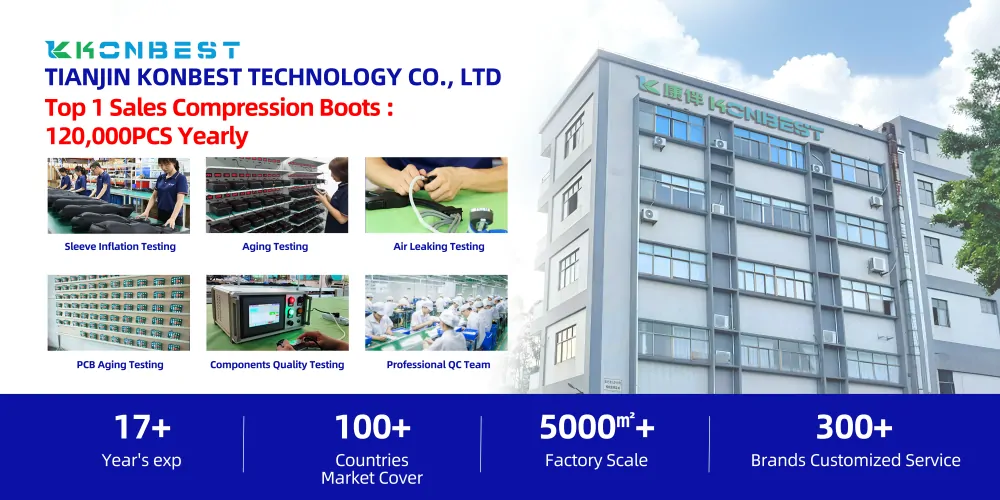
KONBEST has 17 years of experience in sports recovery equipment research, development, and manufacturing. The company reports supplying products to more than 100 countries and completing customization projects for over 300 brands. Its compression recovery boots range includes 4-chamber, 6-chamber, and 8-chamber models, with different configurations for different business needs.
Whether you are adding recovery equipment to an existing catalog or building a new private label brand, this guide will help you evaluate manufacturers, compare product specifications, plan customization, and prepare for bulk purchasing.
View the KONBEST compression recovery boots range to explore available models and discuss your OEM requirements.
- Start With Your Business Requirements
- A Practical OEM Manufacturer Checklist
- Compare 4-Chamber, 6-Chamber, and 8-Chamber Models
- Product Parameters That Matter to Buyers
- Private Label Customization: From Logo to Packaging
- Product Solutions for Different B2B Channels
- How to Move From Sample to Bulk Order
- Check Factory Capacity and Quality Management
- Working With KONBEST
- Frequently Asked Questions
1. Start With Your Business Requirements
Before you contact a compression boots manufacturer, decide what your business wants to achieve. A clear purchasing plan helps you avoid unsuitable models, unnecessary customization costs, and delays during production.
Begin with three questions.
Your target customers may include sports equipment distributors, fitness chains, recovery studios, online retailers, or rehabilitation equipment suppliers. Each group may have different expectations for product functions, packaging, documentation, and after-sales service.
What type of product range do you need?
Some businesses want one model for a focused product launch. Others need several models to serve different price levels and customer requirements. Think about your sales channels before choosing a product configuration.
How will you manage future orders?
A supplier may be suitable for an initial order but less suitable for repeat purchasing. Ask whether the manufacturer can maintain an agreed specification, plan production for future orders, and provide replacement parts or technical support when needed.
For medium and large B2B buyers, these questions are important because product selection, stock planning, and supplier communication all affect daily operations.
2. A Practical OEM Manufacturer Checklist
Use the following checklist when comparing potential OEM suppliers. It helps purchasing teams look at the full supply arrangement instead of focusing only on the quoted unit price.
| Evaluation Area | Questions to Ask | What to Confirm |
|---|---|---|
| Manufacturing experience | How long has the factory produced recovery equipment? | Relevant experience and available product range |
| Product specifications | Can the supplier provide current technical sheets? | Exact model, pressure range, modes, timer, and accessories |
| Customization | Can the factory support my logo, colors, and packaging? | Available options, artwork approval, and added costs |
| Production capacity | Can the supplier handle my order quantity and future orders? | Production schedule and order planning process |
| Quality management | How are finished products checked? | Inspection steps and handling of product issues |
| Compliance documents | Which documents apply to my selected model? | Valid documents for the product and destination market |
| After-sales support | What happens if a product needs repair or replacement? | Warranty terms, spare parts, and support process |
A professional leg compression boots OEM manufacturer should be able to answer these questions clearly. If important details remain uncertain, ask for written confirmation before paying a deposit or approving mass production.
3. Compare 4-Chamber, 6-Chamber, and 8-Chamber Models
Compression recovery boots are available in different chamber configurations. The right choice depends on your target customers, required features, price positioning, and intended use. More chambers do not automatically mean that a product is the best choice for every buyer.
| Product Category | What to Review | Potential Business Fit |
|---|---|---|
| 4-chamber compression boots | Basic configuration, controls, portability, pressure settings, and price | General fitness retail, online resellers, and entry-level recovery product ranges |
| 6-chamber compression boots | Chamber arrangement, available modes, pressure adjustment, and accessories | Sports equipment distributors, gyms, and recovery businesses |
| 8-chamber compression boots | Exact chamber design, controls, operating settings, and technical documentation | Specialist distributors and buyers looking for advanced configurations |
When should you choose a 4-chamber model?
A 4-chamber model may suit businesses that want a straightforward product with clear operating instructions. It can be a useful starting point for a new product category, provided the functions, quality, and price match the needs of the target market.
When is a 6-chamber model worth considering?
A 6-chamber model gives buyers another configuration to compare. Review its pressure range, operating modes, controller, timer, power supply, and garment design. Do not assume that all models in this category have the same functions.
What should you check on an 8-chamber model?
For an advanced product range, review the exact chamber arrangement and available controls. Ask for a technical sheet and sample so your team can check the product before making a larger purchasing commitment.
KONBEST lists 4-chamber models such as the 9490 series, 6-chamber models such as the 9690K series, and 8-chamber models such as the 9890K series. Use these categories to shortlist products, then compare the specifications of the exact versions you plan to order.
4. Product Parameters That Matter to Buyers
Product specifications are not just technical details. They help you compare suppliers, write accurate product listings, train sales teams, and answer questions from your own customers.
Pressure range and operating modes
Confirm the minimum and maximum pressure listed for the exact model, along with the number and function of its operating modes. These details help buyers understand how the product is designed to operate. Use only the manufacturer's approved information in your catalog and marketing materials.
Air chambers and compression sequence
Check the chamber count and the sequence in which the chambers inflate. This helps distinguish between models with similar appearances but different configurations.
Timer and controller
Review the available session durations and control method. Depending on the model, the system may use buttons, a digital display, a remote control, or app functions. These options can affect how easily a customer learns to operate the product.
Power supply and portability
Confirm whether the selected model is wired or cordless. For battery-powered versions, check battery capacity, charging time, and expected operating time as stated in the product documentation. Do not transfer battery information from one model to another.
Garments and accessories
Ask which garments and accessories are included in the quoted price. Additional cuffs, garments, and carrying bags may be available for selected systems, but compatibility and pricing should be confirmed before ordering.
Example: KONBEST 9490 standard model
The published product information for the KONBEST 9490 standard model lists the following specifications:
- 4 air chambers
- 3 operating modes
- Pressure range of 50–200 mmHg
- Air pump output listed at 10 L/min
- Timer settings of 10, 20, or 30 minutes
- Remote and app control listed
- Minimum order quantity shown as 10–50 sets, subject to order requirements
KONBEST provides OEM compression boots support for B2B customers and can work with buyers on several customization requirements.
- Private label logo customization
- Product color customization
- Customized packaging
- Accessory customization
- Product model and configuration selection
- Customized product solutions for different markets
These specifications refer to the listed 9490 standard model. Other 9490-series versions may have different features. Before confirming a purchase, request the latest technical sheet for the exact model, including its power system, warranty, accessories, and final configuration.
For private label projects, the approved technical sheet should match the sample, user manual, packaging, and online product description. This helps prevent errors during production and after delivery.
5. Private Label Customization: From Logo to Packaging
Private label products allow you to sell equipment under your own brand without building a manufacturing facility. For distributors and resellers, customization can help create a consistent product identity across websites, sales catalogs, and retail packaging.
Logo customization
Provide your logo file and confirm its size, placement, colors, and production method. Approve the final artwork before mass production to avoid branding errors.
Product color
Ask which product components can be made in your preferred colors. Some options may depend on materials, order quantity, or production requirements. Confirm any extra cost or longer lead time before approval.
Branded packaging
Packaging may include your logo, product information, labels, and other agreed design elements. Make sure the artwork, dimensions, languages, and required product details are approved before production.
Accessories and product configuration
Accessory customization can help you prepare different packages for different sales channels. Confirm which accessories work with your selected model, which items are included, and which are charged separately.
OEM and ODM development
OEM projects generally follow agreed customer requirements, while ODM projects may involve more product design or development work. If you need changes beyond standard branding, discuss feasibility, sample development, testing, development costs, and the production schedule with the manufacturer.
KONBEST offers OEM/ODM support for suitable projects, including logo, color, packaging, and accessory customization. The available scope depends on the model and project requirements. Discuss your plans with the team before finalizing your order.
6. Product Solutions for Different B2B Channels
A good purchasing plan starts with the problems your customers need to solve. The examples below show how different buyers can evaluate compression boots for their own product ranges.
Distributors supplying sports teams
Sports equipment distributors may supply clubs, training facilities, and athletic organizations. Their customers may want clear technical details, suitable product configurations, and dependable access to replacement parts.
Practical approach: Compare two or three suitable models, review the specifications with your customers, and select a configuration that matches their requirements. Confirm the production schedule before promising delivery to your own buyers.
Wholesalers supplying gyms and recovery centers
Gyms and recovery centers may need products that staff can explain and operate easily. Garment fit, controls, user instructions, cleaning guidance, and warranty support are important points to check.
Practical approach: Standardize the model and accessories where possible. Keep the approved specification sheet for future orders so the next batch can be checked against the original version.
Resellers building an online brand
Online resellers need accurate product descriptions, clear images, packaging details, and reliable stock planning. If the advertised functions do not match the delivered product, customer complaints can become difficult to manage.
Practical approach: Approve the sample and all product information before launch. Confirm that every listed feature is supported by the manufacturer's current documentation.
Suppliers serving physiotherapy and rehabilitation channels
These suppliers may need detailed technical documents and a careful review of intended use. They should confirm local product requirements before selling equipment to professional customers.
Practical approach: Request the documents for the exact model, check the applicable regulatory requirements, and use only claims that can be supported by evidence and local rules.
7. How to Move From Sample to Bulk Order
For medium and large purchases, a clear procurement process helps control specifications, customization, quality, and delivery.
Step 1: Prepare your purchasing brief
Tell the manufacturer your destination market, customer type, estimated quantity, preferred models, required functions, logo needs, color choices, packaging, and expected delivery date.
Step 2: Request a detailed quotation
Ask for the exact model number, included accessories, unit price, customization costs, minimum order quantity, payment terms, and estimated production time. Make sure the quotation covers all the options you requested.
Step 3: Check the sample and artwork
Review product operation, garment fit, finish, controls, accessories, and packaging. Approve the logo and artwork. Record any required changes and obtain written approval of the final version before mass production.
Step 4: Agree on quality checks
Confirm how the factory will inspect the products and packaging. For larger orders, discuss a factory audit or pre-shipment inspection. Agree on how differences from the approved specifications will be handled.
Step 5: Confirm shipping and after-sales support
Check the delivery schedule, shipping method, required documents, warranty, spare parts, and support contact. If a supplier offers fast sampling or shipping, confirm that the schedule applies to your selected model, customization level, and order quantity.
The KONBEST product page indicates a typical bulk lead time of 7–15 days depending on order quantity and an MOQ that may start from 10–50 sets depending on the model and customization. Treat these as indicative details and confirm the current terms directly with the manufacturer.
8. Check Factory Capacity and Quality Management
For a wholesale program, the first order is only the beginning. You also need a supplier that can manage repeat orders and maintain the agreed product configuration.
Before placing a large order, ask how the factory checks incoming materials, assembly, product functions, appearance, accessories, and final packaging. Find out how it records defects, handles complaints, and manages changes to product specifications.
KONBEST reports a 12,000-square-meter factory, five production lines, a product showroom, and R&D and quality inspection teams. The company also reports 17 years of sports recovery equipment development and manufacturing experience, supplying products to more than 100 countries and completing over 300 brand customization projects.
Buyers should also check compliance documents carefully. CE and RoHS relate to different product compliance requirements. ISO refers to standards with a defined scope, while BSCI is associated with social compliance auditing. These are not interchangeable documents. Request current evidence and verify that it applies to the selected product, factory, and destination market.
Do not assume that every certificate covers every model. Also avoid unsupported claims that compression boots treat medical conditions or guarantee specific recovery results. Product descriptions should match the approved intended use and applicable local rules.
9. Working With KONBEST
KONBEST provides sports recovery equipment manufacturing and customization services for international business customers. Its reported capabilities include:
- 17 years of experience: Sports recovery product research, development, and manufacturing.
- International supply experience: Products supplied to more than 100 countries.
- Brand customization: Experience with more than 300 brand customization projects.
- Production resources: A reported 12,000-square-meter factory and five production lines.
- Product development: R&D and quality inspection teams.
- Private label options: Logo, color, packaging, and accessory customization for suitable models and projects.
- Sampling and shipping: KONBEST states that two-day sampling and seven-day shipping are available for applicable orders. Confirm the actual schedule for your project.
- Factory inspection: Buyers can discuss inspection arrangements during supplier evaluation.
- Broader recovery range: Other sports recovery equipment categories for businesses planning a wider product catalog.
These capabilities provide a starting point for supplier evaluation, but the final decision should be based on the actual product, sample quality, specification sheet, quotation, compliance documents, warranty, and delivery terms.
If you are sourcing compression boots for a distributor network, wholesale catalog, or private label brand, prepare your requirements and request a model-specific proposal. Visit the KONBEST compression recovery boots page to review the available product range and start a discussion about OEM customization and bulk supply
10. Frequently Asked Questions
What should I look for in a leg compression boots OEM manufacturer?
Compare manufacturing experience, model options, technical specifications, customization services, quality control, minimum order quantity, lead time, warranty, and after-sales support. Request a sample and confirm the final specifications before mass production.
Can I sell compression boots under my own brand?
Yes, private label programs allow businesses to sell suitable products under their own brand. Available options may include logo printing, product colors, packaging, and accessories. Confirm the customization scope and minimum order quantity with the manufacturer.
Which compression boots model should a distributor choose?
Start with the target customer and required functions. Compare 4-chamber, 6-chamber, and 8-chamber configurations, then check the exact pressure range, operating modes, timer, controller, power supply, and accessories for each model.
What is the MOQ for KONBEST wholesale compression boots?
The product page indicates that MOQ may start from 10–50 sets depending on the model and customization requirements. Confirm the current MOQ for your selected product and order plan before proceeding.
Can I request a sample before placing a bulk order?
Ask KONBEST to confirm sample availability, cost, and timing for your selected model. Testing a sample helps you review the product, packaging, and approved configuration before mass production.
How long does bulk production take?
The product page indicates a typical lead time of 7–15 days depending on order quantity. Actual timing may vary with customization and the production schedule. Obtain written confirmation for your specific order.
Can I arrange a factory inspection?
KONBEST states that factory inspection is supported. Discuss the timing, scope, inspection method, and any third-party inspection needs with the company.
What information is needed for an OEM quotation?
Provide your destination market, estimated quantity, preferred model, required functions, logo files, color preferences, packaging details, accessories, and expected delivery date. Clear information helps the manufacturer prepare a more accurate proposal.
Ready to plan your private label order? Review the KONBEST compression recovery boots range, identify the models that fit your market, and request a quotation with the specifications, customization options, MOQ, and delivery schedule confirmed in writing.