


How Often Should Compression Boots Be Used? A B2B Guide
"How often should compression boots be used?" is a common question from gyms, sports clubs, recovery centers, clinics, and end users. For distributors and wholesalers, it is also an important product question because use frequency can affect which model is right for a target market.
Compression boots are used as part of many recovery routines. But there is no single schedule that fits every person. The right use pattern depends on the user, the purpose of use, the device settings, and the manufacturer's instructions.
For B2B buyers, there is another point to consider: if customers use the equipment often, the product needs stable quality, practical controls, durable construction, and reliable supplier support.
This guide explains how to think about compression boot use, how different business customers may use the equipment, and what distributors should check before placing a wholesale order.
- How Often Should Compression Boots Be Used?
- What Determines Use Frequency?
- How Different Users May Use Compression Boots
- What Commercial Buyers Need to Consider
- Compression Boot Features Worth Comparing
- How to Match Different Models to Different Markets
- Where Compression Boots Can Be Used
- What to Check Before Buying Wholesale
- Why Private Label Compression Boots Can Help Your Brand
- How to Choose a Compression Boots Supplier
- Why KONBEST Is a Strong B2B Manufacturing Partner
- B2B Purchasing Checklist
- Q&A
How Often Should Compression Boots Be Used?
There is no universal number of sessions that should be used by every person.
Compression boots use pneumatic air chambers to provide controlled compression around the legs. A user may include a session in a recovery routine after training, competition, or another demanding activity. However, the correct frequency and session length should always follow the instructions for the specific product and the needs of the user.
More frequent use does not automatically mean better results. A good recovery routine should consider the user's condition, activity level, comfort, and the settings of the device.
For a B2B buyer, this creates a more useful question:
A home user may use a device occasionally, while a recovery center may have several users in one day. The purchasing standard should be different for these two markets.
What Determines Use Frequency?
Several factors can affect how often compression boots are included in a recovery routine.
User Type
A professional athlete, gym customer, rehabilitation client, and home user may all have different needs. A distributor should understand the target customer before selecting a model.
Purpose of Use
Compression equipment may be positioned for sports recovery, fitness recovery, wellness services, or professional rehabilitation environments. The intended application can affect the preferred product configuration.
Pressure and Program Settings
Different models can provide different control options. Buyers should review the available pressure settings, programs, treatment controls, and operating instructions rather than comparing products only by appearance.
Frequency of Commercial Operation
A device used by one person at home does not face the same operating demand as equipment in a busy recovery center.
For commercial purchasing, the buyer should ask about construction quality, expected operating conditions, maintenance, replacement parts, warranty, and supplier support.
How Different Users May Use Compression Boots
Professional Athletes
Athletes often have regular training and competition schedules. Compression boots can be included in a recovery area after demanding activity.
For this market, buyers should focus on reliable pressure control, comfortable boots, durable materials, easy operation, and stable product supply.
Fitness Centers
Fitness centers may offer compression recovery as an additional service. Customers can use the equipment after workouts or during a dedicated recovery session.
A simple interface is useful in this environment because staff may need to explain the basic operation to many different customers.
Physiotherapy and Rehabilitation Businesses
These buyers may require more detailed specifications. When selecting compression therapy equipment, they should review the product's available settings, documentation, accessories, quality-control process, and certification requirements for their market.
Use recommendations should remain within the manufacturer's instructions and applicable professional requirements.
Recovery Centers
Recovery centers can have a much higher operating frequency than home users. Several customers may use the same type of equipment during one business day.
For this reason, commercial buyers should pay close attention to durability, product consistency, after-sales support, and replacement accessories.
What Commercial Buyers Need to Consider
When buying compression boots for a commercial business, the question is not simply "How often can this product be used?"
The better approach is to estimate the expected workload.
For example, a distributor supplying a small fitness studio may need a different model from a distributor supplying a large sports recovery center.
Before placing an order, consider:
- Expected number of users per day
- Expected session frequency
- Target customer group
- Available space
- Required pressure settings
- Required accessories
- Cleaning and maintenance needs
- Warranty requirements
- Replacement part availability
- Expected product lifetime
This is why choosing the right compression boots manufacturer matters. The supplier should be able to explain the differences between models instead of simply sending a price list.
Compression Boot Features Worth Comparing
Air Compression Technology
Compression boots use air chambers to create sequential compression around the legs. For buyers, it is important to understand the chamber structure and how the pressure is controlled.
A product should not be judged only by the number of chambers. The overall system, controller, construction, comfort, and intended application should also be considered.
4-Chamber, 6-Chamber, and 8-Chamber Options
KONBEST offers different chamber configurations for different market positions.
The 4-chamber portable series is positioned as an entry-level option for fitness centers and home recovery markets. The 6-chamber performance series is designed for sports teams and rehabilitation clinics. The 8-chamber professional series targets professional sports, physiotherapy centers, and clinical rehabilitation applications.
This range gives distributors more flexibility when building a product portfolio.
Pressure Control
Pressure control is an important part of the user experience. When comparing suppliers, ask for the exact pressure range and available settings for each model.
Clear technical information also helps distributors train their sales teams and answer customer questions with greater confidence.
Controller Design
A commercial recovery product should be practical to operate.
Buyers should test the controller during the sample stage. Check whether the buttons, screen, programs, and settings are easy to understand.
Buyers should always confirm the exact certification documents required for their target country and specific product configuration before placing a commercial order.
Boot Materials and Construction
Compression boots may be opened, closed, inflated, and moved many times. Buyers should inspect stitching, fastening areas, fabric, tubes, connectors, and other frequently handled components.
This is especially important when the equipment will be used in a commercial environment.
Optional Accessories
A wider accessory range can help a distributor serve different applications.
The KONBEST range includes optional accessories such as arm and shoulder cuffs, hip cuffs, waist cuffs, cold pads, vests, overlapping pants, backpacks, and carry bags.
These options can help buyers create different configurations instead of offering exactly the same package to every customer.
How to Match Different Models to Different Markets
Entry-Level Market
For home recovery and basic fitness applications, a compact 4-chamber model can be easier to position. Distributors can focus on simple operation, portability, and basic recovery use.
Performance Market
Sports teams and rehabilitation clinics may prefer a 6-chamber system with more advanced compression distribution and control options.
Professional Market
Professional sports, physiotherapy centers, and clinical rehabilitation businesses may need a higher-level system. KONBEST's 8-chamber professional series is positioned for this type of application, with programmable settings, pressure control, and construction designed for frequent and intensive use.
For wholesalers, having several product levels can make it easier to serve different customer groups without changing the manufacturing source.
Where Compression Boots Can Be Used
Sports Clubs and Teams
Sports clubs can place compression equipment in athlete recovery rooms. The product can be included as part of a broader recovery equipment program.
Gyms and Fitness Studios
Gyms can add compression recovery equipment beside training equipment. Portable models may be suitable when floor space is limited.
Physiotherapy Clinics
Clinics may require more detailed product specifications, accessories, and documentation. Buyers should confirm local regulatory requirements before placing a commercial order.
Rehabilitation Centers
Rehabilitation businesses may combine compression products with other recovery equipment. This can create a broader sourcing opportunity for distributors supplying this sector.
Commercial Recovery Studios
Recovery studios may use the equipment repeatedly throughout the day. In this case, product durability, operating simplicity, accessories, warranty, and supplier support become important purchasing factors.
What to Check Before Buying Wholesale
Buying one compression boot system is very different from buying dozens or hundreds of units.
For a compression boots wholesale project, buyers should evaluate the complete supply package.
- Product model and chamber configuration
- Pressure range and operating modes
- Materials and construction
- Controller functions
- Available accessories
- Sample quality
- MOQ
- Packaging
- Private label support
- Production capacity
- Lead time
- Quality inspection
- Warranty
- Replacement parts
- Factory inspection
KONBEST states that its wholesale and OEM MOQ starts from 10–50 sets depending on the model and customization requirements, with trial-order options available for new distributors. Standard bulk lead time is listed as 7–15 days depending on order quantity. Buyers should confirm current terms for the selected model before placing an order.
Why Private Label Compression Boots Can Help Your Brand
Generic products can be useful for market testing, but distributors and resellers that want to build a long-term brand may need more control over product presentation.
Private label compression boots can support a consistent brand image across your product line.
Depending on the project, customization may include:
- Logo printing
- Product color
- Packaging design
- UI interface
- Accessories
- Product presentation
KONBEST provides OEM and ODM support for these types of customization projects.
For B2B orders, it is better to complete customization during the sample stage. The approved sample can then be used as a production reference for the larger order.
How to Choose a Compression Boots Supplier
A reliable compression boots supplier should be able to support the complete purchasing process.
Check Manufacturing Experience
Ask how long the manufacturer has worked in sports recovery equipment. Long-term manufacturing experience can be useful when a buyer needs product development, quality control, and repeat production.
Check Production Capacity
Ask about factory size, production lines, production scheduling, and quality inspection. These points become more important as order volume increases.
Request Samples
Never approve a large order based only on photographs.
Test the actual sample. Check the controller, pressure settings, materials, comfort, accessories, packaging, and branding.
Discuss Repeat Orders
A good supplier should be able to explain how it handles repeat orders. If your first purchase is a trial batch and the next order is much larger, the production process should still be clear.
Why KONBEST Is a Strong B2B Manufacturing Partner
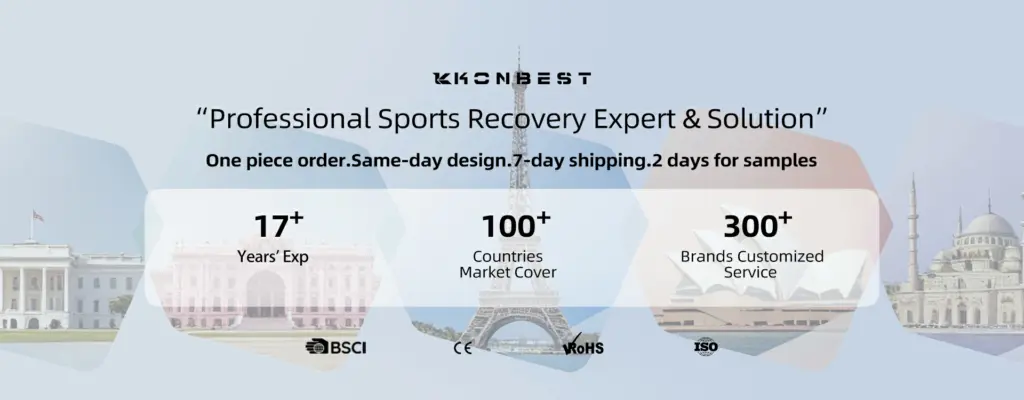
KONBEST has more than 17 years of sports recovery equipment R&D and manufacturing experience.
The company supplies products to more than 100 countries and has experience customizing products for more than 300 brands.
KONBEST operates a 12,000-square-meter factory with 5 production lines, a high-end product showroom, and professional R&D and quality inspection teams.
For distributors, wholesalers, and resellers, the company supports private label logo, color customization, packaging, and accessory customization.
The company also supports 2-day sampling, suitable 7-day shipping projects, and factory inspection.
Its compression boot range includes 4-chamber portable models, 6-chamber performance models, and 8-chamber professional models. This gives B2B buyers several product levels for different markets.
The company also provides optional accessories and a wider recovery equipment portfolio, which can help distributors build a broader sports recovery product range.
How Should a Distributor Explain Compression Boot Use to Customers?
Simple and accurate product education is important.
Instead of telling every customer to use the boots for the same number of sessions, distributors should explain that use frequency depends on the user's needs and the instructions for the selected model.
Sales teams should also explain how to select the pressure setting, how to use the controller, how to clean the equipment, and when to stop using the product and seek professional advice.
Distributors should avoid unsupported medical claims. Product information should match the manufacturer's documentation and the regulations of the target market.
B2B Purchasing Checklist
Before placing a medium or large order, use this checklist:
- Define the target customer.
- Select the correct chamber configuration.
- Compare pressure and program settings.
- Check materials and construction.
- Review available accessories.
- Request a sample.
- Test the sample.
- Confirm logo and packaging requirements.
- Confirm MOQ.
- Confirm lead time.
- Review quality-control procedures.
- Check applicable certificates.
- Discuss warranty and replacement parts.
- Confirm repeat-order support.
- Arrange factory inspection when required.
Final Thoughts
So, how often should compression boots be used?
The answer depends on the user, the purpose, the device settings, and the manufacturer's instructions. There is no universal schedule that should be applied to every customer.
For B2B buyers, the more important decision is selecting a product that matches the expected use environment.
A home recovery customer, fitness center, sports team, and professional rehabilitation business may all need different product configurations.
That is why distributors and wholesalers should compare more than unit price. Product construction, pressure control, chamber design, accessories, customization, production capacity, quality control, and after-sales support can all affect the long-term value of a wholesale purchase.
With different chamber configurations, OEM and private label support, scalable production, and a wider recovery equipment range, KONBEST can support suitable B2B projects from sample testing to larger repeat orders.
Q&A
Q1: How often should compression boots be used?
There is no single schedule for everyone. Users should follow the instructions for the specific device and consider their own needs and comfort.
Q2: Can compression boots be used every day?
Use frequency depends on the user and the equipment. Always follow the manufacturer's instructions and seek suitable professional advice when necessary.
Q3: Are compression boots suitable for wholesale?
Yes. They can be suitable for distributors, wholesalers, resellers, gyms, sports teams, recovery centers, and rehabilitation-related businesses.
Q4: What is the difference between 4-chamber and 8-chamber compression boots?
The chamber configuration changes the structure of the compression system. KONBEST positions its 4-chamber series for entry-level markets and its 8-chamber series for professional applications.
Q5: Can I order private label compression boots?
Yes. KONBEST supports suitable OEM and ODM projects, including logo, color, packaging, UI, and accessory customization.
Q6: What is the MOQ for compression boots wholesale?
KONBEST lists an MOQ of 10–50 sets depending on the model and customization requirements. Buyers should confirm the current MOQ for their selected model.
Q7: Does KONBEST support large-volume orders?
Yes. KONBEST has a 12,000-square-meter factory, 5 production lines, and dedicated R&D and quality inspection teams. Production schedules should be confirmed according to the exact order quantity and customization requirements.
Q8: Can distributors customize the packaging?
Yes. Suitable OEM and private label projects can include customized packaging as well as logo, color, and accessory options.
Q9: What should I check when choosing a compression boots supplier?
Check product specifications, sample quality, manufacturing experience, production capacity, MOQ, lead time, quality control, customization, warranty, replacement parts, and factory inspection support.
Q10: Can one supplier provide different compression boot models?
Yes. KONBEST offers 4-chamber, 6-chamber, and 8-chamber series, allowing B2B buyers to select different configurations for different market segments.