

OEM Compression Boots: From Design to Mass Production
For a recovery brand, an OEM compression boot project is much more than adding a logo to an existing product. The real process starts with choosing the right product structure, matching the needs of the target market, testing samples, confirming customization, checking quality, and then moving into stable mass production.
For distributors, wholesalers, resellers, sports brands, gyms, physiotherapy centers, and rehabilitation businesses, this process can make a big difference. A product may look good in a catalog, but a long-term OEM project needs stable pressure performance, reliable construction, clear specifications, consistent production, and strong factory support.
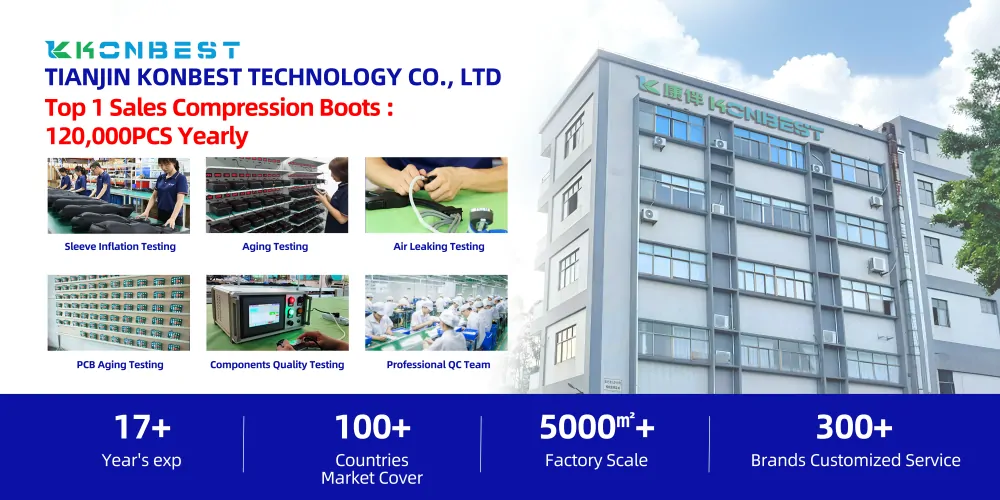
KONBEST has more than 17 years of experience in sports recovery equipment development and manufacturing. Its compression recovery boot range includes 4-chamber, 6-chamber, and 8-chamber models for different market positions, with OEM, ODM, private label, packaging, color, and accessory customization available.
- 1. What an OEM Project Really Includes
- 2. Define the Market Before Designing the Product
- 3. Select the Right Compression Boot Platform
- 4. Technical Details That Should Be Fixed Early
- 5. Turn the Idea Into a Working Sample
- 6. Build Your Brand Into the Product
- 7. Test Before Mass Production
- 8. Keep Quality Consistent During Production
- 9. Prepare for Wholesale and Large Orders
- 10. Suitable B2B Applications
- 11. How to Evaluate an OEM Manufacturer
- 12. Why KONBEST Supports Long-Term OEM Projects
- 13. A Practical OEM-to-Mass-Production Workflow
- 14. Q&A
1. What an OEM Project Really Includes
A professional OEM project normally has several stages. The first stage is product selection. The second is specification confirmation. The third is sample development. After testing and approval, the factory prepares mass production.
For a B2B buyer, the project should also include branding, packaging, accessories, inspection, shipping, warranty, and after-sales support.
This means the right OEM partner should be able to answer questions such as:
- Which model is best for my market?
- What chamber configuration should I choose?
- What pressure settings are available?
- Can the product use my logo and colors?
- Can packaging be customized?
- Can accessories be changed?
- What is the MOQ?
- How long does production take?
- Can I inspect the factory?
- How will repeat orders follow the approved sample?
If these questions are handled clearly from the beginning, the transition from design to mass production becomes much easier.
2. Define the Market Before Designing the Product
The best OEM product starts with the customer, not the factory.
For Sports Brands
A sports brand may want a professional recovery product with stronger positioning, more compression zones, advanced controls, and premium packaging.
For Gyms and Recovery Centers
These customers may need equipment that is easy to operate and suitable for repeated sessions. Product durability, comfortable leg wraps, simple controls, and stable compression can be important.
For Rehabilitation Businesses
Rehabilitation and physiotherapy businesses may prefer professional equipment with more detailed compression control. Buyers should always check local regulations and intended-use requirements before making medical claims.
For Distributors and Wholesalers
Distributors often need several product levels. An entry-level model can serve one customer group, while a professional model can serve clinics, sports organizations, and higher-end recovery businesses.
This is why an experienced compression boots manufacturer should offer more than one product platform.
3. Select the Right Compression Boot Platform
KONBEST divides its leg compression boots into three main product groups.
4-Chamber Portable Series
The 4-chamber series is positioned as an entry-level and portable option. It is suitable for fitness centers, home recovery markets, online resellers, and distributors looking for a compact product.
This type of product can also be useful when a new brand wants to test market demand before moving to more advanced equipment.
6-Chamber Performance Series
The 6-chamber series is positioned as a mid-level performance solution for sports teams and rehabilitation clinics. More compression zones can provide improved pressure distribution compared with a basic configuration.
For wholesalers, this can work as a middle product between portable entry-level boots and professional systems.
8-Chamber Professional Series
The 8-chamber professional series is positioned for professional sports, physiotherapy centers, and clinical rehabilitation applications. The product group features advanced programmable settings, stronger pressure control, and construction designed for frequent use.
For an OEM project, choosing the correct platform first helps avoid unnecessary changes later.
4. Technical Details That Should Be Fixed Early
Appearance is important, but technical specifications should be confirmed before the sample stage.
For compression recovery boots, buyers should review:
- Number of air chambers
- Pressure range
- Compression modes
- Timer settings
- Air pump performance
- Controller design
- Display type
- Battery capacity where applicable
- Charging method
- Boot material
- Tube and connector design
- Available accessories
These details should be written into the product specification instead of being left to verbal communication.
This is especially important for OEM compression therapy equipment. When an order becomes larger, even a small change in material, controller, accessory, or packaging can create problems if the original specification is not clear.
5. Turn the Idea Into a Working Sample
The sample is the bridge between an idea and mass production.
After the model and technical specifications are confirmed, the factory can prepare a sample based on the buyer's requirements.
A good sample review should cover three areas.
Function
Check inflation, compression sequence, pressure adjustment, timer, controller response, and other model-specific functions.
Physical Construction
Check the fabric, stitching, fasteners, air tubes, connectors, seams, and overall finishing of the boots.
User Experience
Test the fit, comfort, operating process, noise, portability, and storage. If possible, let several target users test the sample.
The goal is simple: find problems while the project is still small, not after hundreds or thousands of units have been produced.
6. Build Your Brand Into the Product
Private label should create a complete brand experience.
KONBEST supports OEM and ODM customization that can include:
- Private label logo
- Product color customization
- Branded packaging
- Suitable UI interface adjustments
- Accessory customization
- Product manuals
- Marketing materials
This gives a distributor or reseller more control over the final product presentation.
Accessories can also be selected according to the market. The available options listed by KONBEST include arm and chest cuffs, hip accessories, overlapping pants, waist cuffs, cold pads, vest options, backpacks, carry bags, and nylon bags.
For example, a sports brand may want a premium package with additional accessories, while an online reseller may prefer a compact package with only the most commonly requested items.
7. Test Before Mass Production
One of the biggest mistakes in OEM purchasing is approving a product too quickly.
A real sample should be tested before the production order is finalized.
During testing, pay attention to:
- Pressure stability
- Air chamber inflation
- Compression sequence
- Controller operation
- Battery performance
- Charging performance
- Noise during operation
- Boot comfort
- Connector stability
- Overall product finishing
If a change is required, make it before mass production.
Once the buyer approves the final sample, it should become the reference standard for the production team. This creates a clear connection between the original design and the final shipment.
8. Keep Quality Consistent During Production
Mass production creates a different challenge from sample production: consistency.
The factory must repeat the approved design many times while keeping the same materials, functions, appearance, and packaging requirements.
KONBEST states that it uses professional testing equipment throughout production and operates multiple production lines supported by R&D and quality inspection teams.
For B2B buyers, quality control should cover:
- Incoming materials
- Electronic components
- Air pump performance
- Air chamber construction
- Boot assembly
- Controller testing
- Final appearance
- Accessory matching
- Packaging
- Pre-shipment inspection
For large orders, buyers can also discuss factory inspection and inspection standards before production starts.
9. Prepare for Wholesale and Large Orders
OEM projects are often connected to compression boots wholesale purchasing.
A distributor may begin with a small trial order and increase the quantity after testing the market. A wholesaler may need regular shipments with the same specifications. A reseller may first test one customized model before expanding into a wider product range.
If you are planning a medium or large order, a factory inspection can provide information that a quotation cannot.
KONBEST lists an MOQ of 10–50 sets depending on the model and customization requirements. Lower MOQ trial orders may also be available for new distributors.
The listed standard lead time is 7–15 days depending on order quantity, with priority production scheduling available for urgent shipments and large OEM projects.
Before confirming a bulk order, discuss:
- Quantity
- MOQ
- Final product specification
- Approved sample
- Logo and packaging
- Accessory list
- Production schedule
- Inspection plan
- Warranty
- Replacement parts
- Shipping schedule
Clear planning helps prevent last-minute changes.
10. Suitable B2B Applications
Professional Sports
Professional teams can use compression recovery equipment in training centers, recovery rooms, and sports facilities. A 6- or 8-chamber system can be considered when the market requires more advanced compression control.
Physiotherapy Centers
Physiotherapy businesses may need professional products that can support repeated use. The buyer should select the product according to the center's actual requirements and local regulations.
Fitness Centers
Gyms can place portable compression boots in recovery areas. Compact products can be useful where floor and storage space are limited.
Recovery Studios
Recovery studios can build dedicated recovery services around professional compression equipment. In this case, stable operation, comfort, accessories, and after-sales support become important purchasing points.
Online Resellers
Online sellers usually need clear specifications, branded packaging, product images, manuals, videos, and reliable fulfillment support.
11. How to Evaluate an OEM Manufacturer
The factory should be evaluated as carefully as the product.
A reliable OEM partner should have:
- Real product development experience
- Stable manufacturing capacity
- Professional quality control
- OEM and ODM capability
- Private label experience
- Sample development support
- Packaging customization
- Accessory options
- Factory inspection support
- Clear warranty terms
- Spare parts support
- Experience with repeat B2B orders
Do not compare suppliers only by the first quotation. A slightly lower unit price does not automatically mean a better OEM partner.
For a growing recovery brand, production consistency, communication, technical support, and the ability to handle larger orders can be more important over the entire product life cycle.
12. Why KONBEST Supports Long-Term OEM Projects
KONBEST has more than 17 years of sports recovery equipment development and manufacturing experience. The company states that its products are supplied to more than 100 countries and that it has customization experience with more than 300 brands.
The company has a 12,000-square-meter factory, 5 production lines, a high-end product showroom, and professional R&D and quality inspection teams.
For distributors, wholesalers, and resellers, this creates a stronger foundation for long-term purchasing.
KONBEST provides a one-stop recovery equipment solution with compression boots and other sports recovery products. OEM and ODM support covers private label logo, color customization, packaging, and accessories.
The company also lists 7–15 day standard production lead times, 12–24 month warranty depending on the model, product catalogs, manuals, images, videos, marketing materials, and factory inspection support.
For new distributors, the combination of trial orders and scalable production can make it easier to move from product testing to larger purchasing programs.
13. A Practical OEM-to-Mass-Production Workflow
Step 1: Explain Your Business
Tell the manufacturer whether you are a distributor, wholesaler, reseller, sports brand, gym supplier, clinic, or rehabilitation equipment buyer.
Step 2: Define the Customer
Explain who will use the product and what product level they expect.
Step 3: Choose the Model
Select the most suitable 4-, 6-, or 8-chamber platform based on the market.
Step 4: Confirm Specifications
Fix the pressure range, modes, timer, pump, controller, materials, accessories, and other important specifications.
Step 5: Develop the Sample
Request a sample and test the actual product.
Step 6: Complete Branding
Approve the logo, color, packaging, accessories, manual, and other customized elements.
Step 7: Approve the Final Sample
Use the approved sample as the reference for mass production.
Step 8: Start Production
Confirm the quantity, production schedule, inspection requirements, and shipping plan.
Step 9: Inspect the Finished Goods
Check the production against the approved sample and final specification before shipment.
Step 10: Prepare for Repeat Orders
Keep the final specifications and approved sample so future orders can follow the same standard.
Conclusion
OEM compression boots should be treated as a complete product project, from design to production.
The right process starts with the target market, continues with model selection and technical specifications, and then moves through sampling, customization, quality control, mass production, and after-sales support.
For distributors, wholesalers, and resellers, this approach can make a new recovery product easier to manage as order quantities grow.
KONBEST combines long-term manufacturing experience, multiple production lines, a broad compression boot range, OEM and ODM support, private label customization, accessory options, sample support, quality control, and B2B order services.
If you are planning an OEM compression boot project, the best next step is to define your target market, select the appropriate product level, request a sample, confirm the final specification, and build a clear production plan before moving to mass production.
14. Q&A
Q1: Can compression boots be customized for my own brand?
Yes. KONBEST offers OEM and ODM services including logo printing, color customization, packaging design, suitable UI adjustments, and accessory customization.
Q2: What is the MOQ for OEM compression boots?
The listed MOQ starts from 10–50 sets depending on the model and customization requirements. Trial orders with lower quantities may be available for new distributors.
Q3: How many chambers should I choose?
It depends on your target market. Four-chamber models are positioned for portable and entry-level applications, six-chamber models for performance markets, and eight-chamber models for professional applications.
Q4: Can I request a sample before placing a large order?
Yes. Sample and trial-order support are available for suitable B2B projects. Testing the actual product before mass production is recommended.
Q5: What should I check during sample testing?
Check pressure control, air chamber operation, inflation sequence, controller response, battery performance where applicable, noise, boot comfort, materials, connectors, and overall finishing.
Q6: How long does production take?
KONBEST lists a standard lead time of 7–15 days depending on order quantity. Large or urgent OEM projects should be confirmed with the sales team before ordering.
Q7: Can packaging and accessories be customized?
Yes. Packaging and accessories can be customized for suitable OEM projects. The final design and accessory list should be approved before production.
Q8: Does KONBEST support factory inspection?
Yes. Factory inspection support is available for B2B buyers who want to review manufacturing and quality-control capabilities before a larger order.
Q9: What warranty is available?
KONBEST lists a 12–24 month warranty depending on the model, with technical support and replacement parts available for distributors and after-sales teams.
Q10: Can a small OEM order become a larger repeat order?
Yes. Trial orders can be used to test the market first. Once the product is approved, the same specification and sample can be used as a reference for larger repeat orders.