


How to Launch Your Own Private Label Compression Boots Brand
Building a private label compression boots brand starts with five key decisions: which customers to serve, which product models to offer, how to customize your brand, how to control product quality, and how to manage bulk supply. For distributors, wholesalers, importers, and resellers, getting these decisions right can make product launches easier to manage and future orders more predictable.
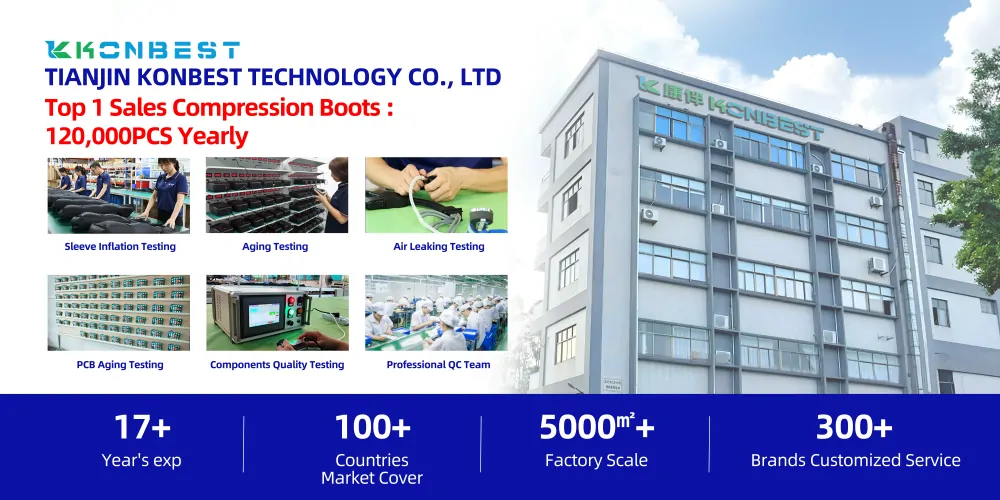
KONBEST is an EU-registered sports recovery brand with 17 years of research, development, and manufacturing experience. The company reports supplying products to more than 100 countries and completing customization projects for over 300 brands. Its manufacturing resources include a 12,000-square-meter factory, five production lines, an R&D team, quality inspection personnel, and a product showroom.
Through its compression recovery boots product range, KONBEST supports businesses looking for private label compression boots, OEM customization, and wholesale supply. This guide explains how to move from an initial product idea to a planned brand launch, with practical advice for medium- and large-volume B2B purchasing.
Table of Contents
- 1. Start with the Market, Not the Logo
- 2. Create a Product Plan for Your Brand
- 3. Select the Right Compression Boots
- 4. Check the Technical Specifications
- 5. Turn a Standard Product into Your Brand
- 6. Test the Sample Before Bulk Production
- 7. Match Products to Different B2B Markets
- 8. Plan Wholesale Orders and Supply
- 9. Evaluate the Factory and Product Documents
- 10. Build a Long-Term Partnership with KONBEST
- 11. Q&A
1. Start with the Market, Not the Logo
A common mistake when launching a recovery equipment brand is to focus on product appearance before deciding who will buy it. A good-looking product may still be difficult to sell if its features, price level, or intended use do not match the target market.
Before choosing a model, define your main customer group and sales channel. This helps you select products based on real purchasing needs instead of adding features that your customers may not need.
- Sports equipment distributors: Need a product range that is easy to explain and suitable for different retail or professional customers.
- Fitness equipment wholesalers: Often look for practical models, clear specifications, dependable supply, and easy-to-understand operating instructions.
- Recovery equipment brands: May need logo, color, packaging, and accessory customization to create a consistent product identity.
- Physiotherapy and rehabilitation suppliers: Need to check intended use, technical documents, applicable regulations, and the requirements of their professional customers.
- Online resellers and importers: Benefit from clear product information, good packaging, product images, and reliable after-sales arrangements.
For example, a wholesaler supplying gyms may prefer a model that is simple to operate and easy to demonstrate. A brand serving professional sports facilities may want to compare more advanced control systems and different chamber configurations. These businesses should not automatically select the same product.
The first step is to prepare a short purchasing brief. Include your target customer, sales country, expected order quantity, target product level, customization needs, and estimated launch date. Share this brief with your manufacturer to receive a more useful product recommendation.
2. Create a Product Plan for Your Brand
A private label project can begin with a proven product and a clear brand identity. You do not always need to develop a completely new device. Starting with an existing model can make it easier to review the product, test the market, and plan a repeat order.
For a new compression boots brand, consider a three-stage product plan.
| Stage | Business Objective | Recommended Action |
|---|---|---|
| Stage 1: Product validation | Confirm that the product matches your target market | Compare models, request samples, test key functions, and review customer feedback |
| Stage 2: Brand launch | Prepare a consistent branded product | Approve logo placement, colors, packaging, accessories, and product information |
| Stage 3: Supply expansion | Support repeat and larger orders | Set quality standards, forecast demand, agree on lead times, and plan replenishment |
This approach is useful for medium-sized distributors that want to introduce a new product category without committing to too many models at the beginning. Larger importers can use the same process to validate product specifications and supplier performance before expanding orders across several markets.
Before launch, decide how many models your brand really needs. A small, well-organized range is often easier to manage than a long list of products with unclear differences.
3. Select the Right Compression Boots
When comparing private label compression boots, start with the product configuration and its actual functions. KONBEST's product range includes 4-chamber, 6-chamber, and 8-chamber compression boots. These configurations can help businesses build different product options, but the exact features depend on the model.
| Product Configuration | Possible Product Position | What Buyers Should Compare |
|---|---|---|
| 4-chamber compression boots | Entry-level or portable product range | Ease of use, control options, pressure settings, included accessories, and target price |
| 6-chamber compression boots | Mid-range or performance-focused range | Compression programs, pressure adjustment, controller design, and operating comfort |
| 8-chamber compression boots | Higher-specification product range | Available modes, control functions, product construction, and requirements for frequent use |
These categories are general planning suggestions, not a claim that chamber count alone determines product quality. A higher chamber count does not automatically make a model the best choice for every customer. Compare the complete specification sheet and test the product before making your decision.
For a distributor, one practical option is to select a core model and a more advanced model. The core model can serve customers who want straightforward operation, while the advanced option can meet demand for additional features. This makes it easier for your sales team to explain the difference between products.
Review the available models here: KONBEST Compression Recovery Boots for Wholesale and Private Label Projects.
4. Check the Technical Specifications
Product specifications should guide the selection process. A professional compression boots manufacturer should provide accurate, model-specific information so your purchasing team can compare products and your sales team can describe them correctly.
Pressure Range and Adjustment
Check the minimum and maximum pressure, available adjustment steps, and control method. Pressure specifications should be confirmed for the exact model, rather than copied from another product in the same series.
For products intended for professional environments, ask whether the operating range and instructions match the needs of the intended users. Do not assume that a higher maximum pressure is automatically better for everyone.
Chambers and Compression Programs
Confirm the chamber configuration and how the compression sequence works. Ask how many operating modes are available and what each mode does. This information helps you compare models and prepare product descriptions that explain real differences.
Controller and Timer
Some models may offer remote controls, LCD displays, touch controls, app functions, or preset session times. These features vary by product. Confirm which functions are standard, which are optional, and whether any interface customization is available for your private label project.
Battery and Portability
For wireless models, review battery capacity, charging method, expected operating time, and charging accessories. For portable products, also check the carrying case, overall weight, storage requirements, and included components.
Materials and Maintenance
Review the boot material, stitching, air tubes, connectors, closures, and cleaning instructions. Ask the supplier which parts are replaceable and whether spare parts can be ordered for future customer support.
Warranty and Technical Support
Before ordering, confirm the warranty period for the selected model, what the warranty covers, and how service requests are handled. For wholesale customers, access to manuals, spare parts, and clear troubleshooting guidance can be important parts of the supply agreement.
Request a current specification sheet for each model you plan to sell. The final quotation, approved sample, purchase order, and product documentation should all refer to the same configuration.
5. Turn a Standard Product into Your Brand
Private label customization should create a consistent experience from the product itself to the box the customer receives. A logo is only one part of this process.
KONBEST supports private label and OEM/ODM options for eligible projects, including the following services:
- Logo customization: Apply your approved brand identity to suitable product areas.
- Color customization: Discuss available colors and production requirements for your selected model.
- Packaging design: Develop branded packaging that fits your product and shipping requirements.
- Accessory selection: Confirm which accessories are included and whether additional options are available.
- Interface or product adjustments: Discuss feasible changes with the manufacturer before finalizing the project.
For a medium or large order, confirm all artwork and product details before production. Send clear logo files, specify color references, approve packaging artwork, and list every included accessory. If you need branded manuals or labels, confirm the languages and required product information in advance.
A simple customization workflow is:
- Choose the product model and confirm its specifications.
- Send your logo, brand colors, packaging requirements, and accessory list.
- Review the sample or design proof.
- Record the approved details in writing.
- Confirm the bulk production schedule and inspection requirements.
Keep the approved sample or an agreed reference record for comparison with the finished order. This helps both sides check whether the delivered products match the agreed design and requirements.
6. Test the Sample Before Bulk Production
A product sample helps turn a quotation into a real purchasing decision. It gives your team a chance to check function, comfort, materials, packaging, and ease of operation before committing to a larger quantity.
During sample review, divide the inspection into four areas.
Function Test
Gym and Fitness Wholesalers
Check inflation, pressure adjustment, available modes, timer operation, controller response, and other functions listed in the model's specification sheet. Record any problem instead of relying on memory or verbal feedback.
Physical Inspection
Check stitching, material finish, zippers or fasteners, air tubes, connectors, and other visible components. Compare the sample with the agreed product description and any reference photos or drawings.
User Experience
Ask suitable test users to review fit, comfort, setup, controls, storage, and portability. If your target customers include professional facilities, consider whether the product's operating process suits their working environment.
Packaging and Documentation
Confirm the brand logo, box condition, accessory list, manual, labels, and model information. Packaging and documentation should match the requirements of your sales channel and destination market.
Once the sample passes your internal checks, approve it in writing. If any changes are required, agree on the updated version before mass production. This step is especially important for orders involving custom colors, branded packaging, or multiple product models.
7. Match Products to Different B2B Markets
The best product recommendation depends on how you plan to sell it. Use the following scenarios to guide discussions with your manufacturer.
Scenario A: A Fitness Equipment Wholesaler
A wholesaler already supplies gyms and fitness retailers and wants to add recovery products to its catalog.
Product strategy: Start by comparing easy-to-operate models and the accessories customers are most likely to need. Request product images, specifications, packaging details, and a sample for evaluation.
Why this approach works: The wholesaler can check whether the new category fits its existing customer base before committing to a broader range.
Scenario B: A Sports Recovery Brand
A brand wants to launch compression boots under its own name and needs a product that fits its visual identity and product positioning.
Product strategy: Compare several configurations, then focus on logo placement, color options, packaging, control functions, and model differences. Make sure the final product description reflects the exact features supplied.
Why this approach works: A clear specification and consistent brand presentation help the sales team explain what makes each model different.
Scenario C: A Rehabilitation Equipment Distributor
A distributor supplies clinics or rehabilitation facilities where buyers may request technical documentation and specific product requirements.
Product strategy: Share the customer's requirements with the manufacturer before selecting the product. Verify intended use, available documents, operating instructions, warranty terms, and local regulatory requirements.
Why this approach works: It reduces the risk of selecting a product that does not meet the customer's purchasing or compliance requirements. Do not assume a general sports recovery product is suitable for every medical application.
Scenario D: An Importer or Online Reseller
An importer wants to build a private label product listing and prepare for ongoing inventory replenishment.
Product strategy: Confirm the carton dimensions, shipping configuration, product images, manual, accessory list, and delivery plan. Make sure your listing clearly explains the model's functions without unsupported health claims.
Why this approach works: Accurate product information helps your sales and customer support teams answer questions and manage expectations.
8. Plan Wholesale Orders and Supply
For medium and large B2B buyers, product quality is only one part of supplier evaluation. You also need a clear order process, realistic lead times, consistent specifications, and a plan for repeat purchases.
Before confirming a wholesale order, review the following items with your compression boots supplier:
- MOQ: Confirm the minimum order quantity for each model and customization level.
- Order mix: Check whether several models or colors can be combined in one order.
- Price structure: Request a written quotation based on model, quantity, customization, packaging, and shipping terms.
- Sample and production schedule: Confirm when the sample will be ready, when production can start, and how long the order is expected to take.
- Quality inspection: Agree on functional tests, appearance standards, packaging checks, and how issues will be handled.
- Shipping terms: Confirm shipment method, destination, shipping responsibilities, and the documents supplied.
- After-sales support: Document warranty coverage, spare parts availability, and the process for reporting defects.
- Repeat orders: Ask how the factory manages product consistency and schedules future production.
KONBEST's product page lists MOQ starting at around 10–50 sets, depending on the model and customization requirements. The page also describes a typical bulk lead time of 7–15 days, subject to order details. These figures should be confirmed in the formal quotation, especially for larger quantities or customized projects.
The company also promotes fast sample and shipping services for eligible projects. Confirm the exact sampling and shipping timeline, including whether the quoted period means sample preparation, dispatch, or delivery. These are different stages and should not be treated as the same commitment.
For a larger order, prepare a simple demand forecast. Estimate the quantity needed for the first launch, likely reorder timing, and any seasonal changes. Ask the factory to confirm its available production schedule rather than assuming the full factory capacity is available for your order.
9. Evaluate the Factory and Product Documents
A reliable private label compression boots manufacturer should be able to explain its production process and show how product requirements are checked. Do not base your decision on a company profile alone.
KONBEST reports the following manufacturing and business resources:
- 17 years of sports recovery equipment R&D and manufacturing experience
- Products supplied to more than 100 countries
- More than 300 brand customization projects
- A 12,000-square-meter factory
- Five production lines
- R&D and quality inspection teams
- A high-end product showroom
- Factory inspection support for buyers
These details can help your team prepare a supplier review. For a medium or large order, also ask about current production capacity, inspection records, product testing, component sourcing, and the process for handling quality problems.
What to Review During a Factory Inspection
- Production equipment and assembly workflow
- Incoming material and component checks
- Functional testing and final inspection
- Product labeling and packaging controls
- Production records and batch identification
- Spare parts and after-sales service arrangements
- Capacity planning for future orders
Before placing an order for international markets, verify the relevant product documents. CE and RoHS relate to different compliance requirements; ISO management system certifications and BSCI social-compliance assessments serve different purposes. The exact documents needed depend on the product, market, and intended use.
Ask the manufacturer to provide current documents that match the selected model and relevant legal manufacturer or entity. Do not assume that one certificate applies to every product in a range. Your business should verify applicable import, labeling, advertising, and sales requirements for the destination country.
KONBEST also reports that its products have been used by more than 20,000 professional athletes. If you intend to use this figure or any endorsement in your own marketing, request supporting evidence and permission for the exact wording before publication.
10. Build a Long-Term Partnership with KONBEST
For a private label brand, the manufacturing relationship should continue beyond the first order. Your supplier needs to understand your specifications, customization requirements, quality expectations, and plans for repeat purchasing.
KONBEST offers compression recovery boots in several chamber configurations and supports private label services for eligible projects. Buyers can discuss logo printing, color options, branded packaging, and accessory selection. Businesses planning a wider recovery equipment range can also ask about related products and one-stop sourcing options.
When evaluating KONBEST for your project, focus on the details that affect your purchasing decision:
- Product fit: Which models match your target users and intended sales channel?
- Customization: Which brand changes are available, and what MOQ or additional cost applies?
- Sample approval: Can you evaluate the exact model before bulk production?
- Quality requirements: What inspections and documents can be provided for your order?
- Production planning: What schedule can the factory confirm for your quantity and customization level?
- Long-term support: What warranty, spare parts, and technical assistance are available?
Instead of asking only for a unit price, send the supplier a complete brief with your target market, preferred chamber configuration, estimated quantity, branding requirements, and expected delivery date. The more clearly you define the project, the easier it is to compare quotations and avoid missing details.
Explore the product range: KONBEST Compression Recovery Boots.
11. Q&A
Q1: What are private label compression boots?
Private label compression boots are products made by a manufacturer and sold under another company's brand. Depending on the model and project, buyers may customize the logo, colors, packaging, and accessories.
Q2: How do I start my own compression boots brand?
Define your target market, compare product models, request specifications and samples, approve your brand design, verify quality and compliance requirements, and confirm the bulk production schedule before placing an order.
Q3: Which compression boots are best for wholesale?
The best model depends on your customers and price positioning. KONBEST offers 4-chamber, 6-chamber, and 8-chamber options. Compare the exact pressure range, modes, controls, portability, accessories, and intended use before selecting a model.
Q4: Can I customize the logo, colors, and packaging?
KONBEST supports private label customization for eligible projects, including logos, colors, packaging, and accessories. Confirm the available options, sample process, MOQ, and additional costs for your selected product.
Q5: What is the MOQ for private label compression boots?
The product page lists an MOQ starting at approximately 10–50 sets, depending on the model and customization requirements. Confirm the exact quantity in the quotation, as more complex customization may affect the MOQ.
Q6: How long does a bulk order take?
KONBEST lists a typical bulk lead time of 7–15 days, depending on order quantity and project requirements. Customization, sample approval, product availability, inspection, and shipping can affect the actual schedule. Request written confirmation before planning your launch.
Q7: Should I test a sample before ordering in bulk?
Yes. A sample allows you to check the functions, materials, fit, controls, packaging, and included accessories. Approve the final sample or an agreed reference before mass production so both parties have a clear quality standard.
Q8: What documents should I request from a manufacturer?
Request the model-specific specification sheet, user manual, applicable conformity or test documents, warranty terms, and any additional records required in your destination market. Confirm that each document matches the exact product being purchased.
Q9: Can KONBEST support factory inspection?
KONBEST states that it supports factory inspection arrangements. Contact the team to confirm available dates, inspection methods, and the production or quality areas your purchasing team wants to review.
Start Your Private Label Compression Boots Project
Launching a private label compression boots brand is a step-by-step process. Start with your target customers, select models based on real requirements, test the sample, approve the brand details, and agree on quality standards and delivery terms before bulk production.
For distributors, wholesalers, importers, and resellers, a clear purchasing plan helps make supplier comparisons more accurate and supports better communication throughout the project.
KONBEST combines sports recovery equipment experience, a range of compression boots configurations, and private label support for eligible orders. To discuss your project, prepare your target market, estimated order quantity, preferred models, logo and packaging requirements, and expected timeline.
View KONBEST Compression Recovery Boots and Request a Wholesale or Private Label Quotation