


Cold Therapy Equipment Opportunities for New B2B Brands
Launching a new recovery equipment brand can be difficult when you do not know which products to start with. There are many recovery products on the market, but not every product is easy to source, customize, ship, and sell through a B2B channel.
Cold therapy equipment gives new distributors and wholesalers another product category to consider. The equipment can be used in gyms, sports facilities, physiotherapy clinics, rehabilitation centers, training rooms, recovery studios, and retail channels.
For a new brand, the goal should not be to order a large number of different machines immediately. A more practical plan is to select a few useful models, test samples, understand the specifications, and then increase the order when the product and customer group are clear.
- Start With One Clear Product Direction
- Understand the Different Types of Cold Therapy Equipment
- Read the Specifications Before Comparing Prices
- A Practical Example: CL05 Cold Therapy Machine
- Match Products With Different B2B Customers
- From Sample Order to Bulk Order
- Build a Private Label Product Line
- What to Check in a Manufacturing Partner
- KONBEST Supply Support
- Q&A
Start With One Clear Product Direction
A new B2B brand does not need a complicated product catalog at the beginning. It needs a product that sales staff can explain easily and customers can use without a difficult setup.
Cold therapy equipment can be divided into several product directions. Some machines use circulating cold water. Others combine cooling with compression. Some models add heating, vibration, or other recovery functions.
This gives a distributor several ways to enter the category.
- A simple cold therapy machine for fitness and wellness customers
- A cold compression system for sports and rehabilitation applications
- A hot and cold contrast system for professional recovery facilities
- A multi-function recovery machine for customers looking for several functions in one device
Instead of asking which machine has the most features, buyers should first ask what their customers actually need. This makes product selection much easier.
Understand the Different Types of Cold Therapy Equipment
Not every cold therapy product serves the same purpose. This matters when a wholesaler is building a new product line.
Cold water circulation systems
These systems circulate cold water through a therapy pad. They can be suitable for sports recovery rooms, gyms, clinics, and home-use retail products.
The main specifications to check include water capacity, circulation speed, temperature control, operating time, pad connection, noise, power supply, and cleaning requirements.
Cold compression equipment
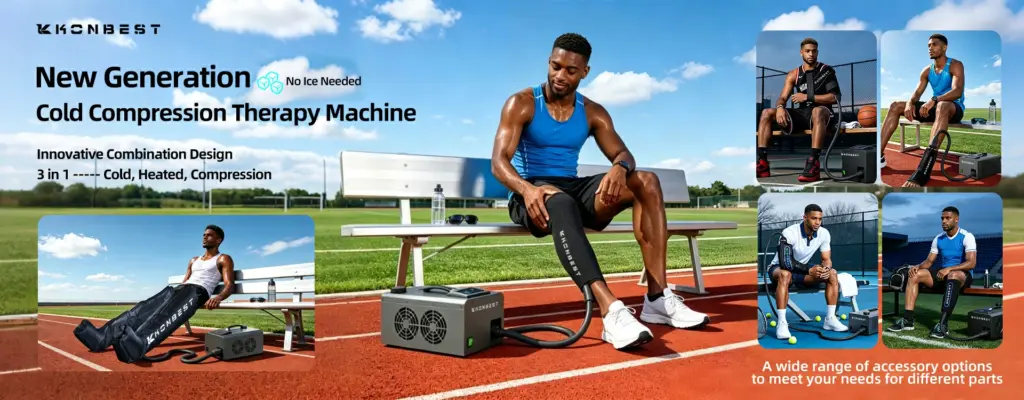
Cold compression systems combine cooling with pneumatic pressure. They can be considered for sports teams, physiotherapy businesses, rehabilitation facilities, and professional recovery centers where a wider recovery equipment range is needed.
For these products, buyers should also check pressure levels, chamber design, control modes, fitting sizes, and whether different body-area accessories are available.
Hot and cold contrast systems
Some professional users want both cooling and heating in the same equipment. This can make a contrast therapy system more suitable for a recovery center or a facility that wants several treatment-style recovery routines from one product platform.
For a distributor, this also creates a higher-specification option within the same product category.
Read the Specifications Before Comparing Prices
When searching for a cold therapy machine manufacturer, price is easy to compare. Technical details are more important to compare correctly.
For example, two machines may look similar but have different water capacity, pump performance, operating time, cooling control, noise levels, or accessory configurations. These differences can affect which customers can use the equipment comfortably.
| Specification | Why a B2B Buyer Should Check It |
|---|---|
| Cooling method | Shows how the machine creates and delivers cooling |
| Water capacity | Helps determine the practical operating setup |
| Temperature control | Important when users need controlled cooling settings |
| Operating time | Useful for facilities with repeated daily sessions |
| Noise level | Important in clinics, gyms, and quiet recovery rooms |
| Pad material | Affects comfort, durability, and repeated use |
| Accessories | Allows the product to cover different body areas |
| MOQ | Helps new brands control their first purchasing commitment |
| Warranty | Important for distributors handling after-sales requests |
These specifications should be reviewed before comparing a quotation from a cold therapy machine supplier. A lower unit price does not tell you whether the machine is the right product for your sales channel.
A Practical Example: CL05 Cold Therapy Machine
The CL05 from KONBEST is one example of a compact cold water circulation system that can be considered when building a new recovery product line.
The machine uses an ABS housing and a Nylon + TPU cold pad. It has a 9L water capacity and supports cold water circulation through the connected pad. The product is designed around digital control, adjustable flow, and timed operation.
These details give a distributor something concrete to evaluate. A buyer can check the machine itself, connect the pad, observe the circulation process, test the controls, and see whether the size and operation fit the intended customer.
The product can also be positioned differently depending on the sales channel. A fitness equipment wholesaler may introduce it as part of a gym recovery range. A physiotherapy distributor may evaluate the pad options and operating controls first. A reseller may focus more on compact design and simple operation.
This is why product specifications should always be connected with the final application.
Match Products With Different B2B Customers
For distributors
A distributor usually needs products that can work across several accounts. A cold therapy machine with simple operation and a clear specification sheet can be easier to introduce to gyms, sports facilities, clinics, and wellness businesses.
The distributor can begin with a standard model and later add more advanced equipment when customers ask for additional functions.
For wholesalers
Wholesalers usually need to think about stock planning. A product with stable specifications and repeat production is important because the second order should match the first order as closely as possible.
Before placing a larger purchase, the wholesaler should confirm the MOQ, packaging, lead time, replacement parts, warranty terms, and available production capacity.
For resellers
Resellers may need fewer models but clearer product positioning. A compact cold therapy machine can be easier to introduce through an existing sports recovery or fitness product channel.
If the reseller already sells compression boots or massage equipment, cold therapy can also become an additional category instead of a completely new business direction.
For rehabilitation and physiotherapy equipment suppliers
These buyers normally pay closer attention to control, materials, accessories, documentation, and after-sales service.
A supplier should be able to provide product information clearly and explain which configurations are available. Buyers should also confirm the certification and compliance documents required in their destination market before making a commercial order.
From Sample Order to Bulk Order
A sample should answer more questions than “Does the machine work?”
For a new B2B brand, the sample stage is a small-scale version of the future purchasing process.
First, check the physical product. Look at the housing, connectors, pad material, display, controls, water connections, cables, and packaging.
Next, test normal operation. Check how the machine starts, how water circulates, how the controls respond, and whether the operating noise is acceptable for the planned environment.
Then look at the supplier response. Ask for the current specification sheet, packing information, warranty terms, available accessories, certification documents, and mass-production lead time.
Only after these points are clear should the buyer discuss a larger order.
This approach is especially useful for buyers searching for cold therapy machine wholesale supply because the first shipment is often used to test the product with local dealers or business customers.
Build a Private Label Product Line
New B2B brands do not always want to sell products with a factory's standard appearance. Private labeling allows the buyer to create a product line that matches its own brand.
KONBEST supports private-label projects that can include logo, product color, packaging, and selected accessories. The exact customization options depend on the model and project requirements.
For the first project, it is better to keep the customization list simple.
- Confirm the basic product model.
- Choose the required product color.
- Place the brand logo in an agreed position.
- Prepare the packaging design.
- Confirm manuals and labels.
- Check which accessories should be included.
The buyer should approve a sample before moving into mass production. This creates a clear reference for the factory and makes later repeat orders easier to control.
For brands looking for an OEM cold therapy machine manufacturer, product development support is also worth checking. A factory with R&D capability can be more useful when the project requires changes to product appearance, functions, structure, software, or accessories.
What to Check in a Manufacturing Partner
Finding a factory is easy. Finding a factory that can support a growing B2B product line requires more checking.
Start with production capacity. Ask how many production lines are available, how the factory manages quality inspection, and whether the supplier can handle repeat orders during busy periods.
Then check the product development team. If the brand plans to make customized equipment, R&D capability becomes important. Industrial design, hardware, software, structure, testing, and quality control can all affect the final project.
Documentation should also be checked early. Depending on the destination market and product, buyers may need CE, ISO, RoHS, BSCI, or other relevant compliance documentation. The actual documents should be reviewed against the exact model and market requirements.
Factory inspection is another useful step for medium and large B2B orders. It gives buyers a chance to review production areas, testing procedures, warehouse management, quality-control processes, and general manufacturing conditions before committing to a long-term supply plan.
KONBEST Supply Support
KONBEST has more than 17 years of experience in sports recovery product development and manufacturing. The company supplies products to more than 100 countries and has experience with more than 300 customized brand projects.
Its manufacturing setup includes a 12,000 m² factory, five production lines, R&D and quality-control teams, and a product showroom for recovery equipment.
The product portfolio covers cold therapy equipment, cold compression systems, hot and cold contrast equipment, compression boots, red light therapy equipment, massage devices, and other sports recovery products.
This wider range can be useful for a new B2B brand. Instead of building separate supplier relationships for every recovery category, the buyer can first develop one product line and then discuss additional products with the same manufacturing partner.
KONBEST also supports OEM and ODM projects, private-label logo and color customization, packaging and accessory customization, sample development, bulk production, and factory inspection. The company promotes 2-day sampling and 7-day shipping for selected projects, with the actual schedule depending on the model, order quantity, customization, and shipping arrangement.
For a distributor, wholesaler, or reseller preparing to enter the recovery equipment market, the next step is straightforward: choose the customer group, select suitable models, request samples, check the technical documents, and then decide which products are ready for a medium or large-volume order.
View KONBEST cold therapy equipment for wholesale and B2B supply to review available models and discuss OEM, private-label, sampling, MOQ, and bulk-order requirements.
Q&A
Q1: Is cold therapy equipment a suitable product category for a new B2B brand?
It can be a practical category because different models can serve gyms, sports facilities, clinics, recovery centers, and retail channels. A new brand can begin with a small product selection and expand later.
Q2: What should I check before buying cold therapy equipment in bulk?
Check the cooling method, temperature control, water capacity, operating time, noise, pad material, accessories, power requirements, MOQ, warranty, production lead time, and required compliance documents.
Q3: What type of cold therapy machine is suitable for gyms?
A compact cold water circulation machine can be considered when the gym needs simple operation and regular recovery use. The final choice should depend on the gym's available space, customer workflow, expected usage, and required accessories.
Q4: Can I create a private-label cold therapy product?
Yes. Depending on the model, KONBEST can support private-label logo, color, packaging, and accessory customization. Buyers should confirm all customization details during the sample stage.
Q5: Can distributors buy several recovery products from KONBEST?
Yes. KONBEST has product categories covering cold therapy, cold compression, hot and cold contrast therapy, compression boots, red light therapy, massage equipment, and other sports recovery products.
Q6: Does KONBEST support factory inspection?
Yes. Factory inspection support is available for B2B buyers who want to review the manufacturing environment, production capability, and quality-control process before placing a larger order.
Q7: What is the MOQ for KONBEST cold therapy equipment?
MOQ depends on the specific model and customization requirements. Buyers should request the current quotation and MOQ for their selected products before preparing a purchase order.