

Does Red Light Therapy Work for Everyone?
One of the first questions people ask about red light therapy is simple: does it work for everyone?
For a B2B buyer, however, there is a better question. Instead of asking whether red light therapy works for every person, ask whether the equipment is suitable for the customer, the application, and the facility.
This difference is important when buying equipment in bulk. A small red light panel may work for one type of user, while a full-body system may be a better match for a sports recovery center or professional wellness facility.
So, before choosing a red light therapy device wholesale product, buyers should understand what can affect the user experience and what type of equipment is suitable for different commercial environments.
- The Simple Answer Is Not Always Yes
- Five Things That Can Change the Experience
- Start With the Customer, Not the Machine
- What RL301 Brings to a Professional Setting
- The Technical Details Behind RL301
- Which B2B Businesses Can Use This Type of System?
- A Different Way to Plan a Wholesale Order
- When Standard Products Are Not Enough
- What a Manufacturer Should Handle
- Q&A
The Simple Answer Is Not Always Yes
Red light therapy is often discussed as if one product can provide the same experience for everybody. In real use, things are more complicated.
People have different needs, different treatment goals, and different levels of sensitivity. Equipment also differs in wavelength, output, coverage, treatment time, and design.
Research into photobiomodulation has also used different treatment conditions, so results cannot simply be transferred from one application to every person.
For this reason, responsible B2B marketing should avoid saying that red light therapy will produce the same result for everyone.
A better approach is to explain what the equipment is designed for and allow the end user or qualified professional to decide whether it fits the intended application.
This is especially important for distributors and wholesalers. If a buyer imports hundreds of units, the product must be matched with the right customer group before the order is placed.
Five Things That Can Change the Experience
When a customer asks whether a red light product will work for them, there are several equipment factors worth checking first.
Wavelength selection
Red light and near-infrared light are not simply different names for the same wavelength.
Professional products may use specific wavelengths such as 660nm red light and 850nm near-infrared light. The selected wavelength should be clearly stated in the product specification.
Light output
The amount of light delivered to the treatment area is another important specification. Buyers should look for a stated light density rather than judging a product only by the number of LEDs.
Coverage area
A customer using a small panel on one body area has a very different requirement from a recovery center that wants a full-body system.
This is one reason product size should be considered together with the customer's intended use.
Session control
A professional system should make basic operation easy. Adjustable treatment time and clear controls can help staff manage repeated sessions more consistently.
Additional functions
Some products only provide red or near-infrared light. Other systems combine light with heat or additional technologies. The right choice depends on what the buyer wants to offer and how much space is available.
Start With the Customer, Not the Machine
For a wholesale buyer, product selection becomes easier when the customer is defined first.
A distributor serving sports facilities
A sports equipment distributor may already sell compression boots, massage equipment, cold therapy products, and other recovery systems.
For this type of customer, a full-body red light system can be positioned as another piece of equipment for a dedicated recovery area rather than as a replacement for every other recovery product.
A wholesaler serving gyms
Gyms often need equipment that is simple to operate and easy to place inside an existing facility. A large system may work better for a dedicated recovery room, while compact products may suit smaller spaces.
A reseller targeting wellness businesses
Online resellers need products with clear specifications that can be explained without making unsupported medical promises. Wavelength, dimensions, power, functions, warranty, and operating range are useful information for product pages.
A professional recovery chain
A multi-location recovery business may care more about consistency. The same model, same operating procedure, replacement parts, packaging, and after-sales support can become important when equipment is installed across several locations.
This is why a red light therapy supplier should be evaluated as a long-term supply partner, not only by the price of the first unit.
What RL301 Brings to a Professional Setting
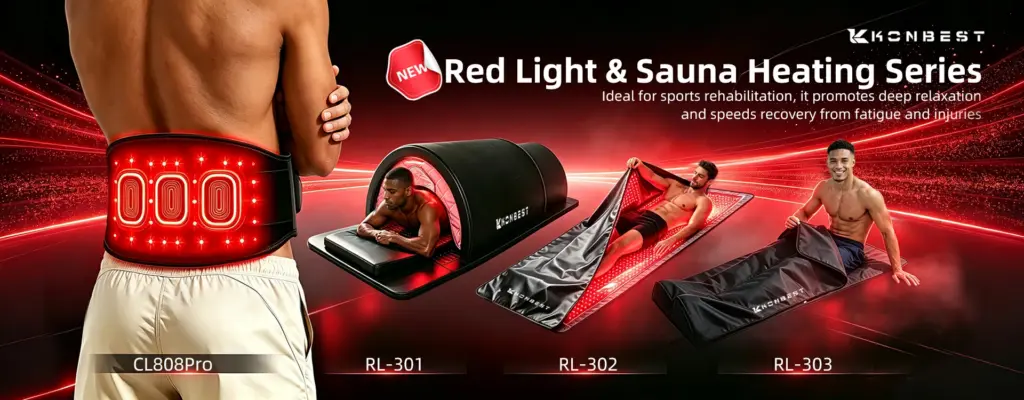
The RL301 5-in-1 Red Light Infrared Sauna Dome takes a different approach from a basic LED panel.
Instead of focusing only on a light source, it combines several functions inside one full-body system. The listed functions include red light, near-infrared light, far-infrared heating, PEMF, and negative-ion support.
This design is useful for B2B buyers who are planning a dedicated recovery or wellness space and need a larger piece of equipment rather than a small portable device.
The product also uses a dome and mat structure, allowing the user to lie inside the treatment area instead of holding a small device against one part of the body.
That physical difference changes how the product can be used in a commercial environment.
For example, a recovery center can plan a dedicated space around the equipment. A premium gym can place it inside a recovery zone. A distributor can add it to a wider professional recovery equipment catalog.
The Technical Details Behind RL301
For B2B procurement, the technical sheet is more useful than a general statement such as “powerful red light.”
RL301 uses 896 visible red LEDs at 660nm together with 224 three-chip near-infrared LEDs at 850nm.
The listed red-to-near-infrared ratio is 1:2, while the stated light density is 120–130mW/cm².
The equipment also includes temperature control. The dome temperature range is listed as 25–90°C, and the mat temperature range is 25–80°C.
For the additional PEMF function, the listed frequency range is 1–30Hz.
The treatment timer can be adjusted from 5 to 60 minutes, giving operators a clear session-setting range.
The physical specifications are also relevant when planning a commercial room. RL301 measures approximately 180 × 80 × 45cm, has a gross weight of about 35kg, and has a rated power of 1200W.
These details help a buyer answer practical questions before ordering: Will it fit the room? Is the electrical configuration suitable? Does the equipment provide the required coverage? Can the operator set an appropriate session time?
Which B2B Businesses Can Use This Type of System?
Not every buyer needs the same red light product. RL301 is more naturally suited to businesses that have enough space for a professional full-body system.
Sports recovery centers
These facilities can combine RL301 with other recovery equipment to create a multi-service recovery environment.
The full-body structure makes it possible to position the machine as a dedicated recovery station rather than a small add-on product.
High-end gyms
Large gyms may have separate spaces for training, stretching, massage, and recovery. RL301 can be considered for a dedicated recovery or wellness area where a professional-looking full-body machine is more appropriate than a handheld device.
Sports teams
Training centers and sports teams can consider full-body equipment when they want to add technology to a structured recovery area. The final use should follow the manufacturer's operating instructions and applicable regulations.
Wellness centers
Wellness businesses may prefer equipment that combines several functions. RL301's light and heat configuration gives distributors another product option for facilities looking beyond a basic LED panel.
A Different Way to Plan a Wholesale Order
Large-volume procurement should not begin with “How many units can we buy?”
A better starting point is “Where will these units go?”
For example, a distributor planning to supply ten recovery centers should first understand the floor space, electrical requirements, target customer, and expected equipment configuration of those locations.
After that, the buyer can decide whether a full-body system such as RL301 fits the project.
Then comes the supply discussion.
- Confirm the standard MOQ.
- Request a sample before mass production.
- Check product dimensions and carton dimensions.
- Confirm voltage and plug requirements.
- Review the warranty terms.
- Ask about replacement components.
- Confirm the production schedule.
- Review available compliance documents.
- Discuss packaging and branding requirements.
- Arrange factory inspection when required.
RL301 is currently listed with a 100-set MOQ, a 7–15 day lead time, and a one-year warranty. Buyers should confirm final commercial terms with the manufacturer because specifications and order conditions can vary by project.
When Standard Products Are Not Enough
Many distributors do not want to sell a completely standard product forever. Once the product has been tested in their market, they may want their own brand identity.
This is where private-label support becomes important.
KONBEST supports private-label logo, color, packaging, and accessory customization. This gives B2B buyers more control over how the equipment is prepared for their sales channel.
For example, a reseller may want branded packaging and a custom exterior color. A distributor may want a consistent design across several recovery products. A larger buyer may need accessories and packaging prepared for a specific market.
These requirements should be confirmed during the sampling stage rather than after mass production has already started.
What a Manufacturer Should Handle
When order quantities become larger, the factory behind the product becomes part of the product itself.
A supplier needs to control more than assembly. It needs to manage product development, component sourcing, production, testing, quality inspection, packaging, and delivery.
KONBEST has 17 years of sports recovery product R&D and manufacturing experience. Its products have been supplied to more than 100 countries, and the company has completed customization projects for more than 300 brands.
The manufacturing base covers approximately 12,000 square meters and includes five production lines, together with R&D and quality-control teams and a professional showroom.
For a distributor or wholesaler, this provides a broader supply foundation than simply buying finished products from a catalog.
KONBEST also supports a one-stop sports recovery equipment solution. Its product range covers different recovery categories, allowing buyers to source more than one type of equipment from the same manufacturing partner.
For applicable projects, KONBEST provides 2-day sampling, 7-day shipping, private-label support, and factory inspection arrangements.
The company also provides documentation related to certifications such as CE, ISO, RoHS, and BSCI for applicable products. Buyers should verify the exact certification and compliance requirements for the selected model and destination market before placing an order.
For B2B buyers, the main point is simple: red light therapy does not need to be sold as a product that “works for everyone.” A stronger commercial approach is to match the equipment with the right users, the right facility, and the right application.
If you are looking for a red light therapy manufacturer for medium- or large-volume distribution, wholesale, or private-label projects, RL301 can be evaluated as a professional full-body option. Share your target quantity, market, and required configuration with KONBEST to confirm the suitable specification and supply plan.
Q&A
Does red light therapy work for everyone?
No. People can respond differently, and results can depend on the application, treatment settings, wavelength, and equipment. Red light therapy should not be presented as a universal treatment for every person or every condition.
What makes a professional red light therapy device different?
Professional equipment may provide larger treatment coverage, defined wavelengths, higher output, adjustable settings, stronger construction, and features designed for repeated commercial use.
Why are 660nm and 850nm used in RL301?
RL301 combines 660nm visible red light with 850nm near-infrared light. These wavelengths are commonly used in photobiomodulation equipment, while the exact effect depends on the application and treatment parameters.
Is RL301 suitable for wholesale?
RL301 is designed as a full-body professional system and is listed with a 100-set MOQ. It can be considered by distributors, wholesalers, and resellers serving gyms, recovery centers, sports facilities, and wellness businesses.
Can I order RL301 under my own brand?
KONBEST supports private-label customization such as logo, color, packaging, and accessories. The exact MOQ, customization scope, and production requirements should be confirmed before mass production.
What should a distributor ask before buying red light therapy wholesale?
Ask about wavelength, light density, treatment coverage, power, timer, temperature range, dimensions, electrical requirements, MOQ, sample time, production lead time, warranty, packaging, spare parts, certification documents, and private-label options.
Can red light equipment be combined with other recovery products?
Yes. Professional recovery facilities may use red light equipment alongside products such as compression boots, cold therapy systems, massage equipment, and other recovery technologies. The exact combination depends on the facility and its operating model.