


Cold Therapy Machine Wholesale: How to Choose Between Cold Therapy and Contrast Therapy Systems
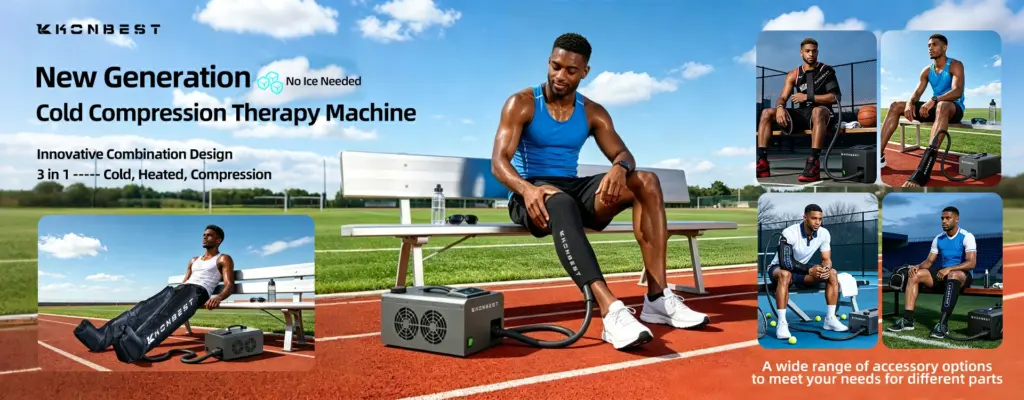
Choosing the right recovery equipment is an important decision for sports equipment distributors, rehabilitation suppliers and wellness product wholesalers. Some customers need a reliable cold therapy machine for targeted cooling. Others want a contrast therapy system that combines cold, heat and compression in one unit. For international buyers, the challenge is knowing which product type fits their market, customers and business plan.
KONBEST is an EU-registered sports recovery brand with 17 years of product development and manufacturing experience. Its product range covers cold water therapy machines, cold and heat compression systems, semiconductor cooling equipment and ice bath tubs. With products supplied to more than 100 countries and over 300 brand customization projects reported by the company, KONBEST supports distributors, wholesalers, resellers and professional recovery businesses with product selection and OEM/ODM services.
This guide explains the differences between cold therapy machines and contrast therapy systems, compares practical product options, and outlines what buyers should check before placing a medium- or large-volume order.
Table of Contents
- 1. The First Question: What Does Your Market Need?
- 2. Cold Therapy vs. Contrast Therapy: Key Differences
- 3. Match Equipment Functions to Business Applications
- 4. KONBEST Product Comparison for Wholesale Buyers
- 5. Cold Water Circulation and Compression: CL05B
- 6. Integrated Cold and Heat Systems: EK-810 and CL08
- 7. When to Add an Ice Bath Chiller
- 8. Eight Checks Before a Bulk Purchase
- 9. How to Evaluate a Cold Therapy Machine Manufacturer
- 10. Private Label and OEM/ODM Cooperation
- 11. Request a Wholesale Quotation
- 12. Questions and Answers
1. The First Question: What Does Your Market Need?
Before comparing prices, distributors should identify the main service their customers want to provide. A product with more functions is not always the best choice. The right equipment should match the customer's daily work, available space, budget and expected use frequency.
There are three common buying needs in the recovery equipment market:
- Targeted cooling: Customers want cold water circulation through wraps or pads for areas such as the knee, shoulder, ankle or leg.
- Multiple recovery functions: Professional facilities want cold, heat and compression functions in one system, so they can offer different session options.
- Full-body cold immersion: Gyms, sports clubs and wellness studios want an ice bath setup for cold water immersion rather than targeted cooling with wraps.
These needs point to different equipment categories. A cold therapy machine is suitable for targeted cooling. A contrast therapy system is designed to combine different temperature functions, and selected models also include pneumatic compression. An ice bath with a chiller serves a separate full-body immersion market.
For a wholesaler, this distinction matters. It helps avoid buying several products that perform almost the same role while missing other product categories that local customers may request.
2. Cold Therapy vs. Contrast Therapy: Key Differences
The main difference is the number and type of functions available. A standard cold therapy machine focuses on cooling. A contrast therapy system adds heat settings and may combine them with compression. The actual functions depend on the model.
| Buying Factor | Cold Therapy Machine | Contrast Therapy System |
|---|---|---|
| Main function | Controlled cooling | Cold and heat settings, with compression on selected models |
| Cooling method | Cold water circulation or another cooling technology | Integrated temperature control and, where available, compression |
| Typical equipment | Cold water circulation unit with wraps or pads | Cold and heat compression device |
| Customer priority | Cooling stability, wrap fit and simple operation | Temperature options, pressure adjustment and operating modes |
| Potential buyers | Gyms, sports teams, clinics and recovery suppliers | Rehabilitation centers, sports performance facilities and recovery studios |
| Wholesale position | Core cooling product | Multi-function product for customers with broader requirements |
When comparing a cold therapy machine manufacturer, buyers should not judge equipment only by its advertised temperature. Water flow, reservoir capacity, pressure range, wrap design, control method and maintenance requirements also affect product suitability.
For contrast therapy equipment, ask whether the machine supports cold and heat independently, whether compression is included, and which accessories are available. A clear technical comparison makes it easier to select products for different customer groups.
3. Match Equipment Functions to Business Applications
For sports teams and training centers
Sports teams often need equipment that can be used as part of a regular recovery routine after training or competition. A cold water circulation machine with suitable wraps can support targeted cooling. A contrast therapy system may be a better fit when the team wants cold, heat and compression options in one device.
When selecting products for this market, check the number of supported body areas, wrap sizes, operating controls and the time needed to prepare each session. These details affect how easily staff can use the equipment during busy training periods.
For physiotherapy and rehabilitation suppliers
Professional facilities may serve customers with different needs and body areas. They often need clear temperature and pressure settings, practical accessories and easy-to-follow operating instructions.
A cold compression machine can be considered when targeted cooling and compression are the main requirements. A contrast therapy system may be more suitable when the facility also needs heat settings. Buyers should check the product's intended use, user manual and local regulatory requirements before supplying it to professional facilities.
For gyms and wellness studios
Some gyms want a simple cold therapy product for targeted use. Others want to add an ice bath area as a separate service. These are different equipment choices: a wrap-based machine cools selected body areas, while an ice bath chiller maintains water temperature in a tub.
For this reason, distributors should ask customers about available floor space, water supply, drainage, power requirements and cleaning routines before recommending an ice bath system.
For importers and regional distributors
Importers usually need products at different price and function levels. A practical range may include a cold compression model, a multi-function contrast system and an ice bath solution. This gives sales teams more choices when serving gyms, clinics, sports clubs and wellness retailers.
4. KONBEST Product Comparison for Wholesale Buyers
KONBEST's cold and hot therapy range includes several equipment types. The following table shows how selected models differ in function and intended use.
| Model | Equipment Category | Listed Technical Details | Potential Business Application |
|---|---|---|---|
| CL05B | Cold water circulation and pneumatic compression | 9L reservoir; 30–180 mmHg pressure; AC 100–240V adapter | Sports recovery suppliers, gyms and rehabilitation equipment distributors |
| EK-810 | Cold and heat contrast compression system | Cold range 3–15°C; heat range 40–55°C; 2L tank; 550W refrigeration capacity; water flow 370±50L/h | Professional recovery facilities and rehabilitation suppliers |
| CL08 | Cold and heat contrast compression system | Cold settings 3°C, 8°C and 12°C; pressure settings 45, 70 and 100 mmHg | Sports recovery studios and facilities looking for adjustable settings |
| CB02 | Inflatable ice bath tub with chiller | Temperature range 3–42°C; Wi-Fi app control; 8-inch LCD screen; 135 × 80 × 65cm | Gyms, sports clubs, wellness studios and cold plunge retailers |
Specifications are based on the product information currently listed by KONBEST. Before ordering, buyers should request the latest model-specific technical sheet. Some product pages contain different figures for certain details, such as weight, timer range or construction measurements. The confirmed quotation and technical documents should be used for purchasing decisions.
5. Cold Water Circulation and Compression: CL05B
CL05B combines continuous ice water circulation with pneumatic compression. It is not simply a cold water unit. The system uses a 9L water reservoir and adjustable air pressure from 30 to 180 mmHg.
The product page lists wrap options for legs, knees, ankles, shoulders and elbows. This gives distributors several application areas to discuss with gyms, sports recovery businesses and rehabilitation equipment suppliers.
For buyers, the main selection points are:
- Water capacity: The 9L reservoir is an important specification when comparing the system with smaller units.
- Pressure adjustment: The listed 30–180 mmHg range gives users adjustable compression settings. Confirm the available pressure modes and operating instructions for the supplied configuration.
- Wrap selection: Check which body-area wraps are included in the quotation and which are optional accessories.
- Power compatibility: The listed adapter supports AC 100–240V input. Confirm the correct plug and local electrical requirements for the destination market.
CL05B may suit buyers whose customers want cold therapy and compression in one product. It should be positioned as a cold compression system, not as a full cold-and-heat contrast machine.
6. Integrated Cold and Heat Systems: EK-810 and CL08
For customers who need more than cooling, a contrast therapy system can provide a wider range of operating options. KONBEST offers models such as EK-810 and CL08, which combine cold and heat functions with compression.
EK-810: Multiple functions in one device
The EK-810 is designed to combine cold therapy, heat therapy and pneumatic compression. Its listed cold temperature range is 3–15°C, while its heat range is 40–55°C. It also lists a 2L water tank, 550W refrigeration capacity and water flow of 370±50L/h. The product parameter table lists a pressure range of 30–180 mmHg.
This combination can be useful for sports recovery facilities and rehabilitation suppliers that want one device with several functions. Instead of purchasing separate cold and heat units, buyers can assess whether an integrated system fits their customers' operating needs.
When comparing EK-810 with a basic cold therapy machine, check the temperature range, pressure adjustment, wrap compatibility, power supply and maintenance process. Also confirm the timer range and product weight with the latest technical sheet before placing a bulk order.
CL08: A compact option with defined settings
The CL08 is another cold and heat contrast compression system. Its product page lists three cold settings: 3°C, 8°C and 12°C. It also lists three pressure levels: 45, 70 and 100 mmHg.
For distributors, the key point is its combination of temperature and compression settings in a compact recovery device. It may be considered for sports recovery studios, clinics and professional equipment suppliers that need adjustable operating options.
The current product page does not clearly list a complete set of heat temperature values. Buyers should request the latest specification sheet to confirm the available heat settings, accessories and operating modes before comparing CL08 with other contrast therapy systems.
7. When to Add an Ice Bath Chiller
An ice bath chiller serves a different purpose from a wrap-based cold therapy machine. It controls the water temperature in a tub for full-body cold water immersion. This makes it a separate product category for gyms, sports clubs, wellness studios and cold plunge retailers.
The KONBEST CB02 combines an inflatable ice bath tub with a remote chiller. Its product page lists a temperature range of 3–42°C, Wi-Fi app control for iOS and Android, an 8-inch LCD screen and a tub size of 135 × 80 × 65cm. The listed accessories include a hand pump, carry bag and repair kit.
The product page also lists an ozone water purification system and water filter. Buyers should confirm the maintenance schedule, filter replacement requirements, local power configuration and water care instructions before ordering.
CB02 can help distributors add a cold plunge product to an existing recovery equipment range. It should not be described as a replacement for a targeted cold compression machine because the two products serve different user needs.
8. Eight Checks Before a Bulk Purchase
For medium- and large-volume orders, buyers should evaluate the full product configuration instead of comparing only the unit price. The following checklist can help reduce mistakes during supplier selection.
1. Confirm the product category
Decide whether your order needs cold water circulation, cold compression, cold and heat contrast functions or an ice bath chiller. Do not use one product name for different equipment types.
2. Compare the main technical parameters
Check temperature range, pressure range, water capacity, water flow, refrigeration capacity, timer settings and power supply. Ask the supplier to confirm which figures apply to the exact model and configuration.
3. Check accessories and replacement parts
Confirm the number and type of wraps, pads, hoses, connectors, filters and other included parts. Ask about the cost and supply time for replacement accessories.
4. Review the user and maintenance process
Ask how to clean the water circuit, replace filters, maintain the chiller and store the wraps. Simple maintenance instructions are important for facilities that use equipment regularly.
5. Confirm MOQ and order mix
KONBEST product pages list model-dependent MOQs. CL05B, EK-810 and CL08 list 10–50 sets, while CB02 lists 5–10 sets. Confirm whether different models can be combined in one order and whether customization changes the MOQ.
6. Request samples before mass production
Where possible, test a sample before confirming a larger order. Review the control interface, cooling performance, compression operation, water connections, accessories and packaging.
7. Confirm lead time and shipping terms
Selected product pages list a lead time of 7–15 days. Actual production and delivery schedules depend on quantity, stock, customization, destination and shipping method. Confirm the agreed schedule in writing.
8. Check warranty and after-sales support
Ask for written warranty terms, spare parts availability, technical support arrangements and the process for handling product issues. These details are important when you supply equipment to multiple business customers.
9. How to Evaluate a Cold Therapy Machine Manufacturer
A reliable cold therapy machine manufacturer should offer more than a product catalog. For distributors and wholesalers, production stability, quality control, documentation and long-term support are important parts of the buying decision.
When reviewing a supplier, consider these areas:
- Manufacturing experience: Ask how long the company has worked in sports recovery equipment and what product categories it can supply.
- Production capacity: Review factory size, production lines, staff organization and the process for handling repeat orders.
- Product development: Check whether the supplier has an R&D team and can support product improvements or OEM/ODM projects.
- Quality inspection: Ask how incoming materials, production stages and finished products are checked.
- Export support: Confirm packaging, manuals, electrical configurations and documents required for your destination market.
- After-sales service: Review warranty terms, spare parts supply and technical support before signing the purchase agreement.
KONBEST reports 17 years of sports recovery product development and manufacturing experience, exports to more than 100 countries, and over 300 brand customization projects. The company also reports a 12,000m² factory, five production lines, a product showroom, and dedicated R&D and quality inspection teams.
KONBEST states that its products are supported by more than 20,000 professional athlete endorsements or user references. Buyers can request relevant project information and supporting materials when evaluating this claim. Factory inspection can also be discussed before cooperation.
For international orders, request the documents that apply to the exact product and destination market. CE and RoHS address different compliance requirements. ISO refers to a management-system standard, while BSCI relates to social compliance. These should not be presented as interchangeable product certificates. Always check the certificate holder, model scope, validity and market relevance.
10. Private Label and OEM/ODM Cooperation
For established distributors and resellers, private label can help build a consistent recovery equipment range under their own brand. KONBEST supports customization options for qualified projects, including:
- Private label logo printing.
- Custom product colors, subject to model availability.
- Branded retail and shipping packaging.
- Accessory selection and package configuration.
- OEM/ODM discussions for product and design requirements.
To start a private label project, prepare your logo file, color reference, packaging design, target quantity and destination market. Ask for a sample or artwork confirmation before mass production. This helps both sides confirm the product appearance and package details before the full order begins.
KONBEST states that sample preparation may take as little as two days and that selected orders may be shipped within seven days. These are project-dependent service targets, not fixed delivery promises for every model or order. Confirm the schedule according to stock, order quantity, customization and destination.
11. Request a Wholesale Quotation from KONBEST
If you are planning to import cold therapy equipment, compare contrast therapy systems or add ice bath products to your recovery equipment range, KONBEST can help you review suitable models and order options.
To receive a more accurate quotation, send the following details:
- Your company type: distributor, wholesaler, reseller, importer or recovery facility.
- Your target market and delivery country.
- The equipment category or models you are interested in.
- Your estimated order quantity and expected repeat-order plan.
- Your requirements for logo, color, packaging and accessories.
- Any required compliance documents or technical specifications.
This information helps the sales team recommend suitable products, confirm the MOQ, prepare a quotation and discuss sampling, production and shipping arrangements.
12. Questions and Answers
Q1: What is the difference between a cold therapy machine and a contrast therapy system?
A cold therapy machine mainly provides controlled cooling. A contrast therapy system combines cold and heat functions, and selected models also include pneumatic compression. Buyers should compare the actual functions of each model before ordering.
Q2: Which KONBEST model combines cold water circulation and compression?
The CL05B combines continuous ice water circulation with pneumatic compression. It has a 9L reservoir and a listed pressure range of 30–180 mmHg. It is a cold compression system rather than a full cold-and-heat contrast system.
Q3: Which KONBEST models offer cold and heat functions?
EK-810 and CL08 are listed as cold and heat contrast compression systems. EK-810 lists a cold range of 3–15°C and a heat range of 40–55°C. CL08 lists three cold settings and three pressure levels. Request the latest CL08 specification sheet for full heat-setting details.
Q4: Is an ice bath chiller the same as a cold therapy machine?
No. An ice bath chiller controls the water temperature in a tub for full-body immersion. A wrap-based cold therapy machine circulates cooling water through pads or wraps for selected body areas. They serve different applications.
Q5: What is the MOQ for KONBEST wholesale orders?
The listed MOQ depends on the model. CL05B, EK-810 and CL08 show 10–50 sets, while CB02 shows 5–10 sets. Confirm the current MOQ and any mixed-model order options with KONBEST before placing an order.
Q6: How long is the production lead time?
Selected KONBEST product pages list a lead time of 7–15 days. The actual schedule depends on the model, order quantity, stock, customization and shipping arrangements. Ask for a confirmed schedule in the quotation.
Q7: Can KONBEST provide private label cold therapy equipment?
Yes. KONBEST supports private label and OEM/ODM projects, including logo printing, custom colors, packaging and accessory options. The available customization scope should be confirmed for each model.
Q8: Can I order different cold therapy products in one shipment?
Ask KONBEST whether the selected models can be combined in one order. Mixed-model purchasing may help distributors build a wider product range, but MOQ, packaging and production schedules must be confirmed for each item.
Q9: What documents should importers request?
Importers should request the product specifications, user manual, warranty terms and compliance documents that apply to the exact model and destination market. Do not assume that one certificate covers every product in the range.
Q10: Does KONBEST support factory inspections?
Yes. Factory inspection can be discussed with the KONBEST team. Buyers should confirm the inspection date, scope and documents required before arranging a visit.