

OEM vs ODM Red Light Therapy Devices: How to Choose the Right Model for Your Business
Red light therapy devices are becoming an important product category for sports recovery brands, wellness suppliers, fitness equipment distributors, and rehabilitation equipment wholesalers. For businesses planning to enter this market or expand an existing product line, choosing the right manufacturing model is a key purchasing decision.
Should you choose OEM to sell existing products under your own brand, or invest in ODM to develop a more customized device? The best answer depends on your sales channels, target customers, order volume, product requirements, and long-term business plan.
This guide compares red light therapy OEM and ODM solutions from a B2B purchasing perspective. It also reviews product specifications, real business applications, customization options, and factory selection points to help distributors, wholesalers, and resellers make a better sourcing decision.
Table of Contents
- Why Red Light Therapy Is Worth Adding to Your Product Range
- OEM vs ODM: Understand the Main Differences
- Which Manufacturing Model Fits Your Business?
- Match Product Types to Your Target Customers
- Technical Details to Check Before Bulk Purchasing
- OEM and ODM Customization Options
- From Sample Approval to Mass Production
- How to Select a Reliable Manufacturer
- KONBEST: Red Light Therapy Manufacturing and Private Label Support
- Frequently Asked Questions
1. Why Red Light Therapy Is Worth Adding to Your Product Range
Many buyers no longer want to sell only one type of recovery equipment. They want a product range that can serve different customer groups and business settings. Red light therapy devices can be part of this wider range, alongside compression boots, cold therapy machines, massage equipment, and other wellness products.
Different product formats also create different sales opportunities:
- Full-body devices for wellness studios and professional recovery facilities.
- Wearable devices for home wellness retailers and portable recovery product sellers.
- Multi-function systems for gyms, sports clubs, and wellness centers.
- Compact devices for online retailers and regional distributors.
For a distributor, the key is not to purchase every available model. It is to build a product mix that matches local demand, price levels, and customer needs. A suitable red light therapy device manufacturer should help you compare product configurations and plan a product range that can support repeat orders.
2. OEM vs ODM: Understand the Main Differences
OEM and ODM are both common manufacturing models in the sports recovery equipment industry. However, they provide different levels of product design and customization.
OEM: Put Your Brand on an Existing Product
OEM stands for Original Equipment Manufacturer. In an OEM project, the buyer selects an existing product or an agreed product platform. The manufacturer produces it according to the confirmed specifications, while the buyer sells it under its own brand.
For example, a distributor may select a full-body red light therapy blanket, add a company logo, choose a package design, and order 200 units. The main product design and technical structure are based on an existing model.
OEM is usually a good choice when your business needs:
- A faster way to add red light therapy devices to an existing catalog.
- Private label products without developing a new device.
- Consistent product specifications for repeat wholesale orders.
- Custom logos, colors, packaging, and selected accessories.
- A practical starting point for testing a new product category.
ODM: Develop a Product Around Your Business Needs
For example, a wellness equipment brand may want a wearable device with a different housing, a special strap design, or a new accessory package. The manufacturer reviews the requirements and evaluates how to develop the product.
ODM may be suitable when your business needs:
- A product design that is different from standard market models.
- Changes to product structure or selected functions.
- A product designed for a specific customer group.
- Long-term product development with a manufacturing partner.
- More control over product appearance and configuration.
OEM vs ODM: B2B Purchasing Comparison
| Comparison | OEM | ODM |
|---|---|---|
| Product starting point | Existing product or platform | Existing design or new development concept |
| Design changes | Usually limited to agreed options | Can include deeper design changes |
| Development time | Usually shorter | Depends on design and testing needs |
| Project cost | Usually easier to control | May include development or tooling costs |
| Brand customization | Logo, color, packaging, accessories | Branding plus agreed product development |
| Best business use | Product expansion and faster market entry | Product differentiation and specific market needs |
One important point: OEM and ODM do not automatically define who owns the product design, tooling, or intellectual property. These matters should be clearly written into the business agreement before development or production begins.
3. Which Manufacturing Model Fits Your Business?
The right red light therapy OEM or ODM solution depends on your current business stage. The following recommendations can help you make a practical decision.
For Established Distributors: OEM Is Often the First Choice
Distributors with existing sales networks usually need stable products, clear technical information, and reliable supply. Their customers may include gyms, sports clubs, wellness centers, and rehabilitation facilities.
For this business model, OEM can reduce the time needed to prepare a new product range. You can select proven product models, apply your brand identity, and focus on local sales, dealer support, and product education.
Recommended solution: Select two or three products with different functions and price positions. Use consistent branding and packaging to create a clear product family. Confirm warranty terms, spare parts, and repeat-order specifications before purchasing in bulk.
For Wholesalers: Focus on Supply Stability and Repeat Orders
Wholesalers often supply retailers, regional dealers, online stores, and other business customers. Their main concern is not only the first order. They also need the same product specifications to be available for future orders.
OEM is a practical choice when you want to purchase established models in medium or large quantities. If your market later requires a special design or function, you can discuss ODM development with the factory.
Recommended solution: Start with products that have clear specifications, manageable packaging, and suitable after-sales support. Confirm production capacity and delivery arrangements before agreeing to a large order.
For Private Label Brands: Combine OEM and ODM in Stages
New private label brands may not have enough customer data to develop a completely new product. Starting with OEM can help them understand market demand before making a larger development investment.
After collecting feedback from customers and sales partners, the brand can identify product improvements. These may include a different appearance, more suitable accessories, or changes to the control system.
Recommended solution: Launch with an existing OEM model, test the market, and use real customer feedback to prepare an ODM project when there is a clear reason for product development.
For Businesses Entering a New Market: Test Before Scaling
If you are entering a new country or sales channel, demand may be difficult to predict. A large first order can create inventory pressure if the product does not match local preferences.
Recommended solution: Request samples, check local product requirements, and begin with an order size that matches your sales plan. Increase the order volume after product acceptance and customer demand become clearer.
4. Match Product Types to Your Target Customers
A good product portfolio should solve different purchasing needs. KONBEST offers several red light therapy product formats that can be considered for different sales channels.
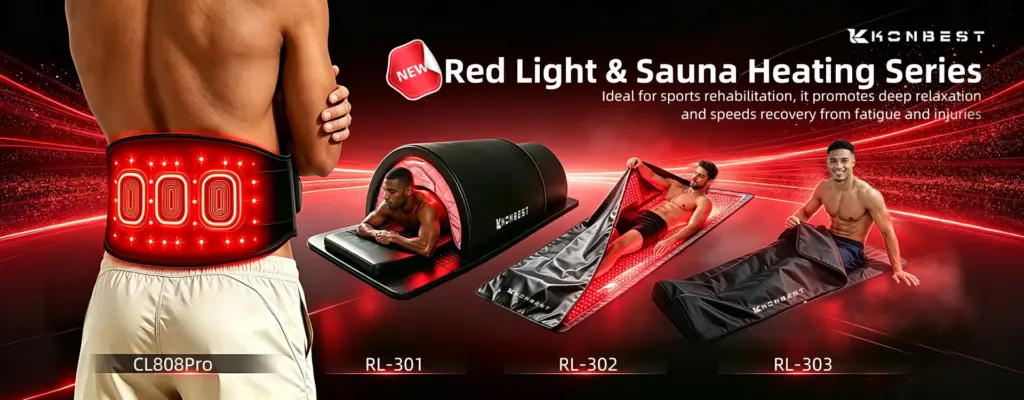
RL302 Full-Body Red Light Therapy Blanket
The RL302 is designed for businesses looking for a full-body light therapy product. It uses 660nm red light and 850nm near-infrared light, with a total of 2,240 LED units.
Key specifications include:
- 660nm red light and 850nm near-infrared light.
- 2,240 LED units.
- Continuous, 10Hz, and 40Hz light modes.
- Five adjustable power levels.
- 10–60 minute timer.
- Rated power: 200W.
- One-year warranty.
Suitable business scenarios: Wellness studios, home wellness retailers, fitness equipment distributors, and recovery product wholesalers.
Why consider it: A full-body product gives distributors a different category from small handheld or wearable devices. Its multiple modes and adjustable settings also provide clear specification points for product comparison.
Product details: RL302 Full-Body Red Light Therapy Blanket.
RL301 5-in-1 Red Light Infrared Sauna Dome
The RL301 is a larger multi-function recovery system. It combines red light, near-infrared light, far-infrared heating, PEMF, mineral stones, and negative ions.
Key specifications include:
- 896 visible red light LED units at 660nm.
- 224 near-infrared LED units at 850nm.
- Light density: 120–130mW/cm².
- PEMF frequency range: 1–30Hz.
- Dome temperature range: 25–90°C.
- Mat temperature range: 25–80°C.
- Rated power: 1,200W.
- Timer: 5–60 minutes.
- Product dimensions: 180 × 80 × 45cm.
- Gross weight: approximately 35kg.
Suitable business scenarios: Professional wellness studios, sports recovery facilities, premium fitness centers, and businesses offering multi-function recovery equipment.
Why consider it: The RL301 provides a higher-function product option for buyers who want to serve professional or premium wellness markets. Its size, power requirements, installation space, and operating instructions should be reviewed before selecting it for a local market.
Product details: RL301 Red Light Infrared Sauna Dome.
RL202 Wearable Mini Red Light Therapy Device
The RL202 is a compact wearable device for customers who prefer a portable product. It combines red light and near-infrared light in a lightweight design.
Key specifications include:
- 19 LED units: 9 at 660nm and 10 at 850nm.
- Pulse frequency: 162Hz.
- Rated power: 5W.
- Battery capacity: 450mAh.
- Weight: approximately 30g.
- Five adjustable modes.
- Up to 105 minutes of use under the stated product conditions.
- Type-C charging.
- One-year warranty.
Suitable business scenarios: Online wellness retailers, portable recovery product sellers, sports accessory distributors, and businesses serving home-use customers.
Why consider it: Its compact size and wearable design make it different from large full-body systems. Distributors can use it to build a more accessible product category alongside higher-value equipment.
Product details: RL202 Wearable Mini Red Light Therapy Device.
Review the full KONBEST cryotherapy and cold therapy product range to compare the available models before requesting a quotation.
CL808Pro Cold, Hot, and Red Light Therapy Belt
Some distributors already sell cold therapy products and want to add more functions to their recovery equipment range. The CL808Pro combines cold therapy, heat therapy, red light, and near-infrared light in one wearable belt.
Key specifications include:
- 660nm red light and 850nm near-infrared light.
- Temperature range: approximately 3°C to 45°C.
- Built-in 5,000mAh battery.
- Three cooling fans.
- USB power supply.
- One- to two-year warranty, depending on the confirmed product terms.
- Product appearance: Check housing, surface finish, connectors, display, and overall assembly.
- Operating functions: Test the cooling or heating functions and other features included in the selected model.
- Water circulation: For water-based machines, check the connections, circulation, tank, and pad compatibility.
- Compression functions: For models with compression, review the pressure settings and control response.
- Accessories: Confirm that pads, hoses, power adapters, straps, and other listed items are included.
- Packaging: Check the carton, protective materials, labels, and user instructions.
- Documentation: Review the specification sheet, user manual, warranty terms, and applicable compliance documents.
Suitable business scenarios: Sports recovery distributors, fitness equipment wholesalers, wellness retailers, and suppliers already working with cold and hot therapy products.
Why consider it: It helps businesses expand from single-function red light products into a wider recovery equipment category. Buyers should confirm the available control functions and production version before placing an order.
Product details: CL808Pro Cold and Hot Red Light Therapy Belt.
5. Technical Details to Check Before Bulk Purchasing
When comparing red light therapy devices from different manufacturers, do not rely on product names or appearance alone. A professional purchasing decision should be based on a complete specification sheet and sample evaluation.
Light Wavelength and LED Configuration
Check the exact wavelengths used by the device. KONBEST models include configurations using 660nm red light and 850nm near-infrared light. Also confirm the number of LED units, chip configuration, and light output data.
Light Density and Power
Light density and rated power are different technical measurements. Ask the manufacturer how light density is measured, where the measurement is taken, and under what operating conditions. Do not compare figures from different suppliers unless the testing methods are consistent.
Operating Modes and Controls
Check the available modes, adjustable power levels, pulse settings, timer, and control method. These features affect product operation and the information your sales team needs to explain to customers.
Materials, Size, and Product Design
For blankets and wearable devices, review the materials, product dimensions, weight, and storage method. For large systems, check the required operating space, rated power, temperature settings, and installation needs.
Electrical and Market Requirements
Confirm the rated voltage, frequency, plug type, power adapter, labels, and user manual for the destination market. Ask for the applicable compliance documents for the exact model being purchased.
Warranty and After-Sales Support
For wholesale orders, confirm the warranty period, covered parts, replacement process, spare parts supply, and technical support. These details are important when you supply multiple dealers or operate a regional distribution network.
6. OEM and ODM Customization Options
Customization should match your sales plan. A distributor may only need a logo and package design, while a brand owner may need a more detailed product development project.
Private Label Logo
Logo printing or labeling helps create a consistent brand identity. Before production, approve the logo file, size, position, color, and application method.
Product Color and Appearance
Selected product models may support color customization. Confirm available materials, color references, minimum order quantity, and whether the selected color affects production time.
Packaging and User Materials
Branded cartons, product manuals, labels, and inserts can help distributors prepare products for local sales. Make sure the package includes the correct product information and destination-market requirements.
Accessories and Functional Changes
Accessory customization may include straps, cables, controllers, or other product-specific items. Functional or structural changes require technical review. Some changes may involve new components, tooling, testing, or additional development time.
For an ODM project, prepare a clear product brief before requesting a quotation. Include the target market, customer type, expected order quantity, required functions, reference images, and estimated budget. This helps the manufacturer understand the project and provide a more useful proposal.
7. From Sample Approval to Mass Production
For medium and large B2B orders, a clear purchasing process helps control product quality, cost, and delivery expectations.
Step 1: Define Your Order Plan
List the models you need, estimated quantities, destination countries, branding requirements, and expected delivery period. If you plan to sell through several channels, estimate the demand for each product type.
Step 2: Request a Detailed Quotation
Ask the supplier to separate product price, customization cost, packaging cost, sample cost, and shipping terms where applicable. Confirm whether the quotation is based on a specific order quantity and product configuration.
Step 3: Test Samples
Check the sample's appearance, functions, controls, materials, accessories, and packaging. If you need OEM branding, review the logo and package before mass production.
Step 4: Approve the Final Specification
Prepare a written specification covering model number, wavelength, LED quantity, power, modes, dimensions, accessories, color, packaging, and warranty. Both sides should approve the same version before production.
Step 5: Confirm Production and Quality Inspection
Discuss the production schedule and inspection plan. Ask how the factory checks incoming components, assembly quality, product functions, and final packaging. For large orders, you may also arrange an independent inspection.
Step 6: Plan Shipping and Repeat Orders
Confirm the shipping method, delivery terms, export documents, carton details, and shipment schedule. If you expect repeat orders, discuss how the factory will maintain the approved product specifications across future batches.
8. How to Select a Reliable Red Light Therapy Manufacturer
A suitable red light therapy device manufacturer should support your business beyond the first shipment. The following points can help you compare potential suppliers.
- Industry experience: Review the manufacturer's experience in sports recovery and wellness equipment.
- Factory capacity: Check factory size, production lines, equipment, and order scheduling ability.
- R&D team: Confirm whether the supplier can support technical questions and product development.
- Quality control: Ask for details about component checks, production testing, and final inspection.
- OEM and ODM experience: Review examples of branding and customization projects.
- Product documentation: Request specifications, manuals, test reports, and relevant certificates for each model.
- Communication: Check whether the supplier can provide clear answers, updated production information, and after-sales support.
- Factory inspection: Consider an on-site or third-party inspection before a major order.
Pay special attention to compliance documents. CE and RoHS documents must be checked against the relevant product and applicable requirements. ISO normally relates to a management system, while BSCI is a social compliance assessment and should not be described as a product safety certificate. Ask the supplier to confirm the scope and validity of every document.
9. KONBEST: Red Light Therapy Manufacturing and Private Label Support
KONBEST is an EU-registered sports recovery brand with 17 years of experience in sports recovery product research, development, and manufacturing. Its products are supplied to more than 100 countries, and the company has completed over 300 brand customization projects.
For international distributors, wholesalers, and resellers, KONBEST provides product selection and manufacturing support across different recovery equipment categories.
Manufacturing and Development Capabilities
- 12,000-square-meter manufacturing facility.
- Five production lines.
- Professional R&D and quality inspection teams.
- Product showroom for business buyers to review product options.
- Experience serving markets connected with more than 20,000 professional athletes.
- OEM and ODM services for selected product models and projects.
Support for International B2B Buyers
- Private label logo customization.
- Selected product color customization.
- Custom packaging and accessory options.
- Product sampling and specification confirmation.
- Factory inspection support.
- One-stop sourcing across red light therapy, compression therapy, cold therapy, and other sports recovery equipment.
KONBEST offers 2-day sampling and 7-day shipping support for applicable products and orders. Actual sample availability and delivery time depend on the model, stock, customization, order quantity, and destination. For mass production, the confirmed schedule should be stated in the quotation and order agreement.
The company also provides relevant quality and compliance documents, including CE, ISO, RoHS, and BSCI-related documentation where applicable. Buyers should request the exact documents for their selected product and target market before placing an order.
If your business also supplies cold therapy products, you can review the KONBEST cryotherapy machine wholesale range. This can help you evaluate additional products for sports recovery distributors and wellness equipment wholesalers.
To compare available red light models, visit the KONBEST red light therapy device collection. You can discuss product specifications, OEM branding, ODM requirements, and bulk order plans with the team.
10. Final Decision: OEM for Faster Product Expansion, ODM for Deeper Customization
OEM and ODM serve different business needs. OEM is usually a practical choice for distributors and wholesalers who want to sell existing products under their own brands. It can help businesses expand their catalogs with less product development work.
ODM is more suitable when a business has a clear product concept and needs changes to design, structure, or selected functions. It requires more technical discussion and project planning, but it can support a more specific product position.
For many B2B buyers, the best approach is to start with suitable OEM products, collect market feedback, and consider ODM when customer demand supports further development.
Before choosing a supplier, compare product specifications, sample quality, production capacity, customization options, compliance documents, and after-sales support. A reliable manufacturing partner should help you manage both the first order and future supply needs.
Frequently Asked Questions
Q1: What is the difference between red light therapy OEM and ODM?
OEM usually means producing an existing product with agreed branding and customization. ODM includes product design and development support. OEM is often faster to start, while ODM allows more product changes.
Q2: Is OEM or ODM better for a red light therapy distributor?
OEM is often a good starting point for distributors with established sales channels. It allows them to add existing products under their own brand. ODM may be more suitable when they need a special product design or configuration.
Q3: Can I order red light therapy devices with my own brand?
Yes. KONBEST supports private label customization for selected models. Options may include logo, product color, packaging, and accessories. The available options and minimum order quantity depend on the product and project.
Q4: What wavelengths should I check when buying red light therapy devices?
Common configurations include 660nm red light and 850nm near-infrared light. Buyers should also check LED quantity, light density, operating modes, rated power, and the manufacturer's testing information.
Q5: What is the MOQ for KONBEST red light therapy devices?
MOQ varies by model and customization requirements. For example, the published RL301 product information lists an MOQ of 100 sets, while RL202 lists an MOQ of 2,000 units. Other models may have different requirements. Confirm the latest MOQ with the manufacturer before ordering.
Q6: How long does production take for a bulk order?
Published lead times for some KONBEST models are around 7–15 days. The actual schedule depends on the model, quantity, stock, customization, and production plan. Confirm the delivery date in the quotation.
Q7: Can KONBEST customize product packaging and accessories?
Yes. KONBEST supports packaging and accessory customization for selected products. Buyers should provide their requirements and confirm the available options before sample approval.
Q8: Can I inspect the factory before placing a large order?
Yes. KONBEST supports factory inspections for business buyers. You can discuss the inspection schedule and review production facilities, quality control processes, and relevant product information.
Q9: What should I include in an OEM or ODM inquiry?
Include the product model, estimated order quantity, destination market, required functions, logo and color preferences, packaging needs, and any special technical requirements. Clear information helps the manufacturer prepare a more accurate quotation.
Q10: Can I buy red light therapy and cold therapy equipment from one supplier?
KONBEST offers both red light therapy products and cold therapy equipment, as well as other sports recovery products. This allows distributors and wholesalers to discuss a wider product range with one manufacturing partner.
Q11: What documents should I request before importing red light therapy devices?
Ask for the product specification sheet, user manual, applicable test reports, relevant CE and RoHS documents, electrical information, labels, and warranty terms. Requirements depend on the product type and destination market, so confirm them before placing the order.
Q12: How can I get a wholesale or private label quotation from KONBEST?
Visit the KONBEST red light therapy product collection and share your target models, estimated quantities, destination market, and customization requirements. The team can review your needs and discuss suitable OEM or ODM options.