


Common Problems Buyers Face When Choosing Compression Boots
Buying compression boots for a business is not just about finding a good-looking product at a low price. For distributors, wholesalers, resellers, sports recovery brands, gyms, and rehabilitation centers, a poor choice can create problems with product fit, quality, branding, delivery, and repeat supply.
The risk becomes higher when the order moves from a small trial to a medium or large-volume purchase. A product that works for a few sample units may not be the best choice for hundreds of units or for a long-term private label program.
This guide explains the key problems B2B buyers should check before choosing a compression boots supplier and shows a more practical way to select products for different markets.
- Start With the Market, Not the Product
- Problem 1: Choosing the Wrong Chamber Design
- Problem 2: Looking at Features Without Understanding Use
- Problem 3: Focusing on Price Before Quality
- Problem 4: Limited Private Label Support
- Problem 5: Not Checking Factory Capacity
- Problem 6: Having No Product Range Strategy
- Problem 7: Skipping Sample Testing
- A Practical B2B Buying Checklist
- Why KONBEST Fits Global B2B Projects
- Planning the Move From Trial Orders to Bulk Supply
- Q&A
Start With the Market, Not the Product
One common mistake is choosing a compression boot first and then trying to find customers for it.
A better method is to define the customer before selecting the model. A fitness center, professional sports team, recovery center, and rehabilitation clinic may all need compression equipment, but their requirements can be different.
For example, a fitness center may prefer an easy-to-use model for regular customer sessions. A professional sports facility may need a more advanced configuration for frequent use. A distributor may need several models so it can serve both price-sensitive and professional buyers.
This is why a reliable Compression Boots Manufacturer should offer more than one product level.
Problem 1: Choosing the Wrong Chamber Design
The number of air chambers is one of the first technical details B2B buyers should compare.
KONBEST offers 4-chamber, 6-chamber, and 8-chamber compression boots. These configurations allow buyers to build a product range for different customer groups instead of using one model for every application.
4-Chamber Models
The 4-chamber series can be positioned toward entry-level markets, fitness users, home recovery, and buyers looking for a simpler product configuration.
This type of product can be useful for distributors that want to test a new market before introducing higher-level equipment.
6-Chamber Models
The 6-chamber series can target more demanding sports and recovery applications. It gives buyers another product level between basic and professional equipment.
This can be useful for fitness centers, sports recovery facilities, and distributors looking for a mid-range product.
8-Chamber Models
The 8-chamber series is more suitable for professional applications where buyers are looking for more advanced compression control and a higher product level.
Potential users include professional sports teams, physiotherapy facilities, rehabilitation centers, and premium recovery businesses.
| Product Level | Possible Market | B2B Selection Focus |
|---|---|---|
| 4-Chamber | Home recovery, fitness | Simple use and entry-level positioning |
| 6-Chamber | Sports and recovery centers | Balanced features and professional use |
| 8-Chamber | Sports medicine and rehabilitation | Advanced control and professional positioning |
Problem 2: Looking at Features Without Understanding Use
A long feature list does not automatically mean that a product is right for every customer.
Buyers should understand how the equipment will be used before comparing technical functions.
Important points include:
- Chamber configuration
- Pressure adjustment
- Compression sequence
- Available programs
- Control interface
- Session settings
- Material and sleeve design
- Ease of operation
- Accessories
For example, a recovery center may need equipment that can be used repeatedly during a busy day. A home user may care more about simple controls and easy storage.
For this reason, an OEM Compression Boots Manufacturer should be able to explain which models are designed for different market positions rather than simply sending a general catalog.
Problem 3: Focusing on Price Before Quality
Price matters in wholesale purchasing, but it should not be the first question.
A lower quotation can become costly if the product has inconsistent quality, unclear specifications, poor packaging, or unstable repeat production.
Before placing a larger order, buyers should check:
- Manufacturing experience
- Product specifications
- Quality inspection process
- Production consistency
- Product testing
- Available certifications
- Warranty policy
- Technical support
- Replacement parts and accessories
This is especially important for distributors and wholesalers. When a customer buys through a distributor, the distributor's reputation is connected to the product.
A dependable Sports Recovery Equipment Manufacturer should therefore provide clear product information and quality requirements before mass production.
Problem 4: Limited Private Label Support
Generic products can be useful for market testing, but they may not be enough for a brand that wants to build a long-term product line.
Private label manufacturing gives businesses more control over how the product is presented in the market.
Depending on the project, buyers may request:
- Private label logo
- Product color customization
- Custom packaging
- Accessories
- Product appearance
- Control interface options
This can be valuable for a reseller that wants a more unique product or a distributor building its own recovery equipment brand.
KONBEST supports private label logo, color, packaging, and accessory customization for suitable OEM and ODM projects.
Problem 5: Not Checking Factory Capacity
A factory may handle a small trial order well but struggle when the quantity becomes much larger.
This is a major concern for B2B buyers planning long-term sales.
Before placing a large order, ask the supplier about:
- Factory size
- Production lines
- Manufacturing experience
- R&D resources
- Quality control staff
- Production planning
- Bulk order lead time
- Repeat order capability
KONBEST has 17 years of sports recovery product R&D and manufacturing experience. Its manufacturing facility covers 12,000 square meters and has 5 production lines, together with professional R&D and quality inspection teams.
For distributors and wholesalers, this type of manufacturing base can be important when moving from trial quantities to regular bulk purchasing.
Problem 6: Having No Product Range Strategy
A business can also run into trouble when it buys many products without a clear reason for each model.
A better approach is to create a simple product ladder.
Entry Level
Use a simpler compression boot model for price-sensitive customers, home recovery, or markets that are still being tested.
Mid Range
Use a more advanced model for gyms, fitness centers, and commercial recovery businesses.
Professional Level
Use higher-level multi-chamber products for sports teams, rehabilitation centers, and professional recovery facilities.
This strategy gives a distributor more control over product positioning. It also makes it easier to expand the catalog as customer demand grows.
Problem 7: Skipping Sample Testing
One of the simplest ways to reduce purchasing risk is to test the actual product before a large order.
Product photos and specifications cannot show everything.
A sample allows buyers to check:
- Product construction
- Material feel
- Sleeve fit
- Controller operation
- Compression programs
- Noise level
- Packaging quality
- Accessories
- Overall user experience
For private label projects, sample testing is even more important because buyers also need to review the logo, color, packaging, and product presentation.
KONBEST supports 2-day sampling for suitable projects, giving B2B buyers an opportunity to evaluate the product before moving into larger production.
A Practical B2B Buying Checklist
Before approving a medium or large order, buyers can use the following checklist:
- Target customer identified
- Correct chamber configuration selected
- Product functions reviewed
- Sample tested
- Product specifications confirmed
- Logo requirements confirmed
- Product color confirmed
- Packaging confirmed
- Accessories confirmed
- Quality requirements agreed
- Warranty terms confirmed
- Production schedule confirmed
- Shipping plan confirmed
- Future order capacity discussed
This process is useful for distributors, wholesalers, and resellers because it turns a simple product purchase into a more organized supply plan.
Why KONBEST Fits Global B2B Projects
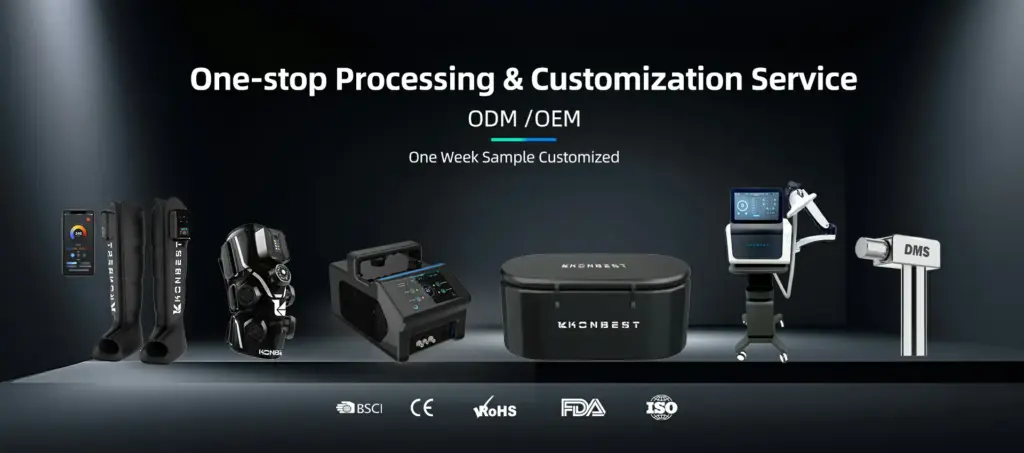
KONBEST has more than 17 years of experience in sports recovery product research, development, and manufacturing. Its products are sold in more than 100 countries, with experience serving more than 300 customized brands.
The company operates a 12,000-square-meter manufacturing facility with 5 production lines, advanced R&D resources, quality inspection teams, and a high-end product showroom.
KONBEST provides a broad sports recovery equipment portfolio, including:
- Compression recovery boots
- Cold therapy equipment
- Hot and cold contrast therapy systems
- Ice bath solutions
- Massage guns
- Home massage devices
- PEMF recovery equipment
This wider product range can help distributors and wholesalers build a complete recovery equipment catalog instead of depending on one product category.
KONBEST supports private label logo, color, package, and accessory customization. The company also supports factory inspection and offers 2-day sampling and 7-day shipping support for suitable projects.
Its stated certifications and qualifications include CE, ISO, RoHS, and BSCI, depending on the applicable product and market requirements.
Why a One-Stop Recovery Supplier Can Be Useful
A distributor may start with compression boots and later receive requests for other recovery products.
If the manufacturer can provide several related categories, the buyer can expand its product range without building a completely new supplier network for every product.
For example, a distributor can start with 6-chamber compression boots for sports facilities and later add cold therapy equipment, ice bath products, or massage devices.
This approach allows the product catalog to grow around the same customer base.
Planning the Move From Trial Orders to Bulk Supply
Medium and large B2B orders should be planned before production begins.
Buyers should clearly confirm:
- Model and chamber configuration
- Quantity
- Logo placement
- Color requirements
- Packaging design
- Accessories
- Sample approval
- Quality inspection
- Production schedule
- Shipping requirements
It is also useful to tell the manufacturer about expected future purchasing volume. If the supplier understands that a project may grow from samples to regular bulk orders, it can better prepare for repeat production.
For distributors, wholesalers, and resellers, this can create a more stable purchasing process and reduce the need to change suppliers as the business grows.
Conclusion
The biggest mistake when buying compression boots is treating the purchase as a simple price comparison.
B2B buyers need to look at the complete picture: chamber design, pressure control, market fit, product quality, private label options, factory capacity, accessories, sampling, and long-term supply.
A suitable Compression Recovery Boots Supplier should be able to support both the product and the purchasing process.
For global distributors, wholesalers, resellers, and private label brands, KONBEST combines compression boot options with a wider sports recovery equipment portfolio and OEM/ODM support. Its manufacturing experience, customization capability, production resources, and international market experience provide a practical foundation for medium and large-volume purchasing projects.
Q&A
Q1: What should buyers check first when choosing compression boots?
Start with the target market and intended use. Then compare chamber configuration, pressure control, functions, quality, customization, and factory capacity.
Q2: What is the difference between 4-chamber, 6-chamber, and 8-chamber compression boots?
They use different chamber configurations and can be positioned for different customer groups. Buyers should select the configuration according to the application rather than simply choosing the highest chamber number.
Q3: Can distributors buy several compression boot models?
Yes. A distributor can select different product levels for different markets, such as entry-level, mid-range, and professional applications.
Q4: Does KONBEST support private label compression boots?
Yes. KONBEST supports private label logo, color, packaging, and accessory customization for suitable OEM and ODM projects.
Q5: Can buyers request samples before a bulk order?
Yes. KONBEST supports 2-day sampling for suitable projects, allowing buyers to evaluate the product before confirming larger production quantities.
Q6: Is KONBEST suitable for medium and large B2B orders?
KONBEST has a 12,000-square-meter factory, 5 production lines, professional R&D and quality inspection teams, and experience with international customers and customized brands.
Q7: Can buyers arrange a factory inspection?
Yes. KONBEST supports factory inspection for qualified B2B buyers who want to review the manufacturing and quality control process before cooperation.