

The Biggest Mistakes New Recovery Brands Make
Starting a recovery brand can look easy from the outside. Pick a product, add a logo, place an order, and start selling. But for a new brand, the real challenge is building a product line that can stay consistent as orders grow.
Many new recovery brands make the same mistakes. They choose a supplier only because of price, skip product testing, use unclear specifications, or do not check whether the factory can handle larger orders later. These problems may be small at first, but they can become serious when the brand starts working with distributors, wholesalers, gyms, clinics, and sports teams.
For B2B buyers, choosing the right compression boots manufacturer is therefore not only about buying a recovery product. It is about choosing a manufacturing partner that can support product quality, private label development, customization, delivery, and repeat orders.
- 1. Choosing a Supplier Only by Price
- 2. Skipping the Sample Stage
- 3. Using Unclear Product Specifications
- 4. Thinking OEM Means Only Adding a Logo
- 5. Ignoring Factory Production Capacity
- 6. Not Checking Quality Control
- 7. Forgetting About Future Orders
- 8. Using Too Many Suppliers
- 9. Choosing Products Without a Clear Application
- 10. B2B Supplier Checklist
- Why KONBEST Can Support New Recovery Brands
- A Better Way to Launch a Recovery Brand
- Q&A
1. Choosing a Supplier Only by Price
Price is important when buying recovery equipment in bulk. However, the lowest quotation should not be the only reason to choose a supplier.
A low-price product may have fewer configuration options, limited customization, weaker inspection, or less support for future production. The difference may not be visible when you first compare two product photos.
For distributors and wholesalers, the better question is not simply, “Which factory is cheapest?” A better question is, “Which supplier gives us the right product, stable quality, suitable service, and a clear path for future orders?”
When comparing a compression recovery boots supplier, buyers should review:
- Product configuration
- Compression chamber design
- Pressure control
- Controller functions
- Material quality
- Accessories
- Packaging
- Customization options
- Quality inspection
- Production capacity
- Lead time and shipping support
A supplier with a complete manufacturing system can be a better choice for a brand that plans to move from test orders to regular wholesale purchasing.
2. Skipping the Sample Stage
One of the biggest mistakes a new recovery brand can make is placing a large order before testing the actual product.
Product photos are useful, but they cannot show everything. A real sample lets the buyer check how the boots fit, how the controller works, how the compression programs feel, and whether the accessories and package meet the brand's requirements.
Before a bulk order, buyers should check:
- Controller operation
- Compression programs
- Pressure adjustment
- Air chamber structure
- Sleeve size and fit
- Material and stitching
- Tube and connector quality
- Power supply
- Accessories
- Retail packaging
KONBEST supports 2-day sampling for suitable projects. This gives distributors, wholesalers, and private label brands a chance to review the product before moving into larger production.
3. Using Unclear Product Specifications
“We need compression boots” is not a complete purchasing requirement.
Different compression boots can have different chamber numbers, pressure settings, operating programs, controller designs, materials, sizes, and accessories. If a buyer does not define these points, different factories may quote different products.
A better purchasing brief should include the main technical and commercial requirements.
For example, buyers can define:
- 4-chamber, 6-chamber, or 8-chamber configuration
- Required compression modes
- Pressure adjustment range
- Controller functions
- Available sleeve sizes
- Material requirements
- Power requirements
- Logo placement
- Product color
- Packaging design
- Required accessories
Clear specifications make supplier comparison easier and reduce the risk of receiving a product that does not match the original business plan.
4. Thinking OEM Means Only Adding a Logo
Many new brands think OEM means taking a standard product and printing a logo on it. For a serious recovery brand, the process can be much broader.
OEM compression boots can include private label logo printing, color customization, packaging design, accessories, labels, and other product details.
KONBEST states that its OEM/ODM service can cover:
- Private label logo
- Custom product colors
- Branded packaging
- Packaging design support
- Accessories customization
- UI interface adjustments for suitable models
The best time to confirm these details is before mass production. A sample should be used as the reference for the final design and configuration.
This is especially useful for resellers and distributors that want a consistent product identity across different order batches.
5. Ignoring Factory Production Capacity
A supplier may complete a small order without any problem. The real question is what happens when your order becomes much larger.
A new recovery brand may begin with 50 or 100 sets. After testing the market, the next order may be several hundred sets or more. If the factory does not have enough production resources, delivery and product consistency may become difficult.
Before starting a long-term project, buyers should ask:
- How large is the manufacturing facility?
- How many production lines are available?
- Does the factory have its own R&D team?
- Does it have dedicated quality inspection staff?
- Can production be increased for larger orders?
- Can the same model be produced again?
KONBEST has a 12,000-square-meter factory and 5 production lines, supported by professional R&D and quality inspection teams.
For medium and large B2B buyers, factory capacity should be checked before the first major purchase, not after demand has already increased.
6. Not Checking Quality Control
Quality control should be part of production from the beginning.
New brands should ask how the factory checks raw materials, assembly, finished products, functions, and packaging. A professional supplier should be able to explain its inspection process clearly.
For international purchasing, buyers should also check which certifications are required in the destination market. KONBEST states that applicable products can be supported with certifications and qualifications such as CE, ISO, RoHS, and BSCI.
For larger B2B projects, factory inspection can also help buyers understand the real production environment before cooperation.
7. Forgetting About Future Orders
The first order is only one part of a recovery brand's supply chain.
Imagine a distributor orders 100 sets and the product performs well in its market. The next order may be 300, 500, or more sets. At this point, the supplier needs to reproduce the same product configuration, branding, packaging, and quality.
That is why buyers should ask about future supply before placing the first bulk order.
Important questions include:
- Can the same model be reordered?
- Can the same colors and packaging be reproduced?
- Can the factory support higher quantities?
- Can production be scheduled in advance?
- Can replacement parts be supplied?
- Can technical support be provided to distributors?
A supplier that can support both the first order and future orders gives a growing brand a more stable foundation.
8. Using Too Many Suppliers
Working with many suppliers can create more communication and quality control work.
For example, one supplier may provide compression boots, another may provide cold therapy equipment, and another may provide massage products. Each supplier has its own packaging, quality process, delivery schedule, and communication style.
For distributors and wholesalers, a wider product portfolio from one manufacturing partner can make sourcing easier.
KONBEST offers a broader sports recovery equipment range. Depending on the project, buyers can source compression recovery boots together with other recovery products and build a more complete product portfolio.
This can be useful for B2B buyers that want to expand their recovery catalog without creating a complex supplier network.
9. Choosing Products Without a Clear Application
Not every compression boot model is intended for the same commercial application. New brands should first understand who will use the product.
Sports Recovery Centers
Recovery centers may use compression boots as part of a wider recovery program. Frequent use makes product durability, simple operation, user comfort, and consistent compression important factors.
Professional Sports Teams
Professional teams may combine compression recovery with cold therapy, massage equipment, and other recovery tools. A manufacturer with multiple product categories can support a more complete equipment plan.
Rehabilitation and Physiotherapy Facilities
These facilities may require products designed for regular professional use. Buyers should focus on the actual configuration, control functions, quality process, documentation, and market requirements instead of selecting only by appearance.
Gyms and Fitness Centers
Fitness businesses can use compression equipment as part of post-training recovery services. Product size, ease of operation, comfort, and price positioning should match the facility's target users.
Distributors and Wholesalers
Distributors and wholesalers need products that are easy to reorder and support at scale. Consistent specifications, packaging, spare parts, documentation, and factory communication are important for long-term purchasing.
10. B2B Supplier Checklist
Before choosing a supplier, buyers can use this simple checklist:
| Area | What to Check |
|---|---|
| Industry Experience | Years of sports recovery R&D and manufacturing experience |
| Factory | Factory size, production lines, equipment, and production resources |
| Product | Chambers, pressure, programs, materials, sizes, and accessories |
| Quality | Raw material control, production inspection, and final testing |
| OEM | Logo, color, packaging, UI, and accessory customization |
| Sample | Whether the product can be tested before bulk production |
| Delivery | Lead time and production scheduling for larger orders |
| Certification | Documents required for the buyer's target market |
| Factory Inspection | Whether buyers can inspect the manufacturing site |
| After-Sales | Warranty, technical support, and replacement parts |
Why KONBEST Can Support New Recovery Brands
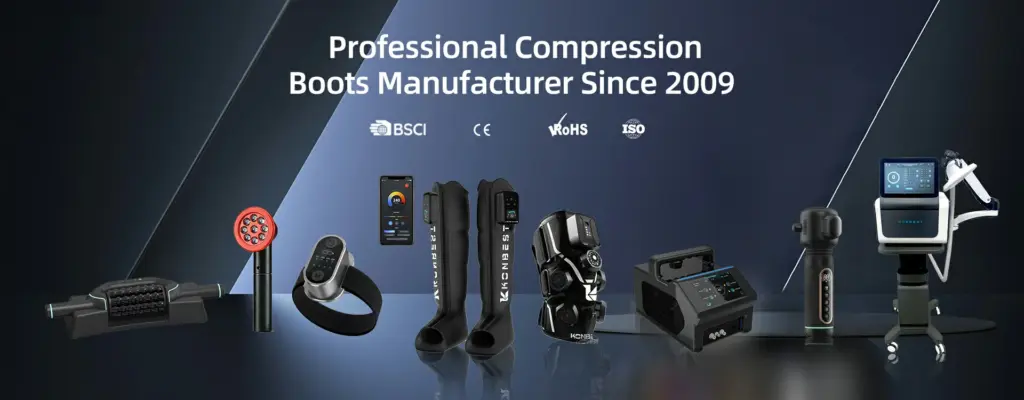
KONBEST has 17 years of sports recovery product R&D and manufacturing experience. Its products are supplied to more than 100 countries, and the company has experience with more than 300 customized brands.
Its manufacturing base covers 12,000 square meters and includes 5 production lines. The company also has a high-end product showroom and professional R&D and quality inspection teams.
For suitable B2B projects, KONBEST supports:
- OEM and ODM manufacturing
- Private label logo customization
- Custom product colors
- Branded packaging
- Accessory customization
- 2-day sampling for suitable projects
- 7-day shipping support for suitable orders
- Factory inspection
- One-stop sports recovery equipment sourcing
The compression recovery boots range also covers different market positions. The current product range includes 4-chamber portable models, 6-chamber performance models, and 8-chamber professional models. This gives B2B buyers more flexibility when building a product line for different customer groups.
The manufacturer also lists optional accessories such as arm and shoulder cuffs, hip accessories, waist cuffs, cold pads, vests, backpacks, and carrying bags. The exact accessory configuration should be confirmed for each model and order.
Build the Product Line Around Your Target Market
A new recovery brand should not try to sell every product to every customer.
A better strategy is to start with a clear market position.
- Fitness market: focus on portable and easy-to-use models.
- Sports market: consider performance-focused configurations.
- Professional recovery: consider higher-end models with more advanced control options.
- Distributor market: build a product range with several price and performance levels.
- Private label market: focus on consistent branding, packaging, accessories, and repeat supply.
This approach can help buyers avoid purchasing a large quantity of one model before they understand what their market actually needs.
A Better Way to Launch a Recovery Brand
A simple purchasing process can prevent many common mistakes.
- Define your target customers.
- Choose the main product application.
- Write down the required product specifications.
- Compare suitable manufacturers.
- Request samples.
- Test the samples in real use.
- Confirm logo, color, packaging, and accessories.
- Check factory production and quality systems.
- Confirm certificates and documents for the target market.
- Place the first commercial order.
- Review the first batch before increasing order volume.
This process works for new brands, distributors, wholesalers, and resellers that want to enter the recovery equipment market with a clearer supply plan.
Do Not Build a Recovery Brand Around Price Alone
The cheapest product may look attractive when a brand is just starting. But a recovery brand needs more than a low unit price.
It needs a product that can be tested, customized, reproduced, inspected, shipped, and supported after the sale.
For distributors, stable supply may be the main concern. For wholesalers, batch consistency may matter most. For resellers, private label customization can be a key requirement. For a growing brand, all of these factors may matter at the same time.
That is why the manufacturer should be evaluated as part of the business plan.
Conclusion
The biggest mistakes new recovery brands make are often caused by making purchasing decisions too quickly.
Choosing only by price, skipping samples, using unclear specifications, treating OEM as simple logo printing, ignoring factory capacity, and failing to plan future orders can all create unnecessary supply problems.
A stronger approach is simple: define the product, test the sample, check the factory, confirm customization, review quality control, and plan for future volume before committing to a long-term supply relationship.
With 17 years of sports recovery manufacturing experience, a 12,000-square-meter factory, 5 production lines, experience in more than 100 countries, and more than 300 customized brand projects, KONBEST provides a practical option for B2B buyers looking for a reliable manufacturing partner.
For distributors, wholesalers, and resellers planning medium or large-volume purchasing, the right factory can help turn a single product order into a more stable recovery product line.
Q&A
Q1: What is the biggest mistake a new recovery brand can make?
Choosing a supplier only because of the lowest price is one of the most common mistakes. Buyers should also compare product quality, specifications, customization, production capacity, delivery, and future support.
Q2: Should I order samples before a wholesale order?
Yes. A sample allows buyers to test the real product and confirm its functions, fit, materials, accessories, packaging, and customization before mass production.
Q3: Can KONBEST make private label compression boots?
Yes. For suitable projects, KONBEST supports private label logo, color, packaging, and accessory customization.
Q4: Does KONBEST support distributors and wholesalers?
Yes. KONBEST works with B2B buyers and supports medium and large-volume purchasing projects. Quantity, model, customization, and production schedules can be discussed before an order.
Q5: How fast can KONBEST provide samples?
KONBEST supports 2-day sampling for suitable projects. The actual time depends on the selected model and customization requirements.
Q6: Can buyers inspect the KONBEST factory?
Yes. KONBEST supports factory inspection for qualified B2B buyers who want to review the manufacturing site before cooperation.
Q7: Can KONBEST supply more than compression boots?
Yes. KONBEST provides a wider range of sports recovery equipment, allowing suitable distributors and wholesalers to build a broader recovery product portfolio through one manufacturing partner.