


How to Align Compression Boots Product Design With Your Brand Positioning
Not every customer wants the same compression boots. Some buyers look for affordable recovery products for daily fitness use. Others need advanced equipment for sports teams, gyms, and rehabilitation facilities. If your product design does not match your target market, even a well-made product may be difficult to sell.
For sports recovery brands, product design should start with brand positioning. You need to decide who will buy your products, what features they expect, and how your products should stand out from other brands.
Working with an experienced compression boots manufacturer makes this process easier. You can select different chamber structures, pressure settings, control systems, colors, logos, and accessories to build a product range that matches your business goals.
For distributors, wholesalers, importers, and resellers, the right product strategy can also make inventory planning and repeat purchasing more efficient.
This guide explains how to connect compression boots design with brand positioning, choose the right product configurations, and develop a private label product line for the sports recovery market.
Table of Contents
- 1. Start With Your Brand Positioning
- 2. Identify Your Main Customer Groups
- 3. Match Compression Boots Structure With Product Positioning
- 4. Select Technical Features That Support Your Brand
- 5. Create a Recognizable Product Appearance
- 6. Use Accessories to Build a Complete Recovery Product Range
- 7. Build a Product Line for Different Market Levels
- 8. How to Develop Private Label Compression Boots
- 9. What Wholesale Buyers Should Consider
- 10. Why Choose KONBEST as Your Manufacturing Partner?
- 11. Frequently Asked Questions
1. Start With Your Brand Positioning
Before choosing a compression boots model, think about how you want customers to see your brand.
A brand that focuses on home fitness products has different needs from a brand serving professional sports teams. The first may care more about easy operation, portability, and product appearance. The second may pay more attention to pressure adjustment, chamber structure, durability, and regular-use performance.
There are three common market positions for compression recovery boots.
Entry-Level Recovery Products
This market focuses on general fitness users, home recovery, and online retail customers.
Products should be easy to operate, comfortable to wear, and simple to explain. A compact four-chamber model with basic massage modes and convenient controls can be a good starting point.
Professional Sports Recovery Products
This market includes gyms, sports clubs, fitness centers, and sports equipment distributors.
Buyers may expect more compression sections, adjustable pressure, multiple operating modes, and a strong product structure.
Six-chamber models can be considered for this market because they provide more compression sections than basic four-chamber products.
Premium Recovery Equipment
Premium brands often want more product functions, advanced controls, and a wider range of accessories.
Eight-chamber compression boots and additional wearable cuffs can help create a more complete product offering for specialized sports recovery facilities and professional equipment channels.
The important point is simple: your product should match the customer group you want to serve. Adding more functions without a clear market reason may only increase product cost.
2. Identify Your Main Customer Groups
A good product design begins with real customer needs. Before discussing customization with a compression boots manufacturer, define where your products will be sold and who will use them.
| Target Market | Main Product Needs | Suggested Direction |
|---|---|---|
| Fitness retailers | Easy operation, attractive appearance, practical functions | Four-chamber series |
| Sports equipment distributors | Different models and reliable product specifications | Four- and six-chamber series |
| Gyms and sports clubs | Adjustable pressure and multiple operating modes | Six-chamber series |
| Rehabilitation equipment suppliers | Product documentation, suitable configurations, support | Six- and eight-chamber series |
| Premium recovery brands | Advanced features and a complete product range | Eight-chamber series and optional accessories |
For example, a European distributor may supply both fitness retailers and professional recovery centers. Selling only one compression boots model may limit the customers it can serve.
A better solution is to create different product levels under the same brand. This allows the distributor to offer suitable choices without changing its overall brand identity.
3. Match Compression Boots Structure With Product Positioning
The chamber structure is one of the most important product design decisions. It affects the compression layout, product positioning, and the type of customers you want to reach.
Four-Chamber Design: Practical and Easy to Position
Four-chamber compression boots are suitable for brands that want to enter the recovery equipment market with a practical product range.
For example, KONBEST offers several four-chamber models, including the 9490, 9490Pro, 9490Max, and 9490C.
The 9490Pro features five massage modes, an adjustable pressure range of 30–240 mmHg, a 12 L/min air output, and a 3200mAh rechargeable battery.
These specifications make it an option for brands targeting portable recovery equipment and general fitness markets.
Six-Chamber Design: A Balanced Professional Product
Six-chamber compression boots offer more compression sections and can support a stronger professional product position.
The KONBEST 9690K-B is one example. Its main specifications include:
- Six air chambers.
- Pressure adjustment from 30–260 mmHg.
- Six massage modes.
- 5200mAh rechargeable battery.
- 15 L/min air output.
- 10–90 minute session settings.
- Operating noise below 45 dB.
- Two-year warranty.
For distributors supplying gyms, sports clubs, and professional recovery equipment retailers, this configuration offers a useful combination of multiple compression sections and adjustable settings.
Eight-Chamber Design: A More Advanced Product Position
For brands targeting premium recovery equipment markets, eight-chamber compression boots can provide a more detailed compression layout.
The KONBEST 9890K-B features eight chambers, six massage modes, a pressure range of 30–260 mmHg, a 5200mAh battery, and a 15 L/min air output.
It also supports session settings from 10 to 90 minutes and uses an LCD touch screen for operation.
This type of product can be considered for specialized sports recovery retailers, advanced fitness facilities, and premium equipment distributors.
However, more chambers do not automatically mean better performance for every user. Product comfort, pressure control, materials, reliability, and ease of use should also be evaluated.
4. Select Technical Features That Support Your Brand
After choosing the product structure, the next step is selecting the right technical configuration.
A professional compression boots manufacturer should help buyers understand which specifications matter for each market.
Pressure Range
Pressure range is an important specification when comparing different compression boots. Models with different pressure ranges can support different product positions.
For example, the KONBEST 9490Pro offers 30–240 mmHg, while the 9690K-B and 9890K-B offer 30–260 mmHg.
For your brand, it is important to explain pressure adjustment clearly and provide accurate product specifications. Do not use a higher maximum pressure as the only reason to promote a product.
Massage Modes
Different operating modes provide more choices for users. A product with several modes may be easier to position as a flexible recovery device.
When developing your product range, compare the actual compression sequences and functions instead of only counting the number of modes.
Battery and Wireless Operation
Wireless products can be useful for customers who need more freedom of movement around their recovery space.
For example, a portable product with a rechargeable battery may suit home fitness users, personal trainers, and mobile sports recovery services.
For commercial customers, battery capacity, charging time, working time, and replacement options should all be checked before purchase.
Noise and Product Materials
Noise level can affect the user experience in gyms, recovery rooms, and rehabilitation facilities.
Material quality also matters because compression boots are worn directly on the legs and may be used repeatedly. Buyers should check fabric strength, cleaning requirements, zipper quality, stitching, and overall comfort.
5. Create a Recognizable Product Appearance
Technical specifications help explain what a product can do. Product appearance helps customers recognize your brand.
For private label compression boots, the visual design should be consistent with your brand identity.
Choose the Right Color Combination
Different colors can create different product impressions.
- Black and gray can support a professional sports equipment style.
- Dark blue can create a clean and technical appearance.
- Custom color combinations can help a brand create a more recognizable product line.
For large orders, it is important to approve the final color sample before mass production. This helps keep product appearance consistent between batches.
Place Your Logo in the Right Areas
Your brand logo can be placed on suitable areas of the compression boots, controller, storage bag, and packaging.
For distributors and wholesalers, consistent logo placement across different models makes it easier to build a unified product catalogue.
Design Packaging for Your Sales Channel
Retail packaging and bulk shipping packaging have different purposes.
Retail brands may need attractive product boxes and branded manuals. Wholesale buyers may focus more on carton strength, product protection, clear labels, and efficient warehouse handling.
When developing your private label project, confirm packaging size, printing details, shipping carton specifications, and included accessories before production.
6. Use Accessories to Build a Complete Recovery Product Range
One way to make your brand different is to offer more than standard leg compression boots.
Some customers may need additional compression areas or accessories for different applications. A wider accessory range can help distributors serve more types of professional customers.
KONBEST provides optional accessories and configurations that include:
- Arm and shoulder cuffs.
- Chest cuffs.
- Hip cuffs.
- Waist cuffs.
- Overlapping pants.
- Cold pads.
- Vest cuffs.
- Storage and carrying bags.
For example, a distributor supplying professional sports facilities may be interested in leg boots together with arm or hip accessories. A recovery equipment wholesaler may prefer to offer standard leg boots first and add optional accessories for customers who need a wider product selection.
This creates a more flexible product catalogue without requiring every customer to purchase the same configuration.
Before ordering, confirm compatibility, available models, additional costs, and packaging requirements for each accessory.
7. Build a Product Line for Different Market Levels
For medium and large-volume buyers, choosing one product is often not enough. A clear product line can make purchasing and inventory management easier.
One practical strategy is to divide your compression boots range into three levels.
Level 1: Standard Recovery Series
Choose a practical four-chamber model with clear functions and easy operation. This product can serve general fitness retailers, home recovery brands, and entry-level wholesale customers.
Level 2: Professional Recovery Series
Use a six-chamber model with multiple modes, adjustable pressure, and a suitable control system. This range can target sports equipment distributors, gyms, and professional fitness channels.
Level 3: Advanced Recovery Series
Offer an eight-chamber model and selected accessories for premium product positioning. This can serve specialized recovery equipment retailers and professional facilities.
For example, a wholesaler can start with three product levels under one brand instead of purchasing many similar models. This makes it easier to prepare product descriptions, train sales teams, and plan repeat orders.
The actual model mix should depend on sales data, target customer needs, minimum order quantities, and available inventory space.
8. How to Develop Private Label Compression Boots
Once your brand positioning and product configuration are clear, you can begin the customization process with your manufacturer.
| Step | Project Work | Expected Result |
|---|---|---|
| 1. Brand Planning | Define target customers and market level | Clear product direction |
| 2. Model Selection | Choose chamber structure and product configuration | Confirmed base model |
| 3. Design Customization | Discuss logo, colors, packaging, and accessories | Brand design plan |
| 4. Sample Development | Check product functions and customized appearance | Sample for evaluation |
| 5. Sample Approval | Confirm product specifications and packaging | Approved production standard |
| 6. Mass Production | Manufacture according to confirmed requirements | Bulk order completion |
| 7. Final Inspection | Check functions, appearance, and accessories | Shipment approval |
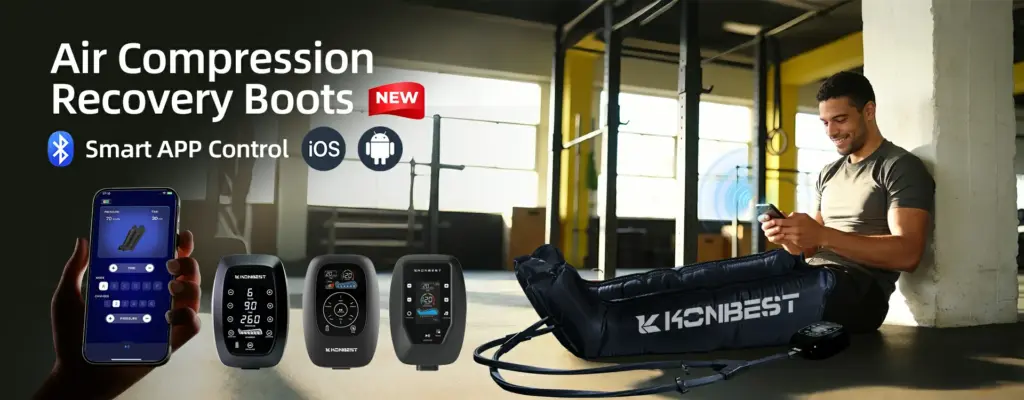
For a medium or large order, do not skip the sample approval stage. A signed specification sheet and approved sample can help reduce misunderstandings during production.
You should also confirm MOQ, production time, warranty, replacement parts, shipping arrangements, and after-sales support before placing the order.
9. What Wholesale Buyers Should Consider
Product design and purchasing decisions should work together. For distributors and wholesalers, a good product range must also fit the company's purchasing plan.
Check the MOQ and Wholesale Price
Different models and customization requirements may have different minimum order quantities. KONBEST lists MOQ starting from 10–50 sets depending on the model and customization requirements.
Ask for tiered quotations based on your expected order quantity. This helps you compare different product configurations and plan future orders.
Check Production and Delivery Schedules
Confirm sample timing, mass production lead time, packaging completion, and shipping arrangements. For repeat orders, discuss how the factory can maintain the same approved specifications.
Review Quality and Certification Documents
Ask for product inspection procedures, applicable CE and RoHS documentation, and other relevant compliance files. Always check that the documents match the exact model and intended market.
Plan After-Sales Support
For large wholesale orders, product support is important. Confirm warranty coverage, spare parts availability, technical assistance, and the process for handling quality issues.
A reliable manufacturer should be able to discuss these points clearly before the order is confirmed.
10. Why Choose KONBEST as Your Manufacturing Partner?
KONBEST is an EU-registered sports recovery brand with 17 years of experience in sports recovery product R&D and manufacturing.
Its products have reached more than 100 countries, and the company has completed over 300 brand customization projects, with more than 20,000 professional athlete endorsements.
For distributors, wholesalers, and sports recovery brands, KONBEST offers manufacturing resources and customization support for different market positions.
Manufacturing and R&D Capabilities
- 12,000 m² manufacturing facility.
- 5 production lines.
- Professional R&D and quality inspection teams.
- High-end product showroom.
- Advanced production and product testing equipment.
- International product compliance and certification support.
Flexible Brand Customization
KONBEST supports private label and OEM projects, including:
- Custom logos and brand labels.
- Customized product colors.
- Branded packaging and manuals.
- Accessory customization.
- Product configuration selection.
- OEM and ODM development support.
Support for Medium and Large Orders
For applicable projects, KONBEST provides two-day sampling support, seven-day shipping support, and factory inspection arrangements. Actual schedules depend on model availability, customization, order quantity, and shipping conditions.
The company also offers a wider sports recovery product range, including cold therapy systems, hot and cold contrast therapy equipment, red light therapy devices, and other recovery products.
This gives distributors and importers the option to build a wider recovery equipment catalogue with one manufacturing partner.
Visit the KONBEST Compression Recovery Boots Product Range to compare four-chamber, six-chamber, and eight-chamber models.
For buyers who want to expand into other recovery categories, the KONBEST Cold Therapy System page provides additional product options.
11. Frequently Asked Questions
Q1: How should I choose compression boots for my brand positioning?
Start with your target customers and sales channels. Four-chamber models can suit general fitness and home recovery markets. Six-chamber models can serve professional sports and fitness channels. Eight-chamber models can support advanced recovery equipment ranges.
Q2: Can I customize compression boots with my own brand logo?
Yes. KONBEST supports private label logo customization, product colors, packaging, and accessories. Available options depend on the selected model and order requirements.
Q3: What technical features should I consider when developing a compression boots product?
Important features include chamber structure, pressure range, massage modes, air output, battery capacity, control system, operating noise, materials, and warranty. Choose features based on your target customers rather than simply selecting the model with the most functions.
Q4: Can I create different product levels under one brand?
Yes. You can combine four-chamber, six-chamber, and eight-chamber models to create entry-level, professional, and advanced product ranges. This can help your brand serve different customer groups.
Q5: What is the MOQ for private label compression boots?
KONBEST lists MOQ starting from 10–50 sets depending on the selected model and customization requirements. Contact the sales team to confirm the MOQ for your project.
Q6: Does KONBEST support large wholesale orders?
Yes. KONBEST has a 12,000 m² manufacturing facility, five production lines, and dedicated R&D and quality inspection teams. It supports bulk purchasing, OEM, ODM, and private label projects.
Q7: How long does sample development take?
KONBEST provides two-day sampling support for applicable projects. The actual schedule depends on the selected model, logo requirements, color customization, and sample availability.
Q8: Can I order compression boots together with other sports recovery products?
Yes. KONBEST also supplies cold therapy systems, hot and cold therapy equipment, red light therapy devices, and other recovery products. Buyers can discuss different product categories when planning a complete wholesale order.
Q9: Can I inspect the factory before placing a bulk order?
Yes. Factory inspection support is available. Buyers can review manufacturing facilities, production processes, and quality inspection procedures before confirming a purchasing project.
Give Your Sports Recovery Brand the Right Product Design.
Choose the right compression structure, technical configuration, appearance, and accessories for your target market. Work with KONBEST to develop a consistent product range and build a reliable supply plan for your next wholesale or private label project.
Contact KONBEST today to discuss your product design and bulk purchasing requirements.