


What Makes a Compression Boots Product Commercially Competitive?
For a B2B buyer, a compression boots product needs to do more than look good in a product catalog. A distributor wants something that customers can understand. A wholesaler wants stable quality and repeat supply. A reseller wants a product that is easy to promote. A private-label brand also needs room for its own logo, packaging, and product design.
That is what makes a product commercially competitive.
For companies planning compression boots wholesale orders, the right product should balance performance, price positioning, user experience, customization, and factory support. A lower factory price alone does not solve these problems.
So before placing a medium or large order, it is worth looking at the product from a business point of view.
- What Does Commercially Competitive Really Mean?
- A Product Range Is More Useful Than One Model
- Turn Technical Specifications Into Selling Points
- When a 4-Chamber Model Makes Sense
- Why 6-Chamber Boots Fit Professional Markets
- Where 8-Chamber Boots Add More Value
- Product Design Should Match Real Working Conditions
- Customization Can Change the Product Position
- What Large B2B Buyers Should Check Before Ordering
- KONBEST as a Long-Term Manufacturing Partner
- Q&A
What Does Commercially Competitive Really Mean?
In a consumer purchase, the buyer may compare price, appearance, and a few functions. B2B purchasing is different. A distributor may need to sell the same product to many customers, while a wholesaler may need to keep stock for months.
This creates a longer list of questions:
- Is the product specification strong enough for the target market?
- Can the factory provide different product levels?
- Can the product be customized for a local brand?
- Is the product practical for repeated commercial use?
- Can the supplier handle repeat orders?
- Are MOQ and lead times suitable for the business plan?
- Can the supplier support warranty and after-sales needs?
A commercially competitive compression boot should perform well across these points. This is why experienced buyers normally compare the whole supply package instead of looking only at the unit quotation.
A Product Range Is More Useful Than One Model
One of the strongest points of the KONBEST range is that buyers do not have to build a business around one compression boot.
The current product range includes 4-chamber, 6-chamber, and 8-chamber compression boots. Each level has a different position in the market. The 4-chamber series is aimed at more portable and accessible applications. The 6-chamber series moves toward performance use. The 8-chamber series is positioned for professional sports, physiotherapy, and rehabilitation settings.
For a compression boots supplier, this creates a simple sales structure.
A distributor can offer a more accessible model to a fitness center, a higher-level model to a sports recovery business, and a professional model to a rehabilitation customer. The distributor does not need to change suppliers every time the customer's requirements change.
This also helps a wholesaler build a clearer product catalog. Instead of having several products that look almost the same, each model can have a specific place in the sales range.
Turn Technical Specifications Into Selling Points
Technical data matters, but simply putting numbers on a product page is not enough. A B2B buyer needs to know what those numbers mean for the final customer.
Take pressure range as an example. The 9490 standard model listed by KONBEST provides a 50–200 mmHg pressure range, three modes, a 10 L/min air pump, and 10/20/30-minute timer settings. It also supports remote and app control.
For a buyer looking for a more advanced product, the 9690K-E provides six chambers, six massage modes, a 30–260 mmHg pressure range, a 15 L/min air outlet, a 5200 mAh battery, and 10–90-minute time settings. Its product page also lists a colored LCD display and a noise level below 45 dB.
These differences give sales teams something useful to explain. The buyer can select a product based on the application instead of simply choosing the model with the highest number.
When a 4-Chamber Model Makes Sense
Four-chamber compression boots can be a practical choice when portability, simple operation, and a clear price position are important.
This makes them suitable for gyms, fitness studios, wellness businesses, general recovery stores, and resellers that want an easier product for a wider customer group.
The 9490 family includes several versions, including standard, portable, professional, and wireless options. This gives a distributor room to select a model without moving immediately into the highest product level.
For a reseller, that can make the product easier to introduce. For a wholesaler, it can also provide an entry-level item for a broader product catalog.
Why 6-Chamber Boots Fit Professional Markets
Six-chamber products sit in an important middle position. They can provide more chamber coverage and a wider set of functions while remaining suitable for many commercial environments.
The KONBEST 9690 family includes several versions. The 9690K-E, for example, uses six chambers, six modes, a 30–260 mmHg pressure range, and a 15 L/min air outlet. The rechargeable design uses a 5200 mAh battery, while the listed working time is 2–5 hours depending on use.
This type of specification can work well for sports teams, training facilities, recovery centers, and rehabilitation businesses that need a more professional product than a basic four-chamber unit.
For distributors, the advantage is clear: a six-chamber product can fill the middle of the catalog and give customers a reason to move up from an entry model.
Where 8-Chamber Boots Add More Value
Some buyers need a stronger product position for professional facilities. This is where an eight-chamber system can become useful.
The KONBEST 9890 series is positioned as a professional range for sports, physiotherapy, and rehabilitation applications. The product family includes several versions, giving buyers different configuration choices within the same series.
For these customers, product selection may involve more than chamber count. They may also look at control functions, pressure adjustment, construction, accessories, warranty, and the manufacturer's ability to support repeat orders.
This is important for a compression boots manufacturer. A professional product needs a supply system behind it. If a distributor wins a large account but cannot get consistent replacement units or after-sales support, the product itself is no longer enough.
Product Design Should Match Real Working Conditions
A commercially useful product should fit the place where it will be used.
Fitness Centers
A gym may have many different users during the day. Easy operation and portable equipment can therefore be important. A 4-chamber model can be a suitable starting point when the gym wants to add compression recovery without building a complex equipment system.
Sports Teams
A sports team may need equipment that can be used as part of a regular recovery routine. Six- or eight-chamber products can be considered when the buyer wants more advanced product positioning and more adjustment options.
Physiotherapy and Rehabilitation Centers
Professional facilities may pay closer attention to specifications, control functions, product documents, warranty, and supplier support. A higher-level model can make more sense when the equipment is intended for frequent professional use.
Distributors and Resellers
Distributors have a different problem: they need to sell the product to someone else. Clear product differences are therefore very important. A range with several chamber options gives the sales team an easier way to match products with customer requirements.
Customization Can Change the Product Position
A standard product may be enough for a first test order. However, established distributors and brands often want something that looks like part of their own product line.
This is where private label compression boots become valuable.
KONBEST supports OEM and ODM services, including logo printing, color customization, branded packaging, UI interface adjustments, and accessories. The website also lists optional accessories such as hip cuffs, waist cuffs, cold pads, vests, overlapping pants, backpacks, and carry bags.
This gives a buyer more options when building a product for a specific market. For example, a sports recovery brand may want a different color and package from a physiotherapy equipment distributor. The core product can remain within the same manufacturing system while the market presentation changes.
For B2B buyers, this can be much more useful than buying a completely standard product with no room for brand development.
What Large B2B Buyers Should Check Before Ordering
Once the product looks suitable, the next step is to examine the purchasing side.
For medium and large orders, buyers should check at least the following points:
- MOQ: The current KONBEST page lists MOQ starting from 10–50 sets depending on model and customization.
- Lead time: The page lists a standard bulk lead time of around 7–15 days, depending on order quantity.
- Warranty: Warranty terms vary by model, so they should be confirmed before ordering.
- Customization: Confirm logo, colors, packaging, UI, and accessory options before production.
- Documents: Check the exact certificates and documents required for the destination market and selected model.
- Quality control: Ask how products are tested before shipment and whether factory inspection is available.
- After-sales: Confirm spare parts, technical support, warranty handling, and replacement procedures.
These points may seem less exciting than product specifications, but they become very important once an order reaches dozens or hundreds of units.
KONBEST as a Long-Term Manufacturing Partner
KONBEST has more than 17 years of sports recovery product R&D and manufacturing experience. The company supplies customers in more than 100 countries and has completed more than 300 brand customization projects.
Its manufacturing setup includes a 12,000 m² facility, five production lines, R&D and quality control teams, and a product showroom. The company also supports factory inspections for B2B buyers.
For new buyers, KONBEST states that two-day sampling is available for applicable projects. It also supports seven-day shipping for applicable orders. Actual timing should be confirmed according to the model, quantity, customization, and destination.
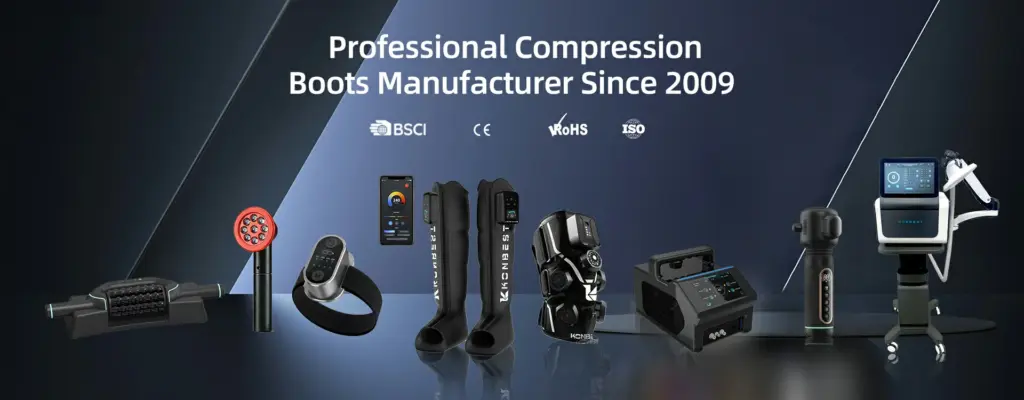
The company can also provide a wider sports recovery product range, including cold therapy equipment, hot and cold contrast therapy systems, ice bath products, red light therapy equipment, massage guns, and other recovery devices.
This matters when a distributor wants to grow from one product into a wider recovery equipment category. Instead of managing many unrelated factories, the buyer can discuss several product lines with one manufacturing partner.
For companies planning wholesale compression therapy boots, the most important question is not simply which product has the highest specification. The better question is whether the product, manufacturer, and supply system can support the market you want to build.
View the KONBEST compression recovery boots range to compare 4-chamber, 6-chamber, and 8-chamber models, then contact the factory for product specifications, samples, OEM, ODM, or bulk purchasing requirements.
Q&A
What makes compression boots commercially competitive?
A competitive B2B compression boots product should combine useful specifications, clear market positioning, stable quality, customization options, suitable purchasing terms, and reliable factory support.
What is the pressure range of KONBEST compression boots?
The range depends on the model. For example, the 9490 standard model is listed at 50–200 mmHg, while the 9690K-E is listed at 30–260 mmHg. Buyers should check the exact specification of the model they plan to purchase.
Which compression boots are suitable for wholesale buyers?
KONBEST offers 4-chamber, 6-chamber, and 8-chamber product families. This allows distributors and wholesalers to build different product levels for fitness, sports, recovery, physiotherapy, and rehabilitation markets.
Can I order private label compression boots?
Yes. KONBEST supports OEM and ODM services including logo, color, packaging, UI, and selected accessory customization. MOQ and customization conditions depend on the model and project.
What is the MOQ for KONBEST compression boots?
The current product page lists MOQ starting from 10–50 sets depending on the model and customization requirements. Trial orders may also be available for new distributors.
Does KONBEST support factory inspection?
Yes. Factory inspection support is available for B2B buyers who want to review the manufacturing environment and production capability before a larger order.
Can KONBEST supply other sports recovery products?
Yes. The product range also includes cold therapy, hot and cold contrast therapy, ice bath equipment, red light therapy, massage guns, and other recovery products. This can help distributors build a broader recovery equipment portfolio.