


Top Compression Boots Manufacturers for Wholesale and OEM
Looking for a reliable compression boots manufacturer for wholesale or OEM supply? For distributors, wholesalers, and resellers, the right manufacturer should offer more than a competitive factory price. You need clear product specifications, stable production, private label support, quality control, and reliable delivery for repeat orders.
KONBEST is a sports recovery equipment manufacturer with 17 years of R&D and manufacturing experience. Its products are supplied to more than 100 countries, and the company has completed customization projects for more than 300 brands. Its compression recovery boots include different chamber configurations, pressure ranges, control systems, and accessory options for different B2B markets.
This guide explains what medium- and large-volume buyers should compare when sourcing compression boots, how to select suitable models, and how to plan a wholesale or private label project.
- 1. Quick Answer: What Makes a Good Compression Boots Manufacturer?
- 2. 7 Factors B2B Buyers Should Check
- 3. Which Compression Boot Model Fits Your Market?
- 4. Compression Boots Specifications Buyers Should Compare
- 5. Best Business Applications for Wholesale Buyers
- 6. OEM and Private Label Compression Boots
- 7. How to Prepare for a Medium or Large Order
- 8. Factory, Quality Control, and Compliance
- 9. Why Choose KONBEST?
- 10. Q&A
1. Quick Answer: What Makes a Good Compression Boots Manufacturer?
A good manufacturer for wholesale and OEM should be able to provide multiple product configurations, stable manufacturing, model-specific technical data, sample support, private label customization, quality inspection, after-sales service, and repeat-order capacity.
For B2B buyers, the best supplier is not always the company with the lowest quotation. The better choice is a manufacturer whose product range and production capability match your sales channel and order volume.
Before requesting a final quotation, check these seven points:
- Product models and technical specifications
- Chamber design and pressure range
- Battery and control system
- OEM and private label capability
- Quality inspection and factory capability
- MOQ, sample time, and production lead time
- Warranty, spare parts, and after-sales support
This approach is especially important when purchasing dozens or hundreds of sets because the product must remain consistent across the whole order.
2. 7 Factors B2B Buyers Should Check
1. Product range
A manufacturer with several compression boot configurations can give distributors more flexibility. Instead of selling one model to every customer, you can build a range for different price levels, applications, and user requirements.
2. Technical specifications
Do not compare products only by appearance. Check the exact pressure range, number of chambers, massage modes, timer, battery, air output, control method, noise level, garment size, and accessories.
3. Manufacturing capability
For medium and large orders, production capacity matters. Ask about factory size, production lines, R&D resources, quality inspection, and the manufacturer's ability to support repeat orders.
4. OEM capability
If you want to sell under your own brand, check whether the supplier can support logo, color, packaging, and accessory customization. Also confirm the MOQ and sample process for each customization option.
5. Quality control
Compression boots combine air pumps, hoses, chambers, controllers, batteries, and wearable materials. A suitable quality process should check both the electronic system and the physical construction.
6. Delivery and sampling
Ask for the actual sample schedule and production lead time for your selected model. A general delivery statement should not be treated as a fixed lead time for every product or order.
7. After-sales support
For wholesale orders, warranty and spare parts are part of supplier evaluation. Ask how product problems are reported, how replacement parts are supplied, and how technical questions are handled after shipment.
3. Which Compression Boot Model Fits Your Market?
Different customers do not need exactly the same compression system. The following product configurations can help B2B buyers build a more useful wholesale catalog.
4-Chamber Compression Boots
Four-chamber systems can be a practical choice for distributors selling to general fitness and sports recovery customers. They can also work well as an accessible option in a private label product range.
The KONBEST 9490 Standard is listed with four chambers, three massage modes, a pressure range of 50–200 mmHg, a 3200 mAh battery, and 9 L/min listed air output.
The 9490Pro is a different four-chamber configuration. It offers five massage modes, 30–240 mmHg pressure adjustment, a 3200 mAh battery, and app or remote control.
For procurement teams, the important point is to compare the exact model code instead of treating all 9490 products as having identical specifications.
6-Chamber Compression Boots
Six-chamber models can provide more compression zones and additional adjustment options. Selected KONBEST 9690 models are listed with six massage modes, a pressure range of 30–260 mmHg, and a 5200 mAh battery. Selected versions also offer a color display and overlapping chamber design.
This type of product can be considered for distributors serving gyms, sports teams, training facilities, and professional recovery businesses that want more feature options.
8-Chamber Compression Boots
Eight-chamber systems can be used as a higher-feature option in a wholesale range. A listed KONBEST 9890 configuration uses eight chambers, a 30–240 mmHg pressure range, 16 pressure levels, four massage programs, and a 5–99 minute electronic timer.
For B2B purchasing, the complete specification is more important than chamber count alone. Buyers should confirm pressure, control system, battery, accessories, garment construction, and warranty for the exact model.
View the KONBEST compression recovery boots range to compare available configurations.
4. Compression Boots Specifications Buyers Should Compare
Technical comparison is one of the most important steps when selecting a compression boots supplier. A detailed specification sheet allows purchasing teams to compare products accurately and gives sales teams reliable information for their own customers.
| Model | Chambers | Pressure Range | Modes | Key Features |
|---|---|---|---|---|
| 9490 Standard | 4 | 50–200 mmHg | 3 | 3200 mAh battery; 9 L/min listed air output |
| 9490Pro | 4 | 30–240 mmHg | 5 | 3200 mAh battery; app and remote control |
| Selected 9690 models | 6 | 30–260 mmHg | 6 | 5200 mAh battery on selected versions; color display |
| Listed 9890 model | 8 | 30–240 mmHg | 4 | 16 pressure levels; 5–99 minute timer |
The specifications above refer to listed configurations. Product specifications can differ between versions, so the exact model number and final configuration should be confirmed before quotation, marketing, or mass production.
Pressure range
Pressure range is one of the first specifications buyers should compare. A wider range may provide more adjustment options, but the suitable range depends on the model and intended use.
Number of chambers
The chamber count describes the number of air sections used in the garment. More chambers can create a different compression pattern, but more chambers do not automatically mean the product is better for every customer.
Control method
Check whether the model uses buttons, LCD controls, touch controls, a remote, Bluetooth, or an app. The control method can affect the product's position in your wholesale catalog.
Battery and portability
For wireless compression boots, battery capacity and operating time are important. Buyers should also confirm charging time, charging method, and whether the system can operate from an external power source.
Air output and pump noise
Air output can affect inflation performance, while pump noise can matter in gyms, recovery rooms, and shared spaces. Ask the supplier for the test conditions behind any performance figure before using it in advertising.
5. Best Business Applications for Wholesale Buyers
The best product range is one that solves a clear purchasing need. B2B buyers should select compression boots based on where the products will be used rather than simply choosing the most advanced-looking model.
Sports equipment distributors
Distributors can create a product range with different configurations for different retail channels. A four-chamber model may serve general customers, while six- or eight-chamber products can target buyers looking for more adjustment options.
This gives the distributor a clearer product structure and reduces the need to sell one model to every customer.
Wholesalers supplying gyms
Gym buyers may care about easy controls, durability, cleaning guidance, warranty, and replacement parts. If several units will be used in one location, consistent product configuration is also important.
Sports teams and performance centers
Sports organizations may purchase multiple units for use by athletes and staff. Buyers should confirm that the complete batch will use the same approved model and accessories. Pre-shipment inspection can help verify quantity, appearance, functions, and packaging.
Recovery centers
Recovery businesses may need different products for different customer requirements. A distributor can provide several compression boot configurations instead of offering many products with almost identical functions.
Physiotherapy and rehabilitation businesses
Professional facilities should check the exact intended use, product documentation, local requirements, and professional guidance. Buyers should not assume that every compression boot is suitable for every clinical application.
Private label and online resellers
For online sales, clear product specifications are important because customers cannot test the product before purchase. Product pages should accurately show pressure range, chamber count, controls, battery, included accessories, dimensions, and operating instructions.
6. OEM and Private Label Compression Boots
For distributors and resellers building their own recovery brand, OEM compression boots can provide a way to create a branded product range without developing the complete manufacturing process from the beginning.
KONBEST supports private label projects for suitable products. Available customization can include:
- Private label logo: Add your brand identity to approved product areas.
- Color customization: Discuss available colors for the selected model and production quantity.
- Package customization: Use branded retail packaging based on your market requirements.
- Accessory customization: Select compatible accessories for the chosen compression boot configuration.
- Product selection: Choose different chamber and feature configurations for different customer groups.
A professional OEM process should start with a clear specification. Provide the manufacturer with your logo file, preferred colors, packaging requirements, expected quantity, target market, and accessory requirements.
Then request a sample before mass production. Check the logo, color, product construction, controller, packaging, accessories, and user documentation. Once approved, keep the sample and specification as the reference for the bulk order.
7. How to Prepare for a Medium or Large Order
Bulk purchasing becomes much easier when the buyer prepares the order before requesting a final quotation.
First, define your order quantity
Tell the manufacturer whether you need a trial batch, medium-volume order, or large production order. Quantity can affect MOQ, pricing, packaging, production planning, and shipping.
Next, define the product mix
Instead of asking for “compression boots,” provide the preferred chamber configuration and key functions. If you are unsure, ask the manufacturer to recommend two or three suitable models for your customer group.
Test the sample
Check inflation, pressure adjustment, massage modes, controller operation, battery performance, noise, garment fit, stitching, zipper quality, and accessories.
Approve the commercial specification
The final document should identify the exact model, quantity, color, logo, packaging, accessories, warranty, inspection requirements, and delivery terms.
Arrange quality inspection
For larger orders, discuss whether factory inspection or third-party inspection is required. The inspection checklist should be agreed before production so both sides understand the quality requirements.
Plan repeat orders
If the product becomes part of your regular catalog, keep the approved specification and packaging files. Ask how future batches will be controlled against the approved sample.
8. Factory, Quality Control, and Compliance
For large B2B orders, the factory itself becomes part of the purchasing decision. A supplier may offer a good product, but buyers also need confidence that the next batch can be produced with the same specification.
KONBEST reports a 12,000 m² factory, five production lines, an advanced R&D team, quality inspection resources, and a high-end product showroom. The company also supports factory inspection for B2B customers.
During a supplier evaluation, buyers can ask to review:
- Production facilities and production lines
- R&D and engineering resources
- Quality inspection procedures
- Product testing procedures
- Packaging and labeling processes
- Warranty and spare-part arrangements
- Factory inspection options
Compliance should also be checked carefully. Depending on the destination market and product classification, buyers may need different documents. CE, RoHS, ISO-related certificates, and BSCI are not the same type of certification or audit.
Ask the manufacturer for the documents that apply to the exact model and market. Verify their validity, scope, and issuing information before using them in sales or import documentation.
9. Why Choose KONBEST?
KONBEST is an established sports recovery equipment manufacturer with 17 years of R&D and manufacturing experience. Its products are supplied to more than 100 countries, and the company reports more than 300 brand customization projects.
For distributors, wholesalers, and resellers, the main advantage is the ability to discuss product selection, customization, production, and related recovery equipment with one manufacturing partner.
KONBEST's stated capabilities include:
- 17 years of sports recovery product R&D and manufacturing
- Products supplied to more than 100 countries
- More than 300 brand customization projects
- 12,000 m² factory
- Five production lines
- High-end product showroom
- R&D and quality inspection teams
- Private label logo customization
- Color customization
- Custom packaging and accessories
- Factory inspection support
- Sampling and shipping support for applicable orders
KONBEST states that two-day sampling and seven-day shipping are available for applicable products and orders. Actual timing should be confirmed based on the selected model, stock, customization, order quantity, and shipping method.
The company also provides other sports recovery equipment, which can be useful for distributors looking for a broader product portfolio rather than sourcing every recovery product from a separate supplier.
If you are comparing compression boots manufacturers for wholesale and OEM, start with the customer group, order quantity, technical requirements, and branding plan. Then compare the exact product specifications, test a sample, and confirm the final production details.
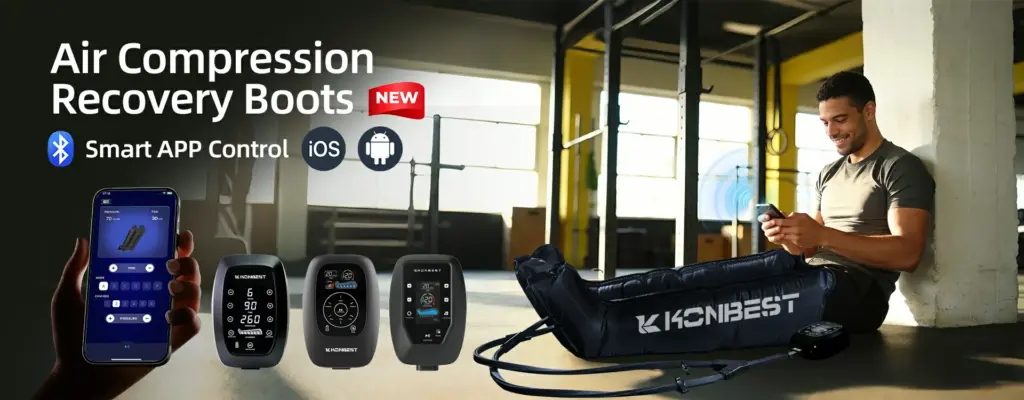
View KONBEST Compression Recovery Boots and contact the manufacturer for model selection, wholesale pricing, OEM customization, sampling, and bulk-order requirements.
10. Q&A
What is the best compression boots manufacturer for wholesale?
The best manufacturer depends on your target market, order quantity, required specifications, customization needs, and destination market. A suitable B2B manufacturer should provide clear technical information, stable production, samples, quality control, OEM support, and after-sales service.
What should I compare when buying compression boots wholesale?
Compare chamber count, pressure range, massage modes, control system, battery, air output, noise, garment construction, accessories, warranty, MOQ, packaging, production time, and applicable compliance documents.
Are more compression chambers better?
Not automatically. Four-, six-, and eight-chamber systems have different configurations. Buyers should select the model based on the intended customer, required functions, product positioning, and technical specifications.
Can I order private label compression boots from China?
Yes. Suitable manufacturers can support private label projects with options such as logo, color, packaging, and accessories. The exact customization options and MOQ depend on the model and order requirements.
How can I reduce risk when placing a large compression boots order?
Start with a sample, confirm the exact model and specification, approve the packaging and branding, set clear quality requirements, and arrange factory or third-party inspection when needed. Keep the approved sample as a reference for future orders.
Can KONBEST provide samples before a wholesale order?
KONBEST states that two-day sampling is available for applicable orders. Buyers should confirm the actual sample time based on the model, customization, stock status, and project requirements.
Does KONBEST support factory inspection?
Yes. KONBEST supports factory inspection for B2B buyers. The inspection scope and schedule should be discussed before production or shipment.
Can KONBEST supply other sports recovery products?
Yes. In addition to compression boots, KONBEST has a wider sports recovery equipment range. Distributors and wholesalers can discuss a broader product supply plan based on their market and purchasing needs.