


How to Reduce Customer Complaints with Better Compression Recovery Boots
Customer complaints are a serious problem for any recovery brand. One complaint may be easy to handle, but repeated complaints can take more time from your sales team and after-sales team. They can also make distributors, resellers, and end users lose confidence in the product.
For B2B buyers, the best way to reduce complaints is to prevent common problems before the products are shipped. This means choosing the right model, testing samples, checking quality, confirming customization, and working with a manufacturer that can support future orders.
For businesses buying in medium or large quantities, choosing a reliable compression boots manufacturer is therefore an important part of the product strategy. The goal is not simply to find a low-cost product. The goal is to find a product that matches the market and can be supplied with stable quality.
- Why Do Compression Boots Cause Customer Complaints?
- 1. Match the Model to the Customer
- 2. Confirm the Product Specifications
- 3. Test Samples Before Bulk Orders
- 4. Pay Attention to Comfort and Operation
- 5. Build Quality Control Into the Order
- 6. Keep Private Label Quality Consistent
- 7. Plan Delivery Before Selling
- 8. Prepare for After-Sales Service
- What Should B2B Buyers Check?
- Why KONBEST Is Suitable for B2B Buyers
- A Simple Complaint-Reduction Process
- Q&A
Why Do Compression Boots Cause Customer Complaints?
Not every complaint means that the product is poor. In many cases, the real problem is that the product does not match the customer's needs.
For example, a portable compression boot may be a good choice for a fitness center or home recovery market. A professional sports team may need a different level of product. A rehabilitation center may also have different requirements for regular professional use.
This is why a B2B buyer should look at the complete product application before placing a large order.
Common reasons for complaints include:
- The wrong product model was selected.
- The product specifications were not clearly confirmed.
- The buyer did not test a sample.
- The product was difficult for users to operate.
- Product quality was not checked carefully.
- Private label details were not confirmed before production.
- The delivery schedule was not clear.
- After-sales support was not prepared.
Most of these problems can be reduced before the first large order is produced.
1. Match the Model to the Customer
One of the first mistakes new distributors and resellers make is trying to sell one compression boot model to every type of customer.
A better approach is to build the product range around the application.
4-Chamber Portable Series
The 4-chamber series is positioned as an entry-level and portable option. The page describes this series as suitable for fitness centers and home recovery markets. It is compact and easy to promote, making it a useful choice for businesses targeting a wider consumer market.
6-Chamber Performance Series
The 6-chamber series is positioned between the portable and professional ranges. It is designed for sports teams and rehabilitation clinics, with improved pressure distribution and a stronger performance focus.
8-Chamber Professional Series
The 8-chamber series is the high-end option for professional sports, physiotherapy centers, and clinical rehabilitation. It offers more advanced programmable settings, pressure control, and construction designed for frequent use.
For distributors and wholesalers, having different product levels can make it easier to serve different customer groups without changing the manufacturing partner.
2. Confirm the Product Specifications
A common purchasing mistake is to ask for “compression boots” without defining the actual product requirements.
Different products can have different chamber numbers, functions, accessories, controller designs, and market positioning. If the specifications are unclear, two suppliers may quote products that look similar but are not the same.
Before placing an order, buyers should confirm:
- Number of compression chambers
- Available compression programs
- Pressure control
- Controller functions
- Sleeve size
- Product materials
- Power requirements
- Included accessories
- Packaging requirements
- Logo and color requirements
This simple step can prevent many misunderstandings between the buyer, factory, sales team, and final customer.
3. Test Samples Before Bulk Orders
A product photo cannot tell you everything.
Before ordering hundreds of units, a distributor or wholesaler should test the actual product. This is especially important for a new private label brand that has not sold the product before.
During sample testing, buyers can check:
- How easy the boots are to put on.
- How the controller operates.
- How the compression programs work.
- Whether the product feels comfortable.
- Whether the accessories match the order.
- Whether the packaging meets the brand requirements.
- Whether the product is suitable for the target application.
KONBEST supports 2-day sampling for suitable projects. This gives B2B buyers an opportunity to check the product before moving to a larger order.
For a new brand, this is much safer than using the first bulk order as the product test.
4. Pay Attention to Comfort and Operation
A recovery product is used directly by people. Because of this, the user experience matters.
A product may have good technical functions, but customers can still complain if it is difficult to operate or does not match their use case.
Buyers should therefore review the full experience, including:
- Sleeve fit
- Material feel
- Controller operation
- Setup time
- Tube and connector design
- Storage
- Carrying options
This is especially important for gyms, recovery centers, sports teams, and rehabilitation facilities where staff may need to help many users with the equipment.
5. Build Quality Control Into the Order
Quality should not be checked only when a customer reports a problem.
A serious B2B buyer should understand how the factory controls product quality before, during, and after production.
Important areas include:
- Raw material inspection
- Production process control
- Functional testing
- Finished product inspection
- Packaging inspection
- Pre-shipment inspection
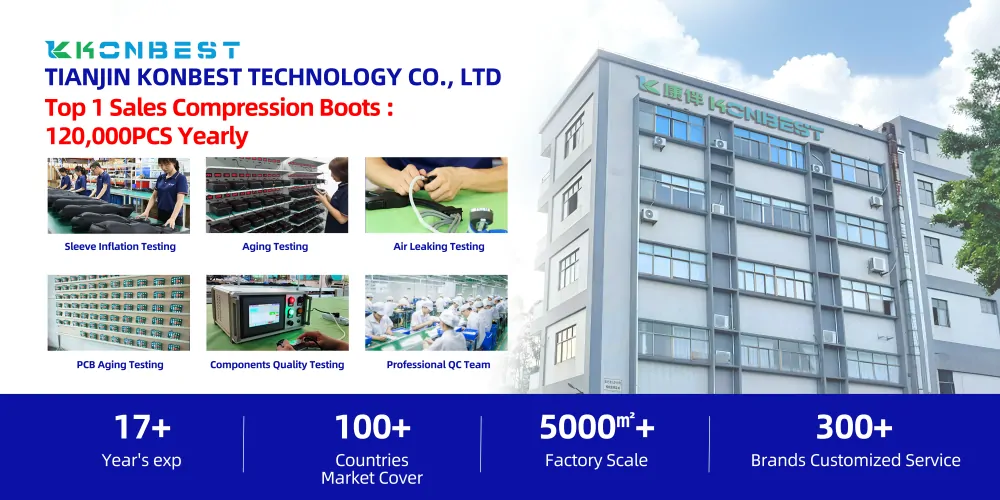
KONBEST states that its manufacturing process uses professional testing equipment and a strict management system. The company also provides factory inspection support for qualified B2B buyers.
For international orders, buyers should also confirm the exact certifications and documents required for their target market and selected model.
6. Keep Private Label Quality Consistent
For a private label recovery brand, the product is also part of the brand image.
If the logo position changes, packaging looks different, or product colors are not consistent between batches, customers may see the brand as less professional.
Depending on the project, KONBEST supports:
- Private label logo printing
- Product color customization
- Branded packaging
- Packaging design support
- UI interface adjustments for suitable models
- Accessory customization
Before mass production, the buyer should approve a final sample and use it as the reference for the bulk order.
This is particularly important for private label compression boots because the product may be sold under the buyer's own brand in several markets.
7. Plan Delivery Before Selling
Late delivery can create complaints even when the product itself is good.
For distributors and wholesalers, delivery planning is even more important because they may have their own customers waiting for stock.
Before confirming an order, buyers should discuss:
- Order quantity
- Production lead time
- Customization time
- Packaging schedule
- Shipping method
- Urgent order requirements
- Future production capacity
KONBEST lists a standard bulk-order lead time of 7–15 days depending on order quantity. For urgent shipments and large OEM projects, priority production scheduling is available.
Clear communication about delivery helps B2B buyers set realistic expectations before accepting orders from their own customers.
8. Prepare for After-Sales Service
No business can guarantee that customers will never have questions or product problems.
What matters is how quickly the problem can be understood and handled.
A reliable compression recovery boots supplier should be able to provide useful support for distributors and resellers.
Important support may include:
- Product manuals
- Technical information
- Replacement parts
- Warranty support
- Product photos and videos
- Marketing materials
KONBEST states that its compression recovery boots have a 12–24 month warranty depending on the model, with technical support and replacement parts available for distributors and after-sales teams.
This gives B2B buyers a clearer process when their customers need help after purchase.
What Should B2B Buyers Check?
For a medium or large order, the product is only one part of the purchasing decision. Buyers should also check the supplier's manufacturing capability.
| Item | What B2B Buyers Should Check |
|---|---|
| Product | Chambers, functions, pressure control, sizes, materials, and accessories |
| Sample | Actual product performance and user experience |
| OEM | Logo, color, packaging, UI, and accessory customization |
| MOQ | Trial order quantity and customized order requirements |
| Quality | Testing process and finished product inspection |
| Delivery | Production time and large-order scheduling |
| Warranty | Warranty period and replacement part support |
| Factory | Production lines, R&D team, QC team, and factory inspection |
| Future Supply | Ability to repeat the same product and handle higher order volumes |
Why KONBEST Is Suitable for B2B Buyers
KONBEST has 17 years of sports recovery product R&D and manufacturing experience. Its products are supplied to more than 100 countries, and the company has experience with more than 300 customized brands.
The manufacturing base covers 12,000 square meters and has 5 production lines. KONBEST also has professional R&D and quality inspection teams and a high-end product showroom.
For suitable B2B projects, KONBEST supports:
- OEM and ODM manufacturing
- Private label logo customization
- Custom product colors
- Branded packaging
- Accessory customization
- 2-day sampling for suitable projects
- 7-day shipping support for suitable orders
- Factory inspection
- Wholesale and distributor cooperation
- One-stop sports recovery equipment sourcing
The compression boots product range is divided into 4-chamber, 6-chamber, and 8-chamber series. This gives distributors and wholesalers a practical way to build several product levels for different markets.
The page also lists optional accessories such as arm and shoulder cuffs, hip accessories, waist cuffs, cold pads, vests, backpacks, and carrying bags. Exact accessory availability should be confirmed for the selected model.
Build a Product Line That Prevents Problems
Reducing complaints is not only about choosing a better product. It is about building a better purchasing process.
A distributor can follow a simple path:
- Identify the target customer.
- Select the correct compression boot series.
- Confirm the specifications.
- Request a sample.
- Test the sample with real users when possible.
- Confirm logo, color, packaging, and accessories.
- Review quality control.
- Confirm required certifications and documents.
- Agree on the production schedule.
- Inspect the first bulk order.
- Collect customer feedback.
- Use the feedback to improve future orders.
This process can help wholesalers, distributors, and resellers avoid many problems before they reach the end customer.
Do Not Let Low Price Create High After-Sales Work
For B2B buyers, a product should be judged by its complete purchasing value, not only by the unit price.
A very low quotation may look attractive at the beginning. But if the product does not match the target market, requires more after-sales support, or cannot be supplied consistently, the original saving may not be useful.
A better purchasing decision considers product configuration, quality, sample testing, customization, delivery, warranty, and future supply together.
This is especially important when buying hundreds of units or building a private label recovery brand.
Conclusion
Customer complaints often start with a purchasing decision that was made too quickly.
The wrong model, unclear specifications, limited sample testing, inconsistent branding, unstable delivery, and weak after-sales support can all create problems for a recovery brand.
The solution is to build stronger controls before the products reach the market.
Choose the right model for the customer. Test the sample. Confirm every important specification. Check the factory and quality process. Approve the private label design. Plan delivery carefully. Then prepare a clear after-sales process.
For distributors, wholesalers, and resellers, working with an experienced OEM manufacturer can make this process easier to manage.
KONBEST combines 17 years of sports recovery manufacturing experience with international supply experience, OEM/ODM support, multiple compression boot series, a 12,000-square-meter manufacturing base, 5 production lines, and support for customized B2B projects.
For businesses planning medium or large-volume orders, the right product and the right manufacturing process can help reduce avoidable complaints and create a more consistent customer experience.
Q&A
Q1: What is the main reason customers complain about compression boots?
One common reason is that the selected product does not match the customer's application. Buyers should select the model according to the target market instead of choosing only by price.
Q2: Should I test a sample before placing a wholesale order?
Yes. A sample allows buyers to check the actual product, functions, comfort, accessories, and packaging before moving to larger quantities.
Q3: Can KONBEST make private label compression boots?
Yes. For suitable projects, KONBEST supports logo, color, packaging, UI, and accessory customization.
Q4: What compression boot series does KONBEST offer?
The current range includes 4-chamber portable models, 6-chamber performance models, and 8-chamber professional models.
Q5: Can distributors place small trial orders?
Yes. The page states that MOQ starts from 10–50 sets depending on the model and customization requirements, with lower trial quantities available for new distributors in suitable cases.
Q6: What is the bulk order lead time?
The listed standard lead time is 7–15 days depending on order quantity. Urgent shipments and large OEM projects can receive priority production scheduling.
Q7: What warranty support is available?
KONBEST lists a 12–24 month warranty depending on the model, together with technical support and replacement parts for distributors and after-sales teams.
Q8: Can buyers inspect the factory?
Yes. KONBEST supports factory inspection for qualified B2B buyers who want to review the manufacturing environment before cooperation.