


What Makes Compression Recovery Boots Ready for Commercial Launch?
Buying compression recovery boots for commercial use is very different from buying one pair for personal use. A distributor, wholesaler, reseller, or importer needs to know if the product can perform well, fit the target market, support private labeling, and remain available when the order grows.
That is why commercial launch readiness should be checked before placing a medium or large order. The right compression recovery boots wholesale program should combine product performance, model selection, customization, quality control, factory capacity, documentation, and after-sales support.
KONBEST offers a complete range of air compression recovery boots, including 4-chamber, 6-chamber, and 8-chamber models. With 17 years of sports recovery product R&D and manufacturing experience, more than 300 brand customization projects, and supply experience in more than 100 countries, KONBEST supports distributors and resellers from product selection to bulk production.
Table of Contents
- What Does Commercial Launch Readiness Mean?
- 7 Technical Points to Check Before Launch
- Which Chamber Configuration Fits Your Market?
- Match the Product to the Customer
- Is the Product Ready for Private Label?
- Why Sample Testing Comes Before Bulk Orders
- Can the Manufacturer Support Your Order Volume?
- Quality Control and Market Requirements
- Why Work With KONBEST?
- Q&A
What Does Commercial Launch Readiness Mean?
A commercial-ready compression recovery product should answer one simple question: can this product be sold, used, reordered, and supported at scale?
For B2B buyers, a good sample is only the starting point. Before launch, you should also check the pressure range, chamber structure, control method, operating time, battery configuration, noise level, material quality, accessories, packaging, and available product documents.
Then comes the supply side. Can the factory make the same product consistently? Can it support your logo and packaging? Can it provide samples quickly? Can it handle your expected quantity? Can it support a factory inspection?
These questions are especially important for buyers looking for a long-term compression boots manufacturer, rather than a one-time trading supplier.
7 Technical Points to Check Before Launch
1. Pressure Range
Pressure adjustment is one of the first specifications buyers should compare. Different customer groups may need different operating levels, so a fixed-pressure product can limit your market options.
For example, selected KONBEST models provide pressure ranges up to 260 mmHg, while the 9490ProE provides a 30–240 mmHg range. Buyers should select the exact pressure range according to the product positioning and intended application.
2. Number of Chambers
Chamber configuration affects how the compression sequence is delivered along the leg. KONBEST offers 4-chamber, 6-chamber, and 8-chamber product series.
This gives B2B buyers a practical way to build different product levels without changing suppliers.
3. Air Pump Performance
Air delivery is another useful specification when comparing commercial products. Selected KONBEST models provide air output from around 9 L/min to 15 L/min, depending on the model.
A stronger air system can be useful when the product is designed for repeated sessions, but buyers should always compare the complete system rather than choosing a product only because it has a higher number.
4. Control and Operating Modes
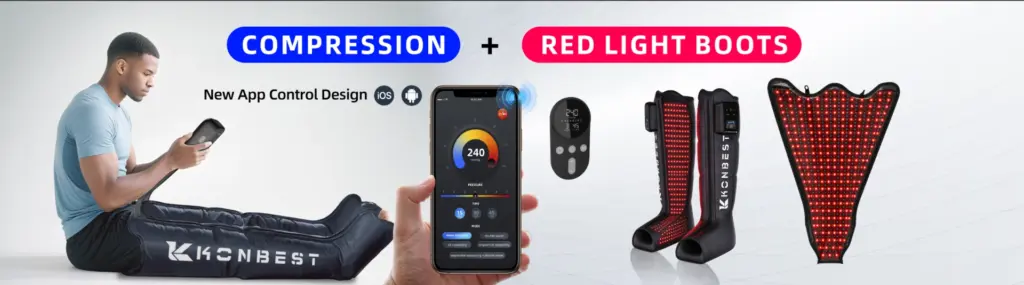
Commercial users usually want simple operation. LCD screens, touch controls, remote controllers, app control, multiple modes, and adjustable session times can make a product easier to use in gyms, sports facilities, and recovery centers.
For example, the KONBEST 9490ProE provides 5 modes, a color LCD, remote and app control, and 15/30/45-minute timer settings. The 9690 series provides 6 modes, a 10–90-minute time setting, and a color or touch display depending on the model.
5. Battery and Wireless Design
Wireless operation can be important for portable recovery products. It removes the need for a fixed hose connection and makes it easier to move the equipment between rooms or training areas.
The 9490ProE uses a 3200mAh rechargeable battery, while selected 6-chamber and 8-chamber models use 5200mAh batteries. The correct choice depends on the expected session frequency and product positioning.
6. Noise Level
Number of Modes
Recovery equipment is often used in gyms, wellness areas, sports facilities, and shared recovery rooms. Excessive operating noise can affect the user experience.
Selected KONBEST models are specified at below 45 dB. For commercial purchasing, it is still important to test the actual sample in the environment where customers will use it.
7. Product Construction and Accessories
Commercial products need to handle repeated use. Buyers should inspect the cuffs, zippers, fabric, connectors, pump, controller, charging system, carry bag, and other included accessories.
KONBEST models use high-strength fabric on selected products, and the product range can also support additional accessories such as waist cuffs, hip accessories, arm or chest cuffs, cold pads, vests, backpacks, and carry bags.
Which Chamber Configuration Fits Your Market?
There is no single best compression boot for every B2B customer. The better approach is to match the configuration with the market and purchasing requirement.
| Series | Key Features | Recommended B2B Market | Commercial Position |
|---|---|---|---|
| 4-Chamber | Compact designs, selected wireless models, simple operation | Fitness stores, gyms, wellness businesses, online resellers | Portable and flexible |
| 6-Chamber | Up to 30–260 mmHg on selected models, 6 modes, up to 15 L/min | Sports teams, gyms, recovery centers, rehabilitation suppliers | Performance-focused |
| 8-Chamber | Up to 30–260 mmHg on selected models, 6 modes, touch/LCD options | Professional sports, physiotherapy, rehabilitation equipment suppliers | Professional positioning |
This product structure is useful for a compression boots supplier because it allows different models to be offered to different customer groups while keeping production within one product family.
Match the Product to the Customer
For Sports Teams
Sports teams may need multiple units for athletes to use after training and competition. In this case, durability, simple controls, adjustable pressure, and easy storage become important purchasing points.
A 6-chamber or 8-chamber model can be considered when the buyer wants a more performance-focused product range.
For Gyms and Fitness Centers
Gyms usually need products that staff can operate without complicated training. Wireless models can also be useful when equipment needs to move between training and recovery areas.
For gym distributors, a 4-chamber product can provide a portable option, while 6-chamber models can create a higher-level product choice.
For Rehabilitation and Physiotherapy Suppliers
Professional rehabilitation suppliers normally pay more attention to pressure control, operating settings, product documentation, durability, and long-term supply.
For this market, buyers can consider the 6-chamber or 8-chamber range and should confirm the exact technical specifications and applicable market documentation before purchase.
For Retail and E-Commerce Resellers
Retail customers often compare appearance, controls, portability, packaging, accessories, and product features before buying. This makes private labeling and product presentation important.
A reseller can start with a selected model, then customize the logo, colors, packaging, and accessories to create a consistent branded product line.
Is the Product Ready for Private Label?
A product is not truly launch-ready for a brand if the manufacturer can only change the logo.
For a serious private label project, buyers should discuss the complete branding package before production:
- Logo position and printing method
- Product color and appearance
- Retail or wholesale packaging
- Product labels and manuals
- Accessories and package contents
- Control interface requirements
- Model selection and product specifications
- Destination-market requirements
KONBEST supports private label services covering logo, color, packaging, and accessories. OEM and ODM support also gives distributors more flexibility when developing their own compression recovery product range.
This is particularly useful for buyers who want private label compression boots rather than selling a completely generic product.
Why Sample Testing Comes Before Bulk Orders
Never judge a commercial product only from a specification sheet.
Before a medium or large order, the buyer should request a sample and test it under real working conditions. Check how quickly the system inflates, how the pressure changes between modes, how comfortable the cuffs are, how easy the controller is to use, and how the battery performs during repeated sessions.
It is also useful to let several people test the same product. A product that feels comfortable for one person may not feel the same for another user.
KONBEST states that it can support 2-day sampling for applicable projects. The actual sample schedule should be confirmed based on the model, customization, and project requirements.
Can the Manufacturer Support Your Order Volume?
This is where commercial launch planning becomes different from normal product buying.
If you are a distributor preparing a few hundred sets, or a wholesaler planning repeat orders, the factory must be able to maintain the same product specifications across production batches.
Before confirming a large order, ask the manufacturer:
- How many production lines are available?
- What is the normal MOQ for the selected model?
- What is the bulk production lead time?
- Can the factory support repeat orders?
- Can the factory provide pre-production samples?
- Can the packaging be customized?
- Can buyers arrange a factory inspection?
- How are finished products tested before shipment?
- What warranty and after-sales support are available?
KONBEST operates a 12,000 m² factory with five production lines and dedicated R&D and quality inspection teams. The company has more than 17 years of sports recovery product manufacturing experience and has completed customization projects for more than 300 brands.
For applicable orders, KONBEST also promotes 7-day shipping support. Actual production and shipping time should always be confirmed according to quantity, model, customization, and destination.
Quality Control and Market Requirements
For international B2B buyers, commercial readiness also includes product documentation and quality management.
KONBEST states that its business supports certifications and compliance requirements including CE, RoHS, ISO-related systems, and BSCI. However, buyers should request and verify the exact document, certificate scope, and applicable model before placing an order.
This is especially important when importing recovery equipment into different countries. The compliance requirements for a product can depend on its specifications, intended use, electrical configuration, and destination market.
A factory inspection can provide another level of confidence. Distributors and wholesalers can review the production area, testing process, quality inspection system, warehouse, packaging process, and manufacturing capacity before moving to larger purchasing volumes.
Why Work With KONBEST for Commercial Compression Recovery Products?
For a B2B buyer, choosing a compression recovery boots manufacturer should be based on more than one product specification.
You need a supplier that can support product selection, sampling, customization, quality control, production, packaging, and repeat orders.
KONBEST has 17 years of sports recovery product R&D and manufacturing experience, supplies products to more than 100 countries, and has completed more than 300 brand customization projects. Its 12,000 m² facility includes five production lines, an R&D team, quality inspection teams, and a high-end product showroom.
The compression recovery range covers 4-chamber, 6-chamber, and 8-chamber models. This gives distributors, wholesalers, and resellers more flexibility when creating different product levels for their markets.
For buyers planning a commercial launch, KONBEST can support the process from sample selection to private label customization and bulk production. The company also supports factory inspection for qualified B2B projects.
The best next step is not to ask for a price on one random model. Instead, provide your target market, estimated order quantity, preferred chamber configuration, customization requirements, and destination country. The manufacturer can then recommend suitable models and confirm the MOQ, specifications, sample schedule, lead time, and quotation.
Compare KONBEST compression recovery boots for wholesale, OEM, and private label projects and request the models that fit your commercial launch plan.
Q&A
What should I check before buying compression recovery boots wholesale?
Check chamber number, pressure range, air pump output, massage modes, timer settings, control method, battery capacity, noise level, materials, accessories, warranty, MOQ, lead time, customization options, and product documentation.
Which compression recovery boots are best for distributors?
The right model depends on your customer group. 4-chamber models can suit portable and general fitness markets, 6-chamber models can suit sports and recovery businesses, and 8-chamber models can support higher-level professional positioning.
Can I order private label compression boots from KONBEST?
Yes. KONBEST supports private label logo, color, packaging, and accessory customization. OEM and ODM options can also be discussed according to the product and project requirements.
What pressure range do KONBEST compression boots provide?
The range depends on the model. Selected KONBEST products provide pressure from 30–240 mmHg or up to 30–260 mmHg. Buyers should confirm the exact specification of the model they plan to order.
What is the difference between 4-chamber, 6-chamber, and 8-chamber boots?
The main difference is the chamber configuration and compression sequence. More chambers can provide more segmented control along the leg. The best configuration depends on the intended market, product positioning, and customer requirements.
Can KONBEST support medium and large B2B orders?
Yes. KONBEST has five production lines and supports OEM, ODM, private label, wholesale, and bulk purchasing projects. MOQ and lead time should be confirmed according to the selected model and customization requirements.
Can I inspect the KONBEST factory before placing a large order?
Yes. KONBEST supports factory inspection for B2B buyers. An inspection can help buyers review production capacity, quality control, testing procedures, packaging, and factory operations before confirming a larger project.
How can I start a compression recovery boots wholesale project?
Start by defining your target customers, expected order quantity, preferred product level, destination market, and branding requirements. Then request samples, compare technical specifications, confirm customization, and discuss MOQ, lead time, warranty, and bulk pricing with the manufacturer.
A commercial launch works best when the product and supply chain are planned together. For distributors, wholesalers, and resellers, a launch-ready compression recovery product should deliver the required technical performance while also giving the business a clear model structure, reliable factory support, private label options, and a realistic path to repeat orders.