

How to Choose an OEM Supplier for Your Own Private Label Compression Boots Brand
Choosing an OEM supplier is one of the most important decisions when you want to build your own private label compression boots brand. The right supplier should do more than offer a low factory price. You need suitable product models, stable production, accurate specifications, flexible customization, quality control, and enough capacity to support repeat wholesale orders.
For distributors, wholesalers, resellers, importers, and sports recovery companies, the supplier you choose can directly affect product consistency and the speed of your business expansion. This guide explains what to check before selecting an OEM partner and how to compare a supplier for medium- and large-volume orders.
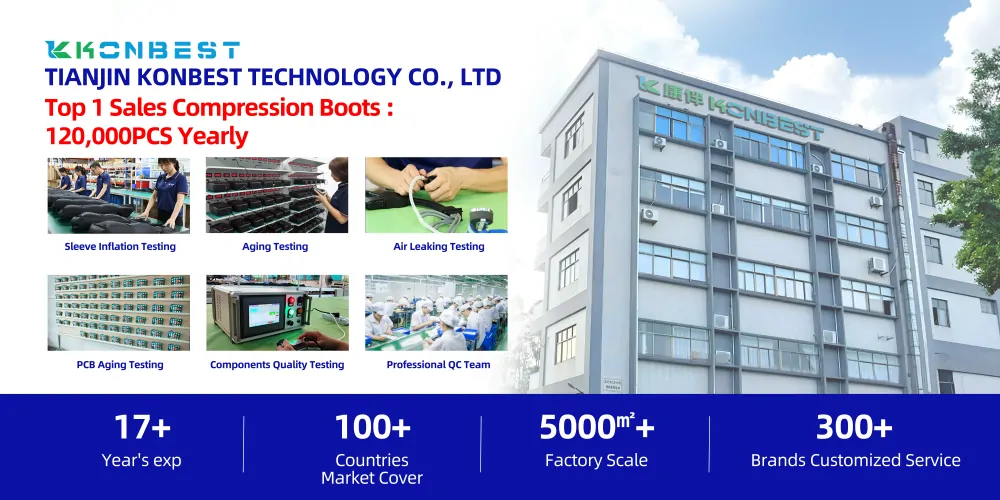
KONBEST is an EU-registered sports recovery brand with 17 years of R&D and manufacturing experience. Its products are supplied to more than 100 countries, with customization experience for more than 300 brands. The company operates a reported 12,000-square-meter factory with five production lines, R&D and quality inspection teams, and a high-end product showroom.
Its compression recovery boots range covers different chamber configurations and supports private label projects with options such as logo, color, packaging, and accessories customization.
- 1. OEM vs. Private Label: What Do You Need?
- 2. What Makes a Good OEM Supplier?
- 3. Compare Compression Boot Configurations
- 4. Check the Specifications Before Ordering
- 5. Review Private Label Customization Options
- 6. Match the Product to Your B2B Market
- 7. Why Sample Testing Matters
- 8. Prepare for Medium and Large Orders
- 9. Evaluate Factory Capacity and Quality Control
- 10. Check Product Documents and Market Requirements
- 11. Why Consider KONBEST as Your OEM Partner?
- 12. Q&A
1. OEM vs. Private Label: What Do You Need?
Before contacting an OEM compression boots supplier, first decide how much customization your business needs.
Private label usually means you select an existing product and sell it under your own brand. Depending on the supplier and model, you may customize the logo, product color, packaging, accessories, or other approved details.
OEM projects can involve deeper product customization or development based on your requirements. This can include product structure, functions, appearance, user interface, or other technical changes when the manufacturer has the capability to support them.
For many distributors and wholesalers entering the recovery equipment market, starting with a proven product is more practical than developing a completely new device.
- Choose private label if you want faster product launch and brand customization.
- Choose OEM customization if your market requires specific product features or design changes.
- Consider a mixed strategy if you want to launch standard models first and develop customized products later.
The important point is to tell the supplier exactly what you need. A clear project brief helps the factory recommend suitable models and provide a more accurate quotation.
2. What Makes a Good OEM Supplier?
A low quotation does not always mean a good OEM partnership. For a B2B buyer planning hundreds or thousands of units over time, the supplier should be evaluated from several angles.
| Supplier Factor | What to Check | Why It Matters |
|---|---|---|
| Product capability | Models, chamber options, functions, accessories | Helps you build the right product range |
| Manufacturing capacity | Factory size, production lines, equipment, workforce | Supports repeat and larger orders |
| Customization | Logo, color, packaging, accessories, OEM options | Creates a consistent private label product |
| Quality control | Incoming inspection, testing, final inspection | Reduces product consistency problems |
| Sample support | Sample availability and approval process | Lets you test before mass production |
| Documentation | Specifications, manuals, applicable compliance documents | Supports import and sales requirements |
| After-sales service | Warranty, spare parts, technical support | Helps manage customer issues after delivery |
A strong supplier should also communicate clearly. If the factory cannot explain product differences, customization limits, MOQ, lead time, and inspection procedures, it becomes difficult for your purchasing team to plan a large order.
3. Compare Compression Boot Configurations
One of the first product decisions is the chamber configuration. KONBEST's compression recovery boots range includes 4-chamber, 6-chamber, and 8-chamber options, with specifications varying by model.
For wholesale purchasing, chamber count should be treated as one comparison point rather than the only measure of product quality.
| Configuration | Possible Positioning | Suitable Business Scenario |
|---|---|---|
| 4-chamber | Simple and portable product range | Fitness retailers, introductory recovery lines, online resellers |
| 6-chamber | Mid-range performance option | Gyms, sports clubs, recovery brands, professional equipment distributors |
| 8-chamber | Higher-specification option | Premium recovery brands and professional sports equipment suppliers |
For a distributor, a two-model strategy can be useful. One model can cover customers looking for practical features, while another can target buyers who want more advanced functions. This gives your sales team a clear product story without creating an unnecessarily large inventory.
Always request the current specification sheet for the exact model you plan to order. Do not use specifications from one model to advertise another model.
4. Check the Specifications Before Ordering
A professional compression boots manufacturer should be able to provide detailed specifications for each model. These specifications should become part of your purchasing decision.
Pressure Range
Check the minimum and maximum pressure and how the user adjusts the pressure. Some KONBEST models are designed with wide pressure adjustment ranges, but the exact range depends on the model.
For example, selected higher-specification models in the range can offer pressure settings up to around 260 mmHg. This should not be treated as a standard specification for every KONBEST boot. Confirm the exact pressure range before placing an order.
Number of Modes
Different compression boots may provide different massage or compression modes. Ask the supplier to explain what each mode does and how the modes differ between models. This gives your sales team useful information when presenting products to customers.
Air Pump Performance
Air delivery affects how quickly the chambers inflate. Selected KONBEST models are available with air delivery specifications such as 15 L/min, while other models use different pump configurations.
For wholesale buyers, compare air pump performance together with noise level, battery performance, and overall product design rather than using one parameter alone.
Battery and Wireless Operation
Wireless compression boots can be useful for customers who want to move between rooms or use the equipment without being connected to a wall outlet during operation. Selected models offer rechargeable batteries, while battery capacity varies by model.
Ask about battery capacity, charging time, expected operating time, charging accessories, and replacement options before selecting a wireless product for your private label range.
Control and Display
Remote controls, LCD displays, touch controls, and app functions can improve the user experience. However, these features are model-specific. Make sure the product page, package, manual, and sales materials all describe the same functions.
Noise Level and User Comfort
For gyms, clinics, recovery centers, and sports facilities, operating noise can be an important consideration. Selected KONBEST models list noise levels below 45 dB. Confirm the tested specification for the exact model and understand the test conditions before using this figure in marketing materials.
5. Review Private Label Customization Options
Your private label product should look like part of your brand, not simply a standard factory product with a small logo added.
KONBEST supports private label customization for eligible projects, including:
- Logo: Add your brand identity to approved product areas.
- Color: Select or develop suitable product colors according to the model and production requirements.
- Packaging: Create branded boxes and packaging materials for your market.
- Accessories: Confirm the accessories included with each model and discuss available options.
- Product details: Discuss feasible OEM or ODM adjustments when standard customization is not enough.
Before approving a bulk order, create a written customization checklist. Include logo files, color references, packaging artwork, product labels, manuals, accessories, and any special requirements.
This is especially important for large distributors. If the first order is successful but the second order uses a different package or logo position, your brand presentation can become inconsistent. A clear approved sample and written specification help prevent this problem.
6. Match the Product to Your B2B Market
The right OEM product depends on where and how you plan to sell it. Here are practical examples for different B2B buyers.
For Sports Equipment Distributors
A distributor may sell to gyms, sports clubs, recovery centers, and retail stores at the same time. A small product range with clear differences can be easier to manage.
Recommended approach: Select one standard model and one higher-specification model. Prepare a comparison sheet covering chambers, pressure range, modes, controls, battery, and accessories.
Business problem solved: Your sales team can quickly recommend different products without managing too many SKUs.
For Fitness Equipment Wholesalers
Wholesalers often need products that are easy for their downstream retailers to understand and demonstrate.
Recommended approach: Prioritize practical controls, clear product specifications, packaging quality, and stable supply. Ask for samples before committing to a larger inventory order.
Business problem solved: Retail partners receive clearer product information and can introduce the product more easily.
For Private Label Recovery Brands
A recovery brand may already have its own logo, color system, and packaging style.
Recommended approach: Start with a proven model, then customize the logo, colors, packaging, and selected accessories. If the market requires unique features, discuss OEM development separately.
Business problem solved: The brand can create a consistent product family while controlling the level of customization.
For Rehabilitation Equipment Distributors
Professional buyers may ask for technical specifications and compliance documentation before purchasing.
Recommended approach: Tell the supplier the destination market and intended application before choosing a model. Verify the applicable documents and permitted product claims.
Business problem solved: This reduces the chance of importing a product that does not match the customer's technical or regulatory requirements.
For Large Importers and Resellers
A large importer needs more than a competitive unit price. It needs predictable production, consistent specifications, packaging control, and repeat-order support.
Recommended approach: Evaluate factory capacity, inspection procedures, sample approval, lead times, spare parts, and future production planning before signing a long-term supply agreement.
Business problem solved: A complete supplier review creates a stronger foundation for repeat purchasing and inventory planning.
7. Why Sample Testing Matters
A sample is one of the best tools for comparing an OEM supplier with your actual requirements. Do not judge a supplier only from product photos or a quotation.
When the sample arrives, check the following areas:
- Boot material and stitching quality
- Air tube and connector construction
- Controller operation
- Pressure adjustment
- Available compression modes
- Timer functions
- Battery and charging performance for wireless models
- Noise during operation
- Fit and user comfort
- Packaging and included accessories
- User manual and product labels
If you are purchasing for a professional customer, test the product in a similar environment. A product used in a sports recovery center may have different requirements from one sold directly to home users.
After testing, create a sample approval document. Record the exact model number, specifications, color, logo, packaging, accessories, and any approved changes. This becomes a useful reference during bulk production.
8. Prepare for Medium and Large Orders
When your order quantity grows, purchasing becomes more complex. A factory quotation should not be the only document you review.
Before confirming a bulk order, ask the OEM supplier to clarify:
- MOQ: What is the minimum quantity for the selected model?
- Customization MOQ: Does changing color or packaging require a higher quantity?
- Production lead time: How many days are needed after sample and artwork approval?
- Inspection: What quality checks are completed before shipment?
- Packaging: How are products packed for international transportation?
- Spare parts: What parts are available for after-sales service?
- Warranty: What is covered and how are claims handled?
- Repeat orders: Can the same specifications be maintained for future production?
KONBEST's product information indicates MOQ levels starting from approximately 10–50 sets depending on model and customization requirements. For a medium or large B2B order, confirm the exact MOQ for your selected model and branding plan.
The product information also indicates typical bulk lead times of around 7–15 days depending on order details. Lead time can change according to quantity, customization, production schedule, and shipping arrangements, so your formal quotation should be the final reference.
KONBEST also promotes 2-day sampling and 7-day shipping for eligible projects. Before using these figures in your purchasing plan, confirm whether they apply to your specific model, quantity, customization, and destination.
9. Evaluate Factory Capacity and Quality Control
A factory audit can give B2B buyers a better view of the supplier's real manufacturing capability.
KONBEST reports a 12,000-square-meter production facility, five production lines, advanced R&D resources, quality inspection teams, and a high-end showroom. The company also supports factory inspections for buyers.
During a factory audit, focus on the processes that can affect your order.
Production Capacity
Ask how many units the factory can produce within your required period and whether current production schedules can support your order. If you expect repeat purchases, ask how capacity is planned for future orders.
Quality Inspection
Review how incoming components are checked, how products are tested during assembly, and what final inspections are performed before shipment.
Customization Control
For private label products, check how the factory manages different logos, colors, packaging versions, and accessories. Clear production records help reduce mix-ups between different customer orders.
After-Sales Support
Ask how defective products are reported, how replacement parts are supplied, and how technical questions are handled. These points become more important as your sales volume grows.
Factory size alone does not prove that a supplier is suitable for your project. The important question is whether the factory can consistently meet the product, quality, customization, and delivery requirements agreed in your order.
10. Check Product Documents and Market Requirements
International B2B buyers should review product documentation before importing compression boots. Requirements can vary by country, product configuration, intended use, and sales channel.
KONBEST states that its products have relevant certifications and compliance credentials including CE and RoHS, and the company also references ISO-related and BSCI credentials. Buyers should request current, model-specific documents and verify the exact scope of each document.
CE, RoHS, ISO, and BSCI do not mean the same thing. CE relates to applicable European product compliance requirements; RoHS addresses restrictions on certain hazardous substances in applicable electrical and electronic products; ISO standards can relate to management systems or other defined standards; and BSCI is associated with social compliance assessment.
Therefore, do not simply ask whether a factory is “certified.” Ask:
- Which document applies to the exact model?
- Which legal entity or manufacturer is named on the document?
- What standard or regulation does it cover?
- Is the document current?
- Does it apply to the destination market?
- Are additional testing, labeling, registration, or import requirements needed?
This process is especially important for distributors selling to professional customers. Avoid making medical or treatment claims unless the product's regulatory status and supporting evidence allow those claims in your market.
11. Why Consider KONBEST as Your OEM Partner?
For businesses searching for an OEM supplier, KONBEST offers a combination of product range, manufacturing experience, customization support, and international market experience.
| KONBEST Capability | Value for B2B Buyers |
|---|---|
| 17 years of sports recovery manufacturing experience | Useful experience for product development and production planning |
| 100+ countries supplied | International market experience for export-oriented buyers |
| 300+ brand customization projects | Experience with private label and OEM project requirements |
| 12,000 m² factory | Provides a dedicated manufacturing base for larger projects |
| 5 production lines | Supports production planning for different order requirements |
| R&D and quality teams | Supports product development and inspection processes |
| 4, 6 and 8-chamber product options | Allows buyers to build different product levels |
| Private label customization | Logo, color, packaging, and accessory options for eligible projects |
| Factory inspection support | Allows B2B buyers to review manufacturing operations |
KONBEST also reports that its products have been used by more than 20,000 professional athletes. If this statement is used in your own marketing materials, confirm the supporting evidence and approved wording with the supplier first.
For a distributor or wholesaler, the main advantage of working with a broad sports recovery manufacturer is the possibility of discussing several product categories through one supply relationship. This can be useful when your business plans to expand beyond compression boots into a wider recovery equipment range.
View the product range here: KONBEST Compression Recovery Boots.
12. Q&A
Q1: What should I look for in an OEM compression boots supplier?
Check product quality, model options, technical specifications, factory capacity, private label customization, MOQ, lead time, sample support, quality inspection, compliance documents, warranty, and after-sales service.
Q2: What is the difference between OEM and private label compression boots?
Private label normally uses an existing product that is customized with your brand identity. OEM can involve deeper customization or product development based on your requirements. The exact service depends on the supplier and project.
Q3: How many compression boots should I order for a new brand?
There is no single quantity that fits every business. Start with your expected sales volume, target market, customization level, and inventory budget. For larger buyers, negotiate the production plan based on forecasted repeat orders rather than choosing quantity only from the lowest MOQ.
Q4: Can I customize compression boots with my own logo and packaging?
Yes. KONBEST supports private label customization for eligible projects, including logo, color, packaging, and accessories. Confirm the exact customization options and MOQ for your selected model.
Q5: Which chamber configuration should I choose?
It depends on your target customers and product positioning. KONBEST offers 4-chamber, 6-chamber, and 8-chamber options. Compare the full specification, user experience, functions, and target price instead of selecting a product based only on chamber count.
Q6: Can I request a sample before a wholesale order?
Yes. Sample testing is recommended before mass production. It allows you to verify product functions, fit, materials, controls, packaging, and accessories. KONBEST promotes fast sampling for eligible projects, with the exact timing to be confirmed for your order.
Q7: Can a buyer inspect the KONBEST factory?
KONBEST supports factory inspection. Buyers can discuss the inspection process and review production, quality control, R&D, packaging, and other areas relevant to the purchasing project.
Q8: What information should I send when asking for an OEM quotation?
Provide the target market, product model or desired configuration, estimated quantity, logo requirements, color, packaging, accessories, destination country, required documents, and expected delivery date. A detailed brief helps the supplier prepare a more accurate quotation.
Choose Your OEM Supplier Before You Choose Your Product
The right OEM supplier can make a private label compression boots project much easier to manage. Instead of comparing factories only by price, look at product specifications, customization capability, sample quality, production capacity, inspection procedures, documentation, and long-term supply support.
For distributors, wholesalers, resellers, and importers planning medium or large orders, a practical process is simple: define the market, shortlist the right models, request samples, confirm the private label design, inspect the supplier, and then finalize the bulk order.
KONBEST combines 17 years of sports recovery manufacturing experience with multiple compression boot configurations, private label customization, factory inspection support, and a broader recovery equipment portfolio. If you are building your own recovery brand, share your target market, estimated quantity, preferred product level, and customization requirements with the team.
Explore KONBEST Compression Recovery Boots for OEM and Private Label Projects