

Private Label Compression Boots: OEM Solutions for Growing Recovery Brands
Building a sports recovery brand takes more than choosing a good product. You need the right product range, a reliable factory, clear quality standards, and a supplier that can support repeat orders. For importers, distributors, wholesalers, and resellers, private label compression boots offer a practical way to enter or expand the sports recovery equipment market without setting up your own production facility.
KONBEST provides air compression recovery boots for professional sports, fitness, rehabilitation, and wellness markets. With different product configurations and OEM/ODM services, buyers can select suitable models and customize them with their own logo, colors, packaging, and accessories.
This guide explains how to build a private label compression boots product line, compare technical features, plan bulk orders, and choose a manufacturing partner for long-term cooperation.
Table of Contents
- 1. What Makes Private Label Compression Boots a Good Business Choice?
- 2. Build Your Product Line Around Three Product Levels
- 3. Technical Features Buyers Should Compare
- 4. Match Each Model to the Right Sales Channel
- 5. Make the Product Look and Feel Like Your Brand
- 6. How to Evaluate a Compression Boots Manufacturer
- 7. Plan Samples, Production, and Bulk Delivery
- 8. Why Choose KONBEST for Private Label Projects?
- 9. Questions and Answers
1. What Makes Private Label Compression Boots a Good Business Choice?
Many sports equipment distributors already sell products such as massage guns, foam rollers, fitness accessories, and recovery tools. Adding compression recovery boots can help them offer a more complete product range to professional buyers.
However, selling a standard product under another company's brand is not always the best long-term plan. A private label project gives a business more control over its product identity and market position.
With a suitable OEM manufacturer, buyers can work on several parts of the product:
- Brand logo on the product or selected components.
- Product color options for brand consistency.
- Custom retail boxes and shipping packaging.
- Accessories that match the needs of the target market.
- Selected product or interface options, depending on the model.
For example, a sports equipment distributor may want a professional-looking product with its own logo and branded packaging. A rehabilitation equipment wholesaler may focus more on technical specifications, user instructions, and suitable accessories.
The important point is to define the target customer before selecting the product. This helps avoid ordering a model with features that do not match the market.
2. Build Your Product Line Around Three Product Levels
A distributor does not always need to sell only one type of compression boots. Different customers have different budgets, product expectations, and usage needs. A product range with several levels can make it easier to serve more than one sales channel.
Level 1: Four-chamber portable models
Four-chamber compression boots can be considered for businesses targeting general fitness, wellness, and entry-level recovery markets. These models can help distributors introduce air compression products to customers who want a simpler product configuration.
For this product level, buyers should pay attention to portability, basic control functions, sleeve comfort, packaging, and the final wholesale price.
Level 2: Six-chamber performance models
Six-chamber models provide another option for sports equipment suppliers, fitness chains, recovery studios, and professional sports channels.
For example, the KONBEST 9690K-C features six air chambers, six massage modes, a pressure range of 30–260 mmHg, a 10–90 minute timer, and a 5200 mAh rechargeable battery. Its color LCD screen and overlapping chamber design are useful product features to present to professional buyers.
This configuration gives distributors a model with a wider set of functions for customers who want more than a basic compression system.
Level 3: Eight-chamber professional models
Eight-chamber compression boots can be positioned as a higher-configuration option for professional recovery facilities, sports teams, and specialized equipment suppliers.
The KONBEST 9890K-C features eight air chambers, six massage modes, adjustable pressure from 30–260 mmHg, a 5200 mAh rechargeable battery, and a 10–90 minute timer. It also has a color LCD touch screen and an overlapping chamber design.
For distributors, offering different product levels can make the catalog more useful. Instead of presenting one model to every customer, sales teams can recommend products according to the customer's business and budget.
3. Technical Features Buyers Should Compare
When sourcing private label compression boots, do not judge a product only by its appearance. Technical specifications help you compare models and explain the product clearly to your own customers.
| Technical Feature | What to Check | Why It Matters to Buyers |
|---|---|---|
| Chamber count | 4, 6, or 8 chambers | Helps define the product configuration and target market. |
| Pressure range | For example, 30–260 mmHg on selected models | Shows the available pressure adjustment range. |
| Massage modes | Number and type of preset modes | Gives users different operating programs. |
| Air pump output | Check the specification for each model | Helps buyers compare air delivery performance. |
| Battery capacity | For example, 5200 mAh on selected models | Important for cordless use and charging plans. |
| Timer | For example, 10–90 minutes on selected models | Allows session time to be set within the product instructions. |
| Control screen | LED display or color LCD screen | Affects the user interface and product presentation. |
| Noise level | Check the stated dB level | Useful when selling to quiet recovery spaces. |
| Accessories | Leg cuffs, hoses, carry bag, and optional cuffs | Helps define the complete product package. |
For example, the KONBEST 9690K-C and 9890K-C both list a 30–260 mmHg pressure range, six modes, a 15 L/min air outlet, and a 10–90 minute timer. Their main configuration difference is the number of air chambers: six for the 9690K-C and eight for the 9890K-C.
Buyers should still request the latest specification sheet for the exact model and production version. Do not assume that every model in the same product family has the same battery, pump, screen, warranty, or included accessories.
4. Match Each Model to the Right Sales Channel
The same compression boots model may not suit every type of customer. A good private label plan starts with the sales channel and works backward to the product configuration.
Sports equipment distributors
Distributors serving sports shops and professional training suppliers may need several product levels. A basic model can cover entry-level demand, while six- and eight-chamber products can serve customers looking for more advanced configurations.
Rehabilitation equipment wholesalers
Wholesalers supplying physiotherapy and rehabilitation facilities may focus on product documentation, operating instructions, pressure settings, sleeve fit, warranty terms, and after-sales support. They should also confirm the intended use and relevant regulatory requirements for their market.
Online recovery brands and resellers
Resellers building their own online brands often care about product appearance, packaging, product images, and clear feature descriptions. A consistent logo and color design can help create a recognizable product line.
Gym and recovery studio suppliers
Suppliers serving gyms and recovery studios may need products that are easy to demonstrate and simple to operate. They should compare control screens, charging requirements, sleeve sizes, cleaning instructions, and optional accessories.
For businesses serving several customer groups, a three-level product range can make quotation and inventory planning easier. The final model mix should be based on customer feedback and actual sales demand rather than assumptions.
5. Make the Product Look and Feel Like Your Brand
Private label customization is more than printing a logo on a box. Buyers should think about the full product presentation, from the main unit to the accessories and user materials.
Logo customization
Ask where the logo can be placed and which printing or branding methods are available. Confirm the logo size, color, position, and artwork format before sample production.
Product color
Custom colors can help a product match your existing brand identity. Ask the manufacturer to confirm available colors, material limits, and any extra cost for special color requirements.
Packaging design
Branded packaging helps create a consistent retail presentation. Buyers should confirm box size, printing details, product protection, labels, manuals, and shipping carton requirements.
Accessories and product combinations
Some customers may need additional cuffs or other accessories for different body areas. The KONBEST range lists optional accessories such as shoulder and chest cuffs, hip cuffs, waist cuffs, and other options. Buyers should confirm compatibility, availability, and pricing for each selected model.
Before mass production, approve the final sample and a written customization specification. This gives both sides a clear reference for the bulk order and future repeat orders.
6. How to Evaluate a Compression Boots Manufacturer
A good product sample is important, but it is only one part of supplier evaluation. A compression boots manufacturer must also be able to support production, quality checks, customization, and communication.
Check the production setup
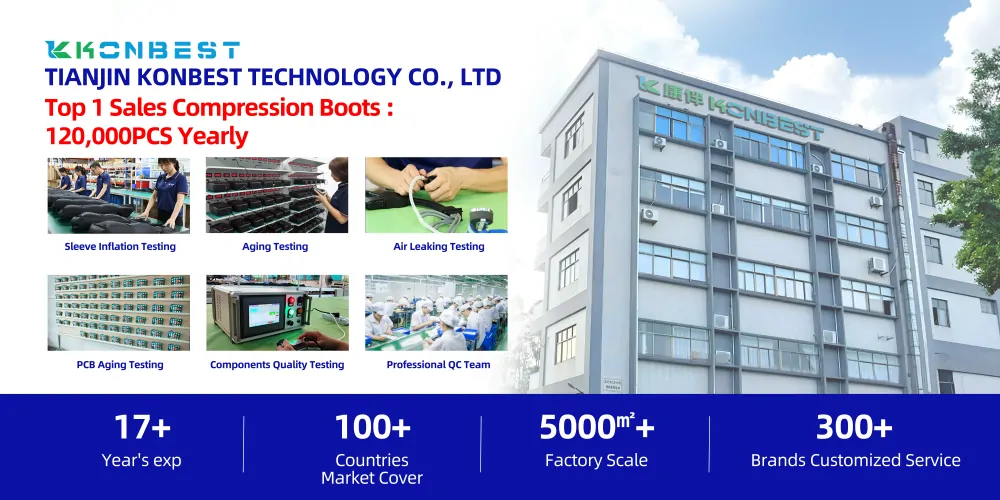
Ask about factory size, production lines, manufacturing processes, and the team's experience with compression recovery equipment. For medium and large orders, production planning matters because the supplier must organize materials, assembly, inspection, and packing.
Review quality control
Ask how the manufacturer checks air pumps, hoses, connectors, sleeves, control units, battery systems, and finished products. It is also useful to agree on the inspection requirements before production starts.
Confirm documents for your market
Request the relevant product documents and confirm their scope. CE, RoHS, ISO, and BSCI relate to different regulatory or management areas. They are not interchangeable product approvals. The applicable documents must match the product, manufacturer, and destination market.
Discuss warranty and spare parts
For distributors, after-sales service is part of the product offer. Confirm the warranty period for each model, the process for handling defects, the availability of replacement parts, and technical support arrangements.
Arrange a factory inspection
A factory visit or inspection can help qualified buyers review production conditions, product testing, and quality management. If an in-person visit is not possible, ask whether a remote factory tour or video inspection can be arranged.
7. Plan Samples, Production, and Bulk Delivery
A private label project should follow a clear process. This helps reduce mistakes and gives both the buyer and manufacturer a shared schedule.
Step 1: Define the project
Prepare your target market, expected order quantity, preferred chamber configuration, logo requirements, color choices, packaging design, and accessory list.
Step 2: Select the model
Compare the technical specifications of the available models. Choose the product that fits your customer group, expected price level, and sales channel.
Step 3: Request a sample
Test the sample before approving mass production. Check pressure settings, air chamber operation, screen functions, battery performance, sleeve fit, materials, and accessories.
Step 4: Approve customization
Confirm the logo artwork, color, packaging, manual, labels, and product configuration. Keep a written record of the approved sample and specifications.
Step 5: Confirm the bulk order
Agree on MOQ, unit price, payment terms, inspection standards, production schedule, warranty, packing details, and shipping terms. For repeat orders, keep the approved specifications as a reference.
Step 6: Arrange shipment and future supply
Confirm the shipping method, destination, documents, and estimated delivery schedule. If you expect regular orders, discuss a forecast with the manufacturer so production can be planned more clearly.
The product page lists MOQ starting from around 10–50 sets depending on model and customization requirements, with a stated standard lead time of around 7–15 days. These details should be confirmed in the quotation because order size, stock, customization, and production conditions can change the schedule.
8. Why Choose KONBEST for Private Label Projects?
KONBEST is an EU-registered sports recovery brand with 17 years of sports recovery equipment R&D and manufacturing experience. According to company information, its products have been supplied to more than 100 countries, with over 300 brand customization projects and support from more than 20,000 professional athletes.
The company reports a 12,000 m² factory, five production lines, a high-end product showroom, and professional R&D and quality inspection teams. These resources support product development, manufacturing, and customization projects for international B2B buyers.
For distributors, wholesalers, and resellers, KONBEST offers:
- Product selection: Different compression boots configurations, including 4-chamber, 6-chamber, and 8-chamber models.
- Private label support: Logo, product color, packaging, and selected accessory customization.
- OEM/ODM cooperation: Project support based on the model and buyer's requirements.
- Sampling: A stated 2-day sampling service for suitable projects.
- Shipping support: A stated 7-day shipping service for applicable products and orders, subject to confirmation.
- Factory inspection: Inspection support for qualified B2B buyers.
- Quality and documentation: Relevant CE, ISO, RoHS, and BSCI-related documents can be discussed according to the product and project scope.
- One-stop product sourcing: A wider range of sports recovery equipment for businesses building a complete product catalog.
For buyers who want to build a branded recovery equipment line, working with one manufacturer across several product categories may also make product communication and future sourcing easier.
Do not select a supplier based only on a low quotation. Compare the product specifications, approved sample, production resources, quality process, customization terms, warranty, and delivery plan together.
Ready to build your own compression recovery boots range? Visit the KONBEST wholesale compression recovery boots page to compare product levels and discuss private label options. Share your target market, estimated quantity, preferred model, and branding requirements to request a project quotation.
9. Questions and Answers
Q1: What are private label compression boots?
Private label compression boots are products manufactured by a supplier and sold under the buyer's own brand. Depending on the project, buyers may customize the logo, product color, packaging, and selected accessories.
Q2: Can I customize compression boots with my own logo and colors?
Yes. KONBEST supports logo and color customization for suitable projects. Buyers should confirm the available methods, artwork requirements, MOQ, and extra costs for the selected model.
Q3: What is the difference between 4-chamber, 6-chamber, and 8-chamber models?
The main difference is the number and arrangement of the inflatable air chambers. Each configuration has its own product design and target market. Buyers should compare the complete specifications instead of choosing only by chamber count.
Q4: What is the MOQ for private label compression boots?
The wholesale page lists an MOQ of around 10–50 sets, depending on the model and customization requirements. The exact MOQ should be confirmed with KONBEST for each project.
Q5: How long does production take for a bulk order?
The page lists a standard lead time of around 7–15 days. Actual timing depends on order quantity, model availability, customization, and the production schedule. Confirm the delivery plan in writing before placing the order.
Q6: Can I test a sample before ordering in bulk?
Yes. KONBEST provides sampling support, with a stated 2-day sampling service for suitable projects. Confirm the sample model, configuration, cost, and preparation time before ordering.
Q7: Does KONBEST support factory inspections?
Yes. Factory inspection support is available for qualified B2B projects. Buyers can contact the team to discuss the inspection method and schedule.
Q8: What should I prepare before requesting an OEM quotation?
Prepare your target country, estimated quantity, preferred model, chamber configuration, logo artwork, color requirements, packaging details, accessory needs, and applicable compliance requirements. This information helps the manufacturer provide a more accurate quotation.
Q9: Can KONBEST supply other sports recovery products?
Yes. KONBEST offers a wider range of sports recovery equipment. Distributors and wholesalers can discuss a combined sourcing plan if they want to expand their product catalog beyond compression boots.
Start your private label project with a clear product plan and a capable manufacturing partner. Contact KONBEST to discuss OEM compression boots, wholesale pricing, sample testing, and medium or large-volume supply for your market.