

Red Light Therapy Before or After Workout? How to Choose the Right Device
Should you use red light therapy before or after a workout? For athletes, gym users, and sports recovery professionals, timing is an important part of choosing a suitable routine. But timing is only one factor. Wavelength, light output, treatment area, session length, and device design also matter.
Red light therapy, also called photobiomodulation (PBM), uses red and near-infrared light. Researchers have studied its possible role in exercise performance, muscle fatigue, and post-workout recovery. Some studies focus on local muscle treatment before exercise, while others examine recovery after training. Results are not the same for every device or exercise type.
For gym owners, sports recovery centers, and equipment distributors, this creates a practical business question: which red light therapy devices are suitable for different training environments and customer groups?
KONBEST is an EU-registered sports recovery brand with 17 years of R&D and manufacturing experience. Its product range includes handheld red light devices, wearable systems, full-body equipment, and combined recovery solutions. This guide explains workout timing, product selection, and what wholesale buyers should check before placing an order.
Table of Contents
- 1. Red Light Therapy Before or After Workout: What Is the Difference?
- 2. What Does Exercise Research Actually Say?
- 3. Before Training: When Does It Fit?
- 4. After Training: How to Use It in a Recovery Plan
- 5. Choose the Device by Training Scenario
- 6. KONBEST Red Light Therapy Devices and Specifications
- 7. A Product Strategy for Gyms and Recovery Businesses
- 8. What to Check Before Buying Wholesale
- Frequently Asked Questions
1. Red Light Therapy Before or After Workout: What Is the Difference?
There is no single timing rule for everyone. The choice depends on the training goal, the device, and the use instructions.
| Timing | Common Use | What Buyers Should Know |
|---|---|---|
| Before workout | Part of a planned pre-training routine | Some local PBM studies have examined muscle performance and exercise-related outcomes |
| After workout | Part of a post-training recovery routine | Research has examined soreness and recovery measures, but results vary |
| Both times | Selected training protocols | Not every device or user needs two sessions |
For a user who wants to follow a pre-training routine, a suitable portable device may be easier to position on selected muscle groups. For a recovery center that serves customers after exercise, wearable devices or larger systems may fit the service workflow better.
The important point is to follow the recommended session time, distance, and operating settings for the exact model. More exposure does not automatically mean better results.
2. What Does Exercise Research Actually Say?
Red light therapy is studied under the name photobiomodulation. It uses specific wavelengths of red or near-infrared light. Research has examined several possible effects, including muscle endurance, strength, soreness, and recovery after exercise.
Research on Local Treatment Before Exercise
Some studies have applied photobiomodulation to selected muscle groups before exercise. A 2025 systematic review and meta-analysis reported possible benefits in some muscle soreness and performance measures when PBM was applied before exercise. However, the authors also noted that the certainty of evidence and the best treatment settings still need further study.
This does not mean every red light device will produce the same result. Research protocols may use different wavelengths, output levels, energy doses, treatment areas, and application times.
Research on Full-Body Treatment
Full-body equipment needs to be evaluated separately from local treatment devices. A 2025 systematic review of whole-body photobiomodulation included five studies with 105 physically active participants. It found no clear benefit in exercise performance or fatigue-related recovery measures, although some studies reported changes in sleep-related outcomes.
This is an important point for buyers. A full-body blanket or dome should not be promoted as having the same proven exercise effects as a localized device used in a specific research protocol.
What This Means for Equipment Buyers
When comparing red light therapy devices, look beyond marketing claims. Ask the manufacturer for:
- Exact red and near-infrared wavelengths
- LED quantity and LED configuration
- Light output or irradiance data and measurement conditions
- Available power levels and pulse modes
- Recommended treatment distance and session duration
- Product-specific test documents and operating instructions
For further reading, see the published research:
3. Before Training: When Does It Fit?
Some athletes and sports facilities include red light therapy before a training session. In research, this approach is often linked to local application on the muscle groups involved in exercise.
Strength and Resistance Training
For strength training, a planned session may focus on the muscle groups used during the workout. For example, a training center may select a device that can be positioned on the shoulders, arms, legs, or back.
Portable handheld equipment is useful when a user needs to target a smaller area. Wearable equipment can be more convenient when hands-free positioning is preferred.
Running, Cycling, and Endurance Training
Endurance athletes often repeat similar training sessions several times a week. A sports facility may include red light equipment in a wider preparation and recovery service. However, the device should be used according to its own instructions rather than copying a research schedule from a different product.
Team Training and Professional Sports
Sports teams need equipment that can fit their training schedule and serve several athletes. A portable wearable device can be moved between training areas, while a larger system may be placed in a dedicated recovery room.
For distributors supplying sports clubs and training centers, product portability, battery capacity, operating modes, and ease of cleaning are important buying points.
4. After Training: How to Use It in a Recovery Plan
After exercise, users may experience tired muscles, temporary soreness, and physical fatigue. Red light therapy is sometimes included in a recovery routine, but it should not replace rest, sleep, hydration, nutrition, or appropriate training management.
For General Gym Users
A gym can make portable devices available in a designated recovery area. Users can follow the product instructions after strength training, cycling, running, or group exercise.
For Sports Recovery Centers
A recovery center may offer several equipment options based on customer needs. Handheld devices can serve targeted use, wearable products can support hands-free positioning, and larger systems can be included in a dedicated wellness area.
For Rehabilitation and Wellness Facilities
Facilities should check the intended use, product documentation, and local regulations before introducing equipment into a professional service. Red light therapy devices should not be presented as a replacement for medical assessment or treatment.
For businesses, a clear operating procedure is important. Staff should understand the recommended session time, device settings, cleaning process, and safety instructions.
5. Choose the Device by Training Scenario
The right red light therapy device depends on the treatment area, number of users, and business setting. A portable product may be suitable for a personal trainer, while a full-body system may be more appropriate for a facility with a dedicated equipment room.
| Training or Business Scenario | Recommended Device Format | Key Buying Factors |
|---|---|---|
| Personal training | Handheld or wearable device | Portability, simple controls, targeted use |
| Commercial gym | Wearable and larger-area equipment | Daily operation, cleaning, user flow |
| Sports team | Wearable devices and professional systems | Battery life, treatment area, session planning |
| Recovery center | Full-body blanket or multi-function dome | Space, power, operating process, staff training |
| Retail and online sales | Handheld and compact wearable products | Packaging, product education, warranty support |
For a distributor, a mixed product range can cover more than one customer group. Portable devices may suit retail stores and online sellers. Larger systems may be more suitable for professional gyms, wellness studios, and sports recovery centers.
6. KONBEST Red Light Therapy Devices and Specifications
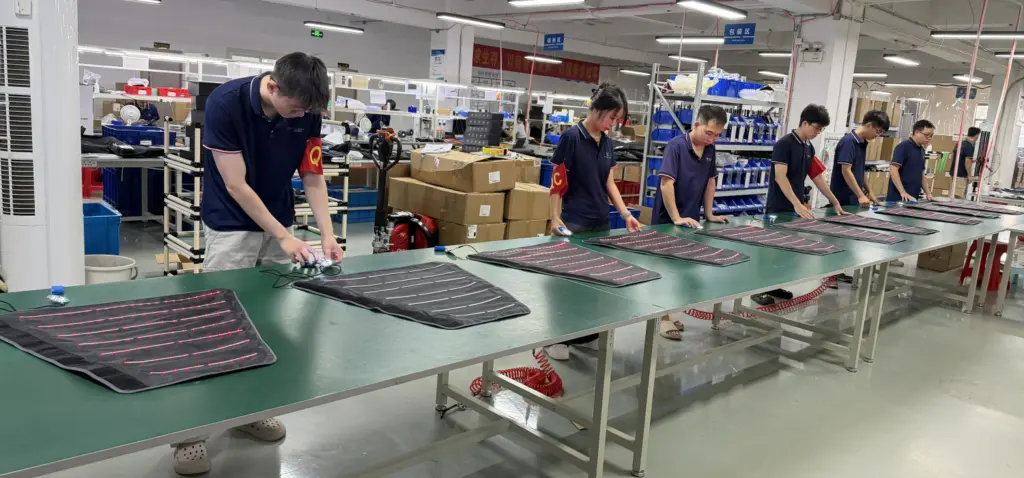
KONBEST offers several red light therapy product formats. The following models can help distributors build a product range for different training and wellness environments.
RL101: Handheld Device for Targeted Use
RL101 is a portable handheld red light therapy device for selected body areas. It uses 650nm red light and 808nm near-infrared light.
Its listed configuration includes 12 red light LEDs at 650nm and 3 near-infrared LEDs at 808nm. It offers four intensity levels, a pulse mode, and 12 timer settings from 5 to 120 minutes. The 2500mAh rechargeable battery supports portable use.
The product includes a stand, protective glasses, charging cable, and user manual. Its handheld design may fit personal training studios, home wellness retailers, clinics, and specialist equipment stores, subject to the product's intended use and local requirements.
RL105: Three-Wavelength Handheld Device
RL105 uses three wavelengths: 630nm, 660nm, and 850nm. It offers three intensity levels and a pulse mode, with a 2500mAh rechargeable battery.
The handheld design includes a tripod stand for hands-free positioning. This format can suit customers who want a portable device for home, office, travel, or targeted wellness routines.
For wholesalers, RL105 can be positioned alongside other handheld products to provide a different wavelength configuration and product design.
RL201: Wearable Red Light Therapy Device
RL201 combines 660nm red light and 850nm near-infrared light. Its product specifications list 6 LEDs at 660nm and 6 LEDs at 850nm.
The device has four operating modes and a built-in timer with 5, 10, 15, and 20-minute settings. Its 1200mAh rechargeable battery supports up to 180 minutes of listed use, and it uses a Type-C charging port.
The package includes the main unit, protective glasses, three Velcro straps, USB cable, and user manual. Its cordless wearable design can fit gyms, training centers, clinics, and sports recovery programs.
For distributors, RL201 is a practical option for customers who prefer portable equipment that can be moved between different training areas.
RL202: Compact Wearable Device
RL202 is designed for customers who prefer a small and lightweight wearable product. It weighs approximately 30g and contains 19 LEDs: 9 at 660nm and 10 at 850nm.
Its technical specifications include a 162Hz pulse frequency, 5W power, and a 450mAh battery. The product offers five adjustable modes and up to 105 minutes of listed use. Type-C charging takes about one hour according to the product information.
An adjustable strap and adhesive patches support different placement options on the shoulders, knees, waist, arms, and ankles. For retail and wholesale businesses, RL202 can serve the compact wearable product category.
The product page lists an MOQ of 2,000 units, a 7–15 day lead time, and a one-year warranty. Confirm the final order terms with KONBEST before purchasing.
RL302: Full-Body Red Light Therapy Blanket
RL302 is designed for larger-area light application. It combines 660nm red light and 850nm near-infrared light, with 2,240 LED units and 6,720 chips.
Its listed light density is 112mW/cm², and rated power is 200W. Users can select continuous light, 10Hz pulse, or 40Hz pulse modes, with five adjustable power levels and a 10–60 minute timer.
The foldable structure is useful for storage and home wellness settings. For wellness studios and recovery equipment distributors, RL302 offers a different product format from handheld and wearable devices.
The product page lists an MOQ of 100 sets, a 7–15 day lead time, and a one-year warranty. Buyers should confirm the final dimensions and configuration on the approved specification sheet before placing an order.
RL301: 5-in-1 Red Light Infrared Sauna Dome
RL301 is a multi-function system for professional wellness and recovery spaces. Its listed functions include 660nm red light, 850nm near-infrared light, far-infrared heating, PEMF, and negative-ion functions.
The product specifications list 896 visible red light LED units and 224 near-infrared LED units. Light density is listed at 120–130mW/cm². The dome temperature range is 25–90°C, while the mat temperature range is 25–80°C.
Other specifications include a 1–30Hz PEMF range, 1200W rated power, a 5–60 minute timer, and dimensions of 180 × 80 × 45cm. Its larger structure makes it more suitable for a dedicated wellness room than a portable training setup.
For gym owners and recovery center operators, the main purchasing points include floor space, electrical requirements, staff training, cleaning, and daily user capacity.
The product page lists an MOQ of 100 sets, a 7–15 day lead time, and a one-year warranty.
7. A Product Strategy for Gyms and Recovery Businesses
For B2B buyers, product selection should start with the customer and service model, not with the largest or most expensive device.
For Gym Equipment Distributors
Build a product range with portable and wearable models first. RL101, RL105, RL201, and RL202 provide different product formats and technical configurations. They can be offered to fitness retailers, personal training studios, and gyms that want compact recovery equipment.
For Sports Recovery Equipment Wholesalers
Consider combining wearable devices with larger-area equipment. RL201 and RL202 provide portable options, while RL302 and RL301 can serve customers looking for a dedicated recovery space.
For Regional Importers and Resellers
Review local customer demand, product regulations, packaging needs, warranty requirements, and after-sales capacity before selecting the first order quantity. A balanced product mix can help reduce dependence on one model.
For Professional Sports and Wellness Facilities
Consider how many users will access the equipment, how often it will operate, and how staff will manage sessions. A portable wearable product may support flexible use, while a dome or blanket may need a dedicated area and a clear operating process.
8. What to Check Before Buying Wholesale
Choosing a red light therapy equipment manufacturer is a long-term supply decision. For medium and large orders, buyers should review product specifications, factory capability, quality control, and after-sales support before confirming a purchase.
Check the Technical Data
Request the wavelength, LED configuration, light output, timer settings, power supply, battery capacity, materials, package contents, and operating instructions for each model. Ask for the test conditions behind light density or irradiance figures.
Check Quality Control and Production Capacity
Ask how the manufacturer checks incoming materials, electronic components, finished products, and packaging. For a large order, agree on the approved sample, inspection points, and acceptance criteria before mass production.
Check Compliance Documents
Different markets have different rules for electrical equipment and wellness products. Buyers should review applicable product safety, electromagnetic compatibility, labeling, and import requirements.
KONBEST can discuss CE, RoHS, ISO, and BSCI-related documentation where applicable. These documents have different purposes. CE relates to applicable European product compliance requirements; RoHS concerns restricted substances in relevant electrical and electronic products; ISO refers to specific standards and certification scopes; BSCI relates to social compliance assessment.
Always request the actual documents and verify the issuing body, validity, named company, and product scope. Do not assume that a company-level certificate automatically covers every model.
Check the Commercial Terms
Before placing a wholesale order, confirm:
- MOQ and unit price for each model
- OEM logo, color, packaging, and accessory options
- Sample cost and sample lead time
- Mass production schedule
- Warranty and spare parts policy
- Carton dimensions and shipping weight
- Inspection requirements and delivery terms
Why Work with KONBEST as Your Red Light Therapy Equipment Manufacturer?
KONBEST has 17 years of sports recovery product R&D and manufacturing experience. Its products have been supplied to more than 100 countries, and the company has completed over 300 brand customization projects.
The company has more than 20,000 professional athlete endorsements and use references. Its manufacturing facility covers approximately 12,000 square meters and has five production lines, supported by R&D and quality inspection teams. A high-end product showroom is also available for business buyers.
For distributors, wholesalers, and resellers, KONBEST offers:
- Red light therapy devices in handheld, wearable, and full-body formats
- OEM and ODM support for private label projects
- Custom logo, product color, packaging, and accessories
- Product sampling support, with 2-day sampling for applicable projects
- Shipping support, with 7-day shipping for applicable orders
- Factory inspection support
- Product catalog, manuals, and technical information
- A wider range of sports recovery equipment for one-stop sourcing
Sampling and shipping schedules depend on model availability, customization, order quantity, production planning, and destination. Confirm the actual timeline in writing before placing an order.
KONBEST's wider product range also includes compression recovery boots, cold therapy equipment, hot and cold recovery systems, and other sports recovery products. This gives distributors the option to discuss several related product categories with one supplier.
Request a KONBEST Wholesale or OEM Quotation
If you are planning to add red light therapy devices to your gym equipment, sports recovery, or wellness product range, KONBEST can help you review suitable models and prepare a purchasing plan.
To receive a more accurate quotation, please provide:
- Your company name and target country or region
- Your business type: distributor, wholesaler, importer, reseller, or brand owner
- The product models you are interested in
- Your estimated order quantity
- Your private label logo, color, packaging, and accessory needs
- Your expected sample and delivery schedule
Frequently Asked Questions
1. Is red light therapy better before or after a workout?
It depends on the goal and device. Some research has examined local photobiomodulation before exercise, while other studies have looked at post-workout recovery. There is no universal timing rule for every user or product. Follow the instructions for the exact device.
2. Can red light therapy help with muscle recovery?
Research has examined photobiomodulation for muscle soreness, strength, endurance, and recovery-related measures. Some results are positive, but findings vary by study and treatment protocol. It should be considered an additional wellness or recovery option, not a guaranteed treatment.
3. Which wavelengths are common in sports recovery devices?
Common configurations include red light around 630–660nm and near-infrared light around 808–850nm. The right device comparison should also include light output, treatment area, session time, and operating settings.
4. Which KONBEST device is suitable for portable use?
RL101 and RL105 are handheld options. RL201 and RL202 are wearable models. Buyers can compare their wavelengths, battery capacity, operating modes, size, and package contents according to their target market.
5. Which KONBEST device is suitable for a larger treatment area?
RL302 is a full-body red light therapy blanket with 660nm and 850nm light, 2,240 LED units, three light modes, five power levels, and a 10–60 minute timer. RL301 is a larger multi-function dome system for professional wellness spaces.
6. Can KONBEST supply red light therapy devices for wholesale orders?
Yes. KONBEST works with distributors, wholesalers, importers, resellers, and brands. Buyers can discuss model selection, MOQ, pricing, production schedules, and repeat orders with the team.
7. Does KONBEST offer private label red light therapy devices?
Yes. OEM and ODM projects can include logo customization, product color, packaging, and accessories. The available options and MOQ depend on the model and project requirements.
8. Can I request samples before placing a bulk order?
Yes. KONBEST offers 2-day sampling support for applicable projects. Confirm sample availability, configuration, customization, and delivery timing with the sales team.
9. Can KONBEST support factory inspection?
Yes. Factory inspection support is available. Buyers can discuss an on-site visit or an inspection arrangement before confirming a medium or large order.
10. What information should I provide for a wholesale quotation?
Provide your target market, company type, selected models, estimated quantity, logo and packaging needs, accessory requirements, and expected delivery schedule. This helps the sales team prepare a more accurate quotation.