


How to Build a B2B Customer Acquisition Strategy for Compression Boots
Getting more B2B inquiries for compression boots is not only a marketing job. If the product information is weak, the buyer cannot compare models. If the sample process is slow, the inquiry may stop. If the factory cannot handle the next order, a new customer may not become a long-term account.
For distributors, wholesalers, resellers, and sports recovery equipment companies, customer acquisition should therefore be connected to the whole buying process. The goal is to bring the right buyers to the product, give them enough information to make a first decision, and make the move from inquiry to sample and then to bulk purchasing as simple as possible.
KONBEST has more than 17 years of sports recovery equipment R&D and manufacturing experience. Its products are supplied to more than 100 countries, and the company has completed customization projects for more than 300 brands. With a 12,000 m² factory, five production lines, professional R&D and QC teams, and a broad recovery equipment portfolio, KONBEST can support B2B customers from product selection to customized production.
- Define the B2B Customer You Want to Attract
- Build Content Around the Buyer's Problem
- Turn Product Specifications Into Sales Information
- Create Different Offers for Different Sales Channels
- Make the First Inquiry More Useful
- Use Sampling as the First Real Conversion
- Prepare Buyers for Medium and Large Orders
- Use OEM and Private Label to Attract Brand Buyers
- Give Buyers Reasons to Check the Factory
- Turn One Order Into a Long-Term Supply Relationship
- How KONBEST Supports the Process
- Q&A
Define the B2B Customer You Want to Attract
Before spending money on advertising or publishing more content, define the type of buyer you want.
A compression recovery equipment distributor may already have a network of gyms, sports clubs, clinics, or fitness retailers. A wholesaler may be looking for several models to add to an existing equipment catalog. A reseller may need products that are easy to market online. A sports recovery brand may want a ready-made product that can be developed under its own brand.
These buyers can all purchase compression boots, but their questions are different.
A distributor may ask about MOQ and repeat supply. A wholesaler may ask about model selection and shipping. A reseller may focus on product appearance, packaging, and sales materials. A brand owner may ask about logo printing, colors, accessories, and OEM development.
Your website and sales content should reflect these differences. This helps attract buyers who already have a clear purchasing need instead of only generating general product traffic.
Build Content Around the Buyer's Problem
Many product pages start with technical specifications. Specifications are important, but they should answer a real purchasing question.
For example, a buyer may ask:
- Do I need a portable compression system?
- Should my product range include 4, 6, or 8 chambers?
- Will the equipment work for a sports club or physiotherapy customer?
- Can I order different models from one factory?
- Can the product carry my own brand?
- Can the manufacturer provide samples before mass production?
- Can the factory support larger repeat orders?
These questions can become landing pages, blog topics, product comparison content, sales materials, and inquiry forms. This is a more useful way to build organic and paid traffic than filling a page with repeated product keywords.
Turn Product Specifications Into Sales Information
Technical data becomes more valuable when buyers can understand what it means for their market.
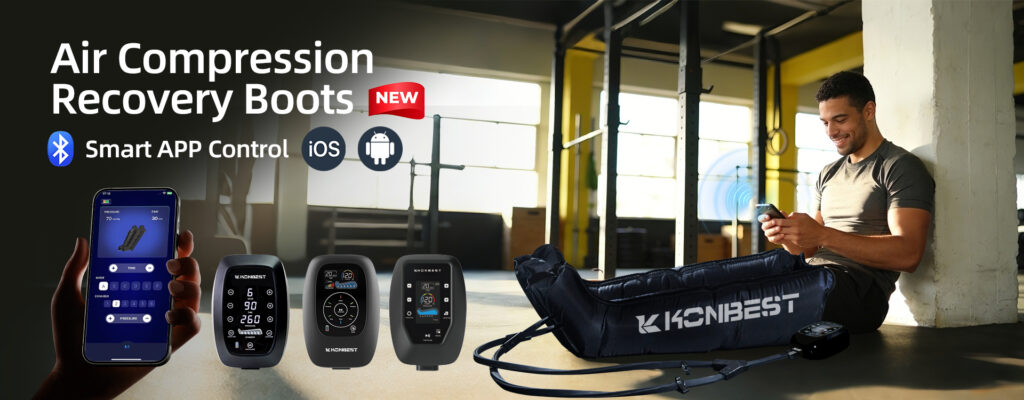
KONBEST offers several air compression boot configurations. Its product range includes 4-chamber, 6-chamber, and 8-chamber systems, allowing B2B buyers to create different product levels within one catalog.
Take the 9490ProE as an example. It is a wireless 4-chamber model with five modes and a pressure range of 30–240 mmHg. It uses a 3200 mAh battery and supports remote control and Bluetooth app operation. The detachable motor also gives the product a practical portable design.
For a reseller or distributor, these details can be connected to specific sales situations. A wireless system may be easier to present to mobile recovery services, personal training studios, sports clubs, and customers who do not want to stay beside a fixed power source during use.
Another customer may need a more advanced specification. The 9690K-D is a 6-chamber model with 30–260 mmHg pressure, six modes, a 5200 mAh battery, and a listed flow rate of up to 15 L/min. Its pump noise level is listed below 45 dB.
This type of information is useful when a buyer is sourcing equipment for professional sports facilities, rehabilitation suppliers, physiotherapy businesses, or recovery centers where product specifications matter during the purchasing process.
The 9890 series adds 8-chamber configurations for customers looking for a higher-level compression boot option. A distributor can therefore use the range to build a product ladder instead of trying to sell one model to every customer.
Create Different Offers for Different Sales Channels
Customer acquisition becomes more efficient when the product message matches the sales channel.
For Sports Equipment Distributors
Distributors usually need a product range that can fit several downstream customers. A 4-chamber model can cover portable applications, while 6-chamber and 8-chamber products can give the catalog more professional options.
The sales material should focus on model differences, technical specifications, customization, MOQ, sample availability, and supply capability.
For Wholesalers
Wholesalers often need clear information before deciding how many units to purchase. Product dimensions, pressure range, chamber number, battery, operating modes, accessories, packaging, lead time, and warranty should be easy to find.
A strong compression boots wholesale page should make it possible for a purchasing manager to prepare an initial product shortlist without sending several emails just to collect basic specifications.
For Resellers
Resellers may need products that are easy to explain to their own customers. Product images, videos, manuals, technical sheets, packaging options, and brand customization can become important parts of the sales package.
When the manufacturer can provide useful product materials, the reseller can spend less time creating basic product information from zero.
For Recovery Equipment Brands
Established brands may have a different requirement. They may want to control the appearance of the product and packaging while keeping the technical platform of an existing model.
This is where OEM, ODM, and private label services become part of the customer acquisition strategy.
Make the First Inquiry More Useful
A contact form that only asks for a name and email does not give a sales team much information.
For B2B compression equipment, the inquiry process can ask a few practical questions:
- What type of business are you operating?
- Which compression boot models are you interested in?
- What quantity do you need?
- Do you need standard products or private label?
- Do you need custom colors or packaging?
- Which country is the shipment going to?
- When do you need the first shipment?
This information helps the manufacturer understand whether the buyer needs a small trial order, medium-volume purchasing, or a larger OEM project.
It also makes the quotation more relevant. Instead of sending the same catalog to every lead, the sales team can recommend models based on the customer's application and order plan.
Use Sampling as the First Real Conversion
A B2B inquiry is only the beginning. For many purchasing teams, the sample is where the real evaluation starts.
Before a larger order, the buyer may want to check compression performance, control functions, battery operation, materials, product finish, noise, accessories, and packaging.
KONBEST provides 2-day sampling support for applicable projects. This gives buyers a practical way to evaluate the selected product before moving to a larger purchase.
The sample stage should also be used to confirm details that are easy to overlook. If the buyer wants a logo, custom color, different packaging, or additional accessories, those details can be reviewed before mass production.
A clear sample process can therefore reduce confusion later in the purchasing cycle.
Prepare Buyers for Medium and Large Orders
Once a sample has been approved, the conversation changes from product interest to production planning.
At this point, a compression boots manufacturer should be able to discuss the complete order rather than only the unit price.
Important points include model mix, total quantity, logo requirements, packaging, accessories, certification documents, power plugs, warranty, inspection requirements, production schedule, and shipping.
KONBEST supports B2B projects with MOQ generally ranging from 10–50 sets depending on the model and customization requirements. Standard bulk lead time is listed at 7–15 days, while priority scheduling can be discussed for urgent or large OEM projects.
This information is especially useful for distributors and wholesalers because they can plan purchasing around their own inventory and sales schedules.
Use OEM and Private Label to Attract Brand Buyers
Not every B2B customer wants a standard product with a factory logo.
Some companies already have a brand, website, sales team, and customer base. What they need is a manufacturing partner that can put their brand into an existing product platform.
KONBEST supports private label compression boots with logo, color, packaging, and accessory customization. OEM and ODM projects can also be discussed according to product requirements.
For customer acquisition, this creates a second route into the market. One landing page can target standard wholesale buyers, while another can focus on companies searching for private label recovery products.
The content should clearly explain the process: choose the model, confirm specifications, discuss branding, create a sample, approve the sample, confirm the bulk quantity, and begin production.
Clear steps make private label sourcing easier to understand, especially for companies entering the compression recovery market for the first time.
Give Buyers Reasons to Check the Factory
Large B2B orders require a different level of trust from ordinary retail purchases.
A buyer planning a long-term supply relationship may want to know where the products are made, how quality is checked, whether the factory has enough production capacity, and whether the supplier can support customization.
KONBEST operates a 12,000 m² manufacturing facility with five production lines. The company has professional R&D and quality inspection teams and a high-end product showroom.
Its products are supplied to more than 100 countries, and the company has completed customization projects for more than 300 brands. More than 20,000 professional athletes are also associated with its product use or endorsement.
KONBEST supports CE, ISO, RoHS, BSCI, and other applicable certification requirements. Buyers should confirm the exact certification documents for the selected model and target market before ordering.
Factory inspection is also supported. For a distributor or wholesaler preparing a medium or large purchasing program, an inspection can provide another way to review the manufacturing environment and quality process before production.
Turn One Order Into a Long-Term Supply Relationship
Customer acquisition should continue after the first shipment.
A distributor may start with one compression boot model and later need more models. A reseller may begin with standard products and then move to private label. A wholesaler may add cold therapy or other recovery products after establishing the first supply relationship.
This is why product range matters.
KONBEST can provide more than compression recovery boots. Its sports recovery portfolio covers multiple product categories, making it possible for B2B buyers to expand their range through one manufacturing partner.
A useful follow-up process can include new model information, product updates, sample opportunities, packaging development, accessory options, and planning for repeat orders. The goal is to keep the supplier relationship connected to the buyer's changing product requirements.
How KONBEST Supports the Process
For a company building a B2B customer acquisition strategy, the manufacturer should support the sales process from the first technical question to mass production.
KONBEST combines product R&D, manufacturing, quality control, customization, sampling, and supply support in one system.
- 17+ years of sports recovery R&D and manufacturing experience
- Products supplied to more than 100 countries
- 300+ brand customization projects
- 20,000+ professional athlete use or endorsement experience
- 12,000 m² manufacturing facility
- Five production lines
- 4-chamber, 6-chamber, and 8-chamber compression boot options
- OEM and ODM support
- Private label logo and color customization
- Custom packaging and accessories
- 2-day sampling support for applicable projects
- 7-day shipping support for applicable orders
- Factory inspection support
- Professional R&D and QC teams
- One-stop sports recovery equipment sourcing
For distributors, wholesalers, and resellers, the customer acquisition path can be built around real purchasing needs rather than general promotion: attract the right buyer, show useful technical information, understand the application, recommend suitable models, provide a sample, confirm customization, and prepare the bulk order.
If you are sourcing compression boots wholesale for a medium- or large-volume project, visit the KONBEST compression recovery boots product range to compare available models and configurations. You can then contact the factory to discuss samples, MOQ, private label requirements, accessories, and production planning.
Q&A
How can a distributor attract more B2B compression boot buyers?
Build content around real purchasing questions. Show model differences, technical specifications, application scenarios, MOQ, customization, samples, lead time, and quality information. This helps attract buyers who already have a clear sourcing requirement.
What information should a B2B compression boots product page include?
The page should provide chamber number, pressure range, operating modes, battery information, control method, product dimensions, accessories, warranty, MOQ, lead time, customization options, and applicable certification information.
Which compression boots can KONBEST supply?
KONBEST provides 4-chamber, 6-chamber, and 8-chamber compression boot configurations. Different models have different pressure ranges, operating modes, batteries, controls, and other specifications.
Can KONBEST support private label compression boots?
Yes. KONBEST supports private label projects with logo, color, packaging, and accessory customization. OEM and ODM requirements can also be discussed according to the project.
Can buyers order samples before a bulk purchase?
Yes. KONBEST supports 2-day sampling for applicable projects. Buyers can use the sample to check the selected configuration and confirm customization details before mass production.
What MOQ is available for compression boots?
MOQ generally starts from 10–50 sets depending on the selected model and customization requirements. Trial quantities may be available for some projects. The exact MOQ should be confirmed with the factory before ordering.
Does KONBEST support factory inspection?
Yes. Factory inspection support is available for B2B projects. Buyers can discuss inspection requirements before confirming a medium- or large-volume production order.
Can a distributor source other recovery equipment from KONBEST?
Yes. KONBEST provides a wider sports recovery equipment range, allowing distributors and wholesalers to discuss multiple recovery product categories with one manufacturing partner.