


Compression Boots: Complete Guide for Wholesale Buyers, Distributors and Private Label Brands
Compression boots are becoming an important product in sports recovery, fitness, physiotherapy, rehabilitation, and wellness markets. They use air compression chambers to apply pressure to different parts of the legs in sequence. This makes them useful for athletes, active people, recovery centers, gyms, and professional service providers.
For distributors, wholesalers, resellers, and sports recovery brands, buying compression boots is different from buying one product for personal use. A B2B buyer needs to think about product configuration, quality, production capacity, customization, certification, delivery, and long-term supply.
This guide explains how compression boots work, what product features matter, where they can be used, and how to choose a reliable compression boots manufacturer for wholesale and private label projects.
This guide explains how compression boots work, what product features matter, where they can be used, and how to choose a reliable compression boots manufacturer for wholesale and private label projects.
Table of Contents
- What Are Compression Boots?
- How Do Compression Boots Work?
- 4-Chamber, 6-Chamber and 8-Chamber Compression Boots
- Why Compression Boots Are Attractive for B2B Markets
- Compression Boots for Different Business Applications
- How to Choose Compression Boots Wholesale
- How to Choose a Compression Boots Manufacturer
- Private Label Compression Boots and OEM
- Why Work With KONBEST?
- How to Start a Bulk Order
- Q&A
What Are Compression Boots?
Compression boots are wearable recovery devices designed to provide pneumatic air compression around the legs. The boots normally contain several air chambers. When the system starts, the chambers inflate and release air in a planned sequence.
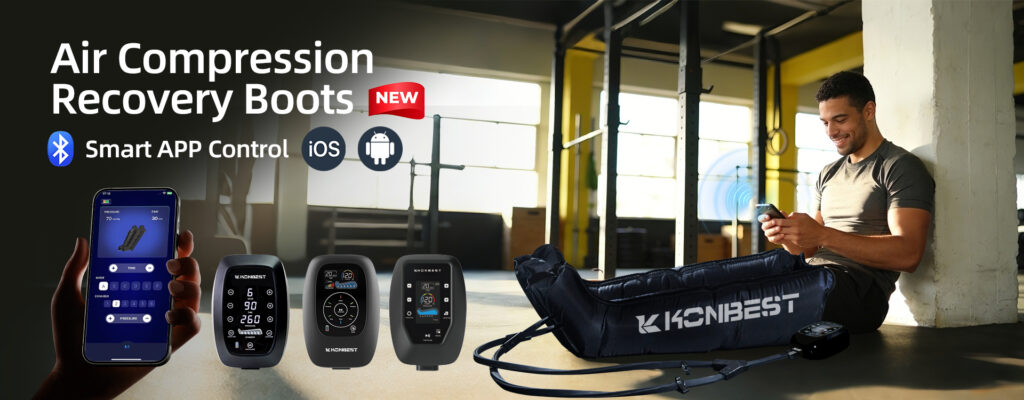
The main product structure normally includes leg sleeves, air chambers, a control unit or pump, air tubes or an integrated system, and power components. Different models can have different chamber numbers, control functions, materials, sizes, and accessories.
For a B2B buyer, these differences are important because one configuration may be suitable for a professional sports recovery center, while another may be better for gyms, distributors, or retail channels.
How Do Compression Boots Work?
Compression boots use controlled air pressure. The chambers inflate and deflate around the legs, creating sequential compression from one section to another.
This working method is one of the main reasons compression boots are used in sports recovery and professional wellness environments. Current high-ranking compression boot guides also focus on sequential compression, pressure levels, chamber design, portability, comfort, and session control when explaining how buyers should compare products.
However, product performance should not be judged by one specification alone. A professional buyer should consider the complete system, including chamber design, pressure control, product construction, user comfort, controller operation, durability, and quality consistency.
4-Chamber, 6-Chamber and 8-Chamber Compression Boots
Chamber design is an important point when comparing compression boots.
4-Chamber Compression Boots
Four-chamber models can provide a relatively simple product configuration. They can be suitable for businesses that want an entry-level or easy-to-position recovery product for their market.
6-Chamber Compression Boots
Six-chamber compression boots provide more compression sections along the leg. This configuration can be attractive for professional recovery businesses, sports facilities, and distributors looking for a more advanced product option.
8-Chamber Compression Boots
Eight-chamber models provide additional compression zones and can be positioned for professional users who want a more detailed compression experience.
For B2B purchasing, the correct chamber number depends on the target market, selling price, application, product positioning, and customer expectations. A manufacturer that can provide several configurations gives distributors more flexibility when building a product portfolio.
Why Compression Boots Are Attractive for B2B Markets
One reason compression boots are interesting for B2B buyers is their wide range of applications. The same product category can be sold through different business channels.
- Sports recovery centers
- Professional sports teams
- Gyms and fitness clubs
- Physiotherapy centers
- Rehabilitation facilities
- Wellness and recovery businesses
- Sports equipment distributors
- Medical and rehabilitation equipment suppliers
- Online recovery equipment resellers
- Private label sports recovery brands
This creates opportunities for distributors and wholesalers that already sell fitness, rehabilitation, wellness, or sports equipment.
Instead of selling only one consumer product, a B2B company can build a complete recovery product range and offer different compression boot configurations for different customer groups.
Compression Boots for Different Business Applications
Sports Recovery Centers
Recovery centers need equipment that can be used repeatedly by different customers. Product durability, easy operation, comfortable fitting, and stable production quality are therefore important purchasing factors.
Gyms and Fitness Clubs
Gyms can add compression recovery equipment to their existing services. This can help create additional recovery service packages for members and athletes.
Professional Sports Teams
Athletes may use recovery equipment after training, competition, or travel. For team buyers, portability, product consistency, easy operation, and reliable supply can be important.
Physiotherapy and Rehabilitation Businesses
Professional clinics may need different configurations for different service requirements. Buyers should check the applicable compliance and documentation requirements in their target market before commercial use.
Distributors and Wholesalers
For distributors, the biggest opportunity is product range. A supplier that can provide multiple models, customization, packaging, and accessories allows the distributor to create different product levels for different customers.
How to Choose Compression Boots Wholesale
When purchasing compression boots wholesale, price should not be the only consideration. A low unit price does not always create a lower total business cost if quality problems, delayed delivery, inconsistent products, or poor after-sales support appear later.
Before placing a bulk order, buyers should check:
- Compression chamber configuration
- Available product models
- Control system and operating programs
- Product materials and construction
- Size options
- Accessories
- Packaging options
- Quality inspection process
- Certification and compliance documents
- Sample availability
- Production capacity
- Customization capability
- Delivery time
- Factory inspection support
This checklist helps B2B buyers compare suppliers based on the complete supply chain instead of comparing only the factory quotation.
How to Choose a Compression Boots Manufacturer
A reliable compression boots manufacturer should be able to support more than mass production.
First, look at manufacturing experience. A factory with long-term experience in sports recovery products is more familiar with product development, production control, quality inspection, and international B2B requirements.
Second, check production capacity. Large orders require stable production. Buyers should understand the factory size, production lines, quality control team, and experience with international customers.
Third, check customization. Distributors and brands may need logo, color, packaging, accessories, manuals, or other private label requirements.
Fourth, request samples before mass production. A sample gives the buyer an opportunity to check the product before committing to a larger order.
Finally, ask whether the factory supports factory audits. An on-site inspection can help buyers understand the actual production environment and quality management process.
Private Label Compression Boots and OEM
Private label compression boots allow a company to develop its own recovery product line without building a complete factory.
This model is suitable for distributors, wholesalers, sports brands, fitness equipment companies, rehabilitation suppliers, and online resellers that want to build a long-term product business.
KONBEST supports private label and OEM customization, including:
- Private label logo
- Product color customization
- Branded packaging
- Accessory customization
- Product model selection
- Sample confirmation
- Bulk production
For a new brand, the process can start with a sample. After the product specification, appearance, logo, packaging, and other requirements are confirmed, the project can move toward mass production.
Why Work With KONBEST?
KONBEST has 17 years of experience in sports recovery product research, development, and manufacturing. The company serves customers in more than 100 countries and has completed more than 300 brand customization projects.
KONBEST operates a 12,000-square-meter factory with 5 production lines, a high-end product showroom, and professional R&D and quality control teams. This manufacturing structure is designed to support both standard products and customized B2B projects.
The company has also worked with more than 20,000 professional athletes through product and brand applications, providing experience in the professional sports recovery market.
KONBEST provides a complete range of sports recovery products, allowing B2B customers to source more than one recovery category from the same supplier. This can help distributors and wholesalers build a broader recovery equipment portfolio.
For international projects, KONBEST supports private label logo and color customization, packaging customization, accessories, product sampling, factory inspection, and bulk production.
KONBEST also provides applicable certification and compliance documentation, including CE, ISO, RoHS, and BSCI-related qualifications according to the product and market requirements. Buyers should confirm the exact documents required for their destination market before placing an order.
For applicable projects, KONBEST supports 2-day sampling and 7-day shipping, helping qualified B2B buyers move from product evaluation to purchasing planning more efficiently.
How to Start a Bulk Compression Boots Order
A clear purchasing process can make a large order easier to manage.
- Define your target market. Tell the supplier whether you sell to gyms, sports teams, clinics, recovery centers, distributors, or online customers.
- Choose the product configuration. Compare 4-chamber, 6-chamber, and 8-chamber options according to your market.
- Request product information. Ask for specifications, available accessories, packaging information, and applicable certificates.
- Order a sample. Test the product before mass production.
- Confirm private label requirements. Approve logo, color, packaging, accessories, and other customized details.
- Check the factory. If required, arrange a factory audit before the bulk order.
- Confirm bulk production. Agree on product specifications, quantity, packaging, delivery, and commercial terms.
This process is especially useful for medium and large B2B orders because it creates a clear path from product selection to repeat purchasing.
Q&A
Q1: What are compression boots used for?
Compression boots use pneumatic air compression around the legs. They are commonly used in sports recovery, fitness, wellness, physiotherapy, rehabilitation, and professional recovery environments.
Q2: Are compression boots suitable for wholesale?
Yes. Compression boots can be suitable for distributors, wholesalers, resellers, sports brands, gyms, recovery centers, and rehabilitation equipment suppliers. Different models can be used to create different product levels.
Q3: What is the difference between 4-chamber, 6-chamber, and 8-chamber compression boots?
The main difference is the number of compression chambers or zones used around the leg. More chambers can provide more compression sections. Buyers should select the configuration according to their target customers and product positioning.
Q4: Can I order private label compression boots?
Yes. KONBEST supports private label logo, color, packaging, and accessory customization for qualified B2B projects.
Q5: How do I choose a compression boots supplier?
Check manufacturing experience, production capacity, product configuration, quality control, certifications, customization options, sample support, delivery capability, and factory audit support before placing a bulk order.
Q6: Can KONBEST provide samples before a bulk order?
Yes. KONBEST supports 2-day sampling for applicable projects. Buyers can evaluate the product before confirming a larger order.
Q7: Can KONBEST support factory inspection?
Yes. KONBEST supports factory inspection for qualified international B2B customers that need to evaluate manufacturing capability and production conditions.
Q8: Where can I buy compression boots wholesale?
For wholesale purchasing, buyers should work directly with a manufacturer or established supplier that can provide product samples, stable production, customization, quality control, and international shipping support.
Looking for a reliable compression boots supplier for your next bulk project? Contact KONBEST to discuss product models, samples, private label requirements, packaging, accessories, and wholesale production.